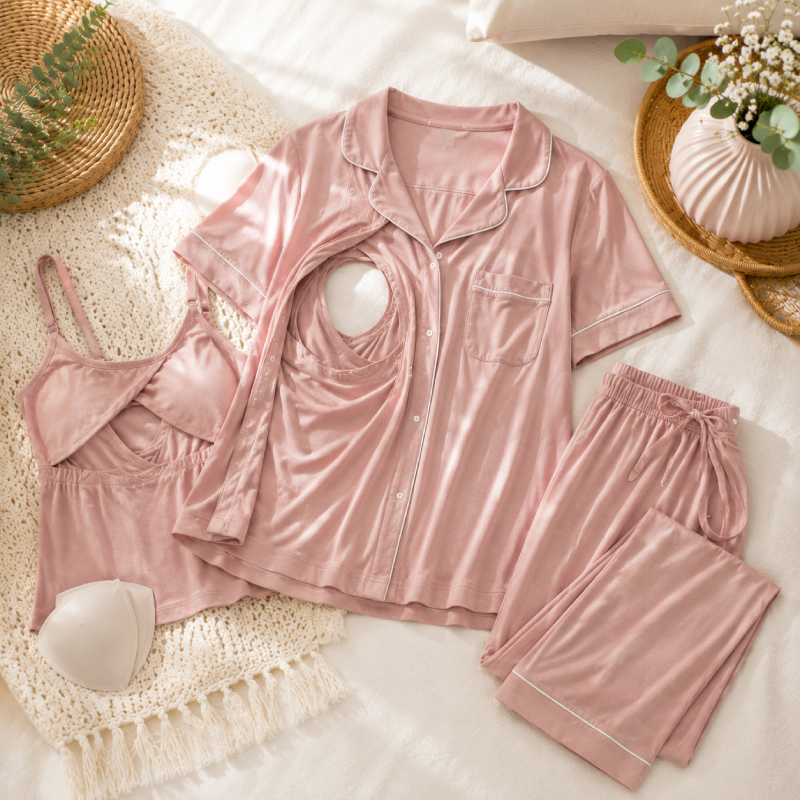
Bringing a new baby home reshapes everything — your schedule, your priorities, and yes, even your pajama drawer. Those silk slip dresses and delicate lace-trimmed sets that once defined bedtime suddenly feel wildly impractical at 3 a.m. when you’re fumbling in the dark with a hungry newborn. This is where nursing pajamas step in: sleepwear engineered specifically for the breastfeeding journey, balancing easy feeding access with the softness, adjustability, and durability that postpartum life demands.
If you’ve searched “best nursing pajamas” and felt overwhelmed by the options — button-downs, clip-downs, wrap-fronts, nightgowns, two-piece sets, tank-and-pant combos — you are not alone. In this guide, we break down everything that matters: which fabrics actually work through night sweats, what nursing access styles suit different body types, and how to build a postpartum sleepwear wardrobe that you’ll genuinely love wearing, long after your breastfeeding days are behind you.
What Are Nursing Pajamas?
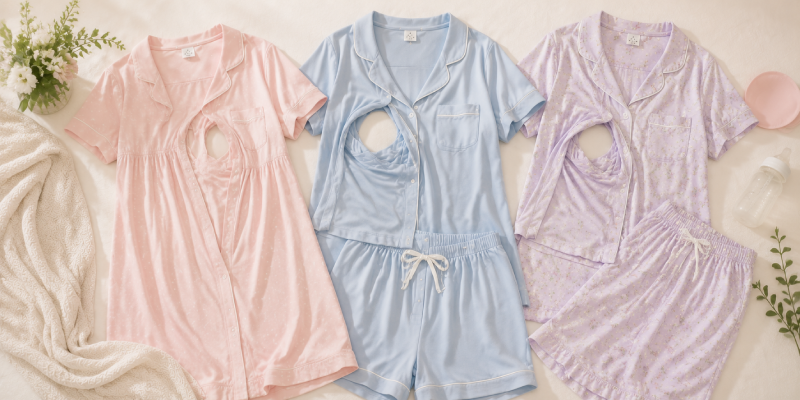
Nursing pajamas are sleepwear designed with discreet, one-handed nursing access — typically through hidden snaps, clip-down straps, button-front plackets, wrap-style crossovers, or stretchy pull-aside necklines. Unlike standard pajamas, they eliminate the awkward dance of pulling an entire top up (or off) for middle-of-the-night feeds.
The best nursing pajamas also consider the postpartum body: adjustable waistbands that expand and contract with your changing shape, relaxed silhouettes that don’t press on C-section incisions, and fabrics engineered to handle hormonal temperature swings without becoming a sweaty mess. They also sit against two sets of skin — yours and your newborn’s — which means fabric safety and softness matter more than in any other sleepwear category.
Nursing Pajamas vs. Regular Pajamas: Why It Actually Matters
It’s tempting to think any old button-down shirt will do the job. And technically, it will — but the difference between making do and actually being comfortable is significant.
Fabric | Regular Pajamas | Nursing Pajamas |
|---|---|---|
Night feed speed | Fumble with small buttons, hold shirt up with chin | One-hand snaps or pull-aside in 2 seconds |
Skin contact | Fabric may contain residual chemicals, rough seams | OEKO-TEX certified, flatlock seams, baby-safe |
Temperature swings | Standard fabric can’t wick fast enough | Moisture-wicking bamboo or TENCEL™ manages hot flashes |
Body changes | Fixed waist, no give for postpartum belly | Adjustable drawstrings, expandable panels |
Leak management | Light colors show every drop | Dark prints, leak-hiding patterns, machine-washable |
C-section recovery | Waistband sits on incision line | High-waist or nightgown options, zero pressure on scar |
Pumping compatibility | Must completely undress top half | Clip-down or snap-front works with pumping bras |
Longevity after nursing | Still functional but generic | Hidden nursing access = indistinguishable from regular pajamas |
Bottom line: a button-down shirt from your existing wardrobe works for the first few nights home. But by week two of cluster feeding at 2 a.m., 4 a.m., and 6 a.m., the speed and comfort difference becomes impossible to ignore.
How Many Nursing Pajamas Do You Actually Need?
The short answer: 3 pairs, minimum. Here’s the math behind that number, based on how often a nursing mom does laundry during the newborn phase:
Quantity | Why |
|---|---|
1 pair | You’ll be doing laundry every day. With a newborn. Not realistic. |
2 pairs | Cutting it close. One in the wash, one on your body — but what about the leak-through at 3 a.m.? |
3 pairs (ideal minimum) | One wearing, one in the wash, one clean backup. Survivable. |
4-5 pairs | True comfort zone. Room to rotate, no laundry panic, can throw one in the hospital bag permanently. |
Real-world breakdown by stage:
Hospital bag (2-3 days): Pack 2 sets — a nightgown for the first 24 hours (easier with monitoring and epidural recovery) and a two-piece set for day two when you want to feel more human.
First 2 weeks at home: 3-4 sets. Your body is leaking, sweating, and bleeding at unpredictable rates. You will change pajamas more often than you think.
2 weeks to 3 months: 3 sets as things stabilize. By this point you’ll know which styles you actually reach for.
3 months+ / returning to work: 2-3 sets that double as loungewear. You’ll be pumping more, so clip-down styles become your MVP.
Budget tip: Start with 2-3 core sets in dark colors. Add a lighter or prettier set later as a “I survived the fourth trimester” gift to yourself.
Key Features to Look For
1. Nursing Access Mechanism
This is the defining feature — and the one that most directly impacts your daily experience. Choosing the wrong access type for your body and lifestyle turns every feed into a minor wrestling match.
Access Type | How It Works | Best For | Watch Out For |
|---|---|---|---|
Snap-closure placket | Hidden snaps run vertically along the front placket; unsnap one side to feed | Moms who want the speed of snaps with a clean, non-nursing look | Snaps can wear after 6+ months of heavy use; test snap tension before buying |
Clip-down straps | Bra-style nursing clips at the shoulder; drop one cup down for access | Tank-top lovers; those who want built-in bra support; pumping-friendly | Clips can be fiddly in the dark until you build muscle memory; visible under thin fabrics |
Button-front | Classic button-down shirt design; unbutton from the top or bottom as needed | Skin-to-skin contact right after birth; most “normal” looking; adjustable coverage | Slower than snaps at 3 a.m.; tiny buttons are nearly impossible with one hand |
Wrap / crossover V-neck | Fabric crosses over at the bust with no hardware; pull aside to feed | Side-lying nursing positions; no hardware to break; flattering cleavage | Can gape open when you roll over in your sleep; less structured for larger busts |
Stretchy pull-down neckline | Deep stretchy V-neck or scoop neck; simply pull fabric down for access | Minimalists who want zero hardware; budget-friendly options | May stretch out permanently after 3-4 months; least supportive |
Hidden zipper access | Invisible vertical zippers along the side seams or front princess seams | Most discreet look; no visible nursing indicators | Zippers are the least durable option; prone to catching on skin or fabric |
2.Fabric That Works Overtime
Postpartum bodies run hot, cold, and everything in between — sometimes in the same hour. Meanwhile, you’re washing these pajamas 2-3 times more often than regular clothes. The right fabric makes all the difference:
Bamboo viscose: The gold standard for nursing sleepwear. Naturally temperature-regulating, moisture-wicking, and silk-soft against sensitive postpartum skin. Laboratory tests show bamboo viscose maintains skin temperature 2-3°C lower than cotton during night sweat episodes, with roughly 30% better moisture-wicking capability. Breathable enough for hot flashes, warm enough for air-conditioned rooms. The trade-off: pure bamboo can show minor pilling after 15+ wash cycles.
Pima / Supima cotton: Premium long-staple cotton with fibers roughly twice the length of standard cotton, which means a smoother surface and far better pilling resistance through frequent washing. Excellent breathability, though it absorbs moisture rather than wicking it — so you’ll feel damp longer during night sweats. One major advantage: breastmilk stains release from Pima cotton more easily than from most synthetics.
TENCEL™ Lyocell: Closed-loop production makes this the sustainability leader. Its smooth fiber surface naturally resists bacterial growth, meaning less odor between washes — a meaningful advantage when laundry is piling up. The slightly higher price point is justified by both the eco-credentials and the fabric’s ability to handle temperature swings without the pilling issues of standard modal.
Cotton-modal-spandex blends: The pragmatic choice. Typically 47-48% cotton, 47-48% modal, 5% spandex — this blend balances breathability, softness, and the critical stretch recovery that pull-aside necklines and wrap-fronts demand. Without that 5% spandex, the neckline will bag out within weeks.
- Modal: Derived from beechwood pulp, modal drapes beautifully and feels noticeably cooler against the skin than cotton. It’s 50% more absorbent than cotton, which helps with leak management. The downside: modal tends to pill more aggressively than bamboo or Pima under the heavy wash cycles of the newborn phase.
What to absolutely avoid:
100% polyester — traps heat, holds onto odors, can irritate sore nipples
Rough lace or sequin trims anywhere near the bust — chafing risk on already-sensitive skin
- “Dry clean only” labels — you will be washing these every 24-48 hours, and your dry cleaner is not open at 3 a.m.
Scratchy tags at the neck or side seam — tagless labels or printed care info only
3. Postpartum-Friendly Silhouette
You’re not dressing the body you had at 20 weeks pregnant, and you’re not dressing the body you’ll have at 6 months postpartum. You’re dressing the body that exists right now — soft, healing, and in flux.
Adjustable waistbands: Drawstrings beat fixed elastic every time. They expand for the immediate postpartum belly, cinch in as you heal, and can be tied loosely above a C-section incision.
No irritating seams: Flatlock stitching or seamless construction around the bust, underarm, and side seams minimizes friction on skin that may be more sensitive than ever before.
- C-section recovery: High-waisted pants that sit 2-3 inches above the incision line, or nightgowns that apply zero pressure to the abdomen. If you’re packing a hospital bag before knowing whether you’ll have a C-section, pack a nightgown as your primary option.
Room to layer: A relaxed fit that accommodates nursing bras, disposable breast pads, postpartum belly bands, and — eventually — a sleeping newborn against your chest. If the fabric pulls tight across the bust when you’re wearing a nursing bra underneath, size up.
4.Practical Details That Make or Break the Experience
Pockets: You will carry your phone, a Haakaa pump, nipple balm, a burp cloth, and three other things you’ll forget you’re holding between the nursery and your bedroom. Pockets are not a luxury; they’re a survival tool.
Dark colors and small-scale prints: They hide breastmilk leaks, spit-up, and the fact that you haven’t changed in 36 hours. Solid white, blush, and light grey are aspirational but impractical for the first 8 weeks.
Machine wash cold + tumble dry low: That’s the only care label you should accept. If it can’t survive the dryer, it can’t survive your life right now.
Modesty snaps or hidden plackets: Nursing access is functional, but you don’t necessarily want your father-in-law to see it when he visits. The best nursing pajama designs look indistinguishable from regular sleepwear when fully closed.
Types of Nursing Sleepwear: A Detailed Breakdown
Two-Piece Nursing Pajama Sets
The most popular category — and for good reason. A button-down or snap-front top paired with drawstring pants gives you the versatility of a regular pajama set with hidden nursing functionality. The pants can be worn independently with nursing tanks long after breastfeeding ends.
Best design features to look for:
Full-length snap placket
Pants with a wide, soft elastic waistband or drawstring
Matching or coordinating colors that hide leaks
Pros: Full coverage, feels the most “normal,” separates extend the wardrobe, visitors won’t clock them as nursing wear
Cons: Two pieces to manage during night feeds; pants may need frequent drawstring adjustment; more fabric to wash
Nursing Nightgowns / Sleep Shirts
A single piece that pulls on over the head, with a button placket or deep V-neck for feeding access. Many new moms prefer nightgowns in the first 2-3 weeks postpartum for the zero-waistband comfort, particularly after a C-section. They’re also the easiest option for those middle-of-the-night bathroom trips when you’re still recovering.
Best design features to look for:
Button placket that extends at least 8-10 inches from the neckline
Curved hem or side slits for freedom of movement
Fabric with enough weight to drape without clinging — lightweight jersey can be unflattering and ride up
Pros: Nothing pressing on the abdomen; easiest to get on and off; one item to wash; ideal C-section option
Cons: Can ride up during sleep (look for styles with a slight A-line cut to minimize this); less coverage for visitors
Nursing Tank + Pant Sets
The hybrid option that bridges sleepwear and loungewear. Many tank tops in this category feature built-in shelf bras with removable padding, making them viable for daytime wear — throw a cardigan over it, and you’re dressed for a pediatrician appointment.
Best design features to look for:
Clip-down nursing straps with one-hand release
Built-in shelf bra with enough elasticity to hold breast pads
Racerback or wide-set straps (narrow straps dig in on larger busts)
Pros: Built-in support eliminates the need for a separate nursing bra; transitions from bed to couch to front door; cooler for hot sleepers
Cons: Shelf bras rarely provide enough support for cup sizes above D/DD; straps can create pressure points during long wear
Nursing Robes and Kimonos
Not standalone sleepwear, but the most versatile piece in a nursing wardrobe. A soft, lightweight robe over a nursing tank or nightgown provides warmth during night feeds, coverage when walking to the nursery, and a layer of modesty when the doorbell rings.
Best design features to look for:
Knee-length or longer (short robes leave your legs cold at 4 a.m.)
3/4 sleeves or roll-tab sleeves that stay out of the way during feeding
Inner tie + outer tie closure (prevents gaping)
Pros: One size works through pregnancy and postpartum; universally flattering; the piece you’ll use longest
Cons: Not a standalone sleep solution; sleeves can dip into diaper changes if too long
Nursing Pajamas by Pregnancy and Postpartum Stage
Your needs shift dramatically from the second trimester through the first year postpartum. Here’s what to prioritize at each stage:
Stage | Timeline | Body Changes | Pajama Priority | What to Buy |
|---|---|---|---|---|
Third Trimester | Weeks 28-40 | Full bump, rib cage expansion, trouble sleeping | Maximum comfort, no restrictions | Stretchy nightgown or oversized button-front set; adjustable waistbands at their loosest |
Hospital Stay | 1-3 days | Epidural recovery, monitoring, first breastfeeding attempts | Easy access for skin-to-skin, IV/epidural-friendly | Nursing nightgown with full front opening + lightweight robe; dark color |
First Week Home | Days 1-7 | Milk coming in, engorgement, night sweats, bleeding | Absorbent fabrics, maximum access, zero waist pressure | 2-3 nightgowns or loose two-piece sets; bamboo or modal for night sweats |
Weeks 2-6 | Fourth trimester | Hormonal rollercoaster, cluster feeding, C-section healing | Frequent changes, leak management, comfort above style | Dark-colored snap-front sets; high-waist pants for C-section recovery |
6 Weeks – 3 Months | Breastfeeding established | Supply regulating, body starting to stabilize, more visitors | Looking put-together without sacrificing function | Two-piece sets that pass as loungewear; one “nice” set for visitors |
3-6 Months | Returning to work | Pumping multiple times daily, sleep deprivation peaks | Pumping-friendly access, durability through heavy washing | Clip-down tank sets; button-fronts for pumping room speed |
6-12 Months+ | Extended breastfeeding | Body approaching new normal | Pajamas that work for nursing but don’t look like nursing wear | Hidden-snap sets in premium fabrics; pieces you’ll keep wearing post-weaning |
Seasonal Guide: Nursing Pajamas for Every Climate
Your due date has a lot to say about which nursing pajamas will work best for you:
Summer Baby (June – August)
Priorities: Breathability above all else. Postpartum hormones already make you run hot; add August humidity and you’re in a sauna.
Best fabrics: Bamboo viscose, TENCEL™ Lyocell, lightweight Pima cotton
Best styles: Nursing tank + short set, sleeveless nightgown with snap placket, lightweight kimono robe
- Avoid: Polyester blends, heavy jersey, anything labeled “cozy” or “brushed”
Pro tip: Buy one long-sleeve option anyway — hospitals and postpartum rooms are often aggressively air-conditioned
Winter Baby (December – February)
Priorities: Warmth without bulk. You need layers that come off quickly for feeds and go back on before you get chilled.
Best fabrics: Brushed modal, cotton flannel, bamboo-spandex jersey (heavier weight)
Best styles: Long-sleeve snap-front set, full-length nightgown with button placket, fleece-lined robe
Avoid: Anything that requires pulling over your head
Pro tip: A waffle-knit or fleece robe over a nursing tank is the coziest winter combo — warmth when you need it, easy access when you don’t
Spring / Fall Baby (March – May, September – November)
Priorities: Versatility. Temperatures swing 15 degrees between 2 a.m. and 7 a.m.
Best fabrics: Mid-weight bamboo or cotton-modal blend
Best styles: Two-piece long-sleeve set + lightweight robe for layering; 3/4 sleeve nightgown
Pro tip: A 3-in-1 approach works best: nursing tank base layer + button-front top + robe. Peel off or add layers as the thermostat (and your internal one) fluctuates.
Nursing Pajamas and Pumping: What Works for Both
If you’re planning to pump — whether exclusively, occasionally, or when you return to work — your nursing pajama choices change slightly. Here’s the compatibility breakdown:
Access Type | Breastfeeding | Pumping | Notes |
|---|---|---|---|
Snap-front placket | ★★★★★ | ★★★★☆ | Flanges fit through the opening; you may need to unsnap further than for nursing |
Clip-down straps | ★★★★☆ | ★★★★★ | Best for hands-free pumping bras — clip down, attach pumping bra, go |
Button-front | ★★★★☆ | ★★★★☆ | Works for both; slightly slower than snaps for pump setup |
Wrap / crossover | ★★★★☆ | ★★★☆☆ | Fabric can interfere with flange seal; pull completely aside |
Pull-down neckline | ★★★☆☆ | ★★☆☆☆ | Neckline may not open wide enough for double pumping setup |
The pumping-specific upgrade: If you’ll be pumping regularly, invest in at least one clip-down tank set specifically for pumping sessions. The built-in shelf bra holds flanges in place for hands-free pumping, and the clip-down access means you don’t have to fully undress — especially relevant if you’re pumping in an office lactation room.
Hospital Bag: What Nursing Pajamas to Pack
Your hospital bag is the first test of your nursing pajama choices. Based on input from hundreds of postpartum moms, here’s the optimized packing list:
Item | Quantity | Why |
|---|---|---|
Nursing nightgown (dark color) | 1 | First 24 hours: epidural, catheter, monitoring — you want zero waistbands and easy access |
Two-piece nursing set (dark color) | 1 | Day 2: when you want to feel like a person again; pants provide coverage for walking the halls |
Lightweight robe | 1 | Layers over the gown for warmth; covers your back during hallway walks; doubles as a nursing cover |
Going-home outfit | 1 | Loose, soft, zero compression on the abdomen — your nursing set can serve this function |
Non-slip socks or slippers | 1 pair | Hospital floors are cold and you will be walking to the NICU/bathroom at all hours |
What NOT to pack: White or light-colored anything (hospital lighting is unforgiving, and postpartum bleeding is real), your favorite pre-pregnancy silk set (it will get stained, and you will be sad), and anything labeled “one size” (your body just did something extraordinary — give it clothes that fit).
Common Mistakes When Buying Nursing Pajamas
Even savvy shoppers make these errors. Learn from the collective wisdom of postpartum forums everywhere:
Mistake #1: Buying only one pair. You will leak through it at 2 a.m. on a Tuesday. You will have no backup. You will cry. Buy three.
Mistake #2: Prioritizing looks over function. That beautiful ivory lace-trimmed set? Stunning on Instagram. Impractical when you’re engorged, leaking, and fumbling one-handed in the dark. Save the pretty sets for month three, when breastfeeding is established and your body has stabilized.
Mistake #3: Assuming your pre-pregnancy size still fits. Your rib cage expanded during pregnancy. Your bust is 1-3 cup sizes larger. Your belly is soft and healing. Size up at least one size from your pre-pregnancy size — two if you’re buying for the first 6 weeks postpartum.
Mistake #4: Skipping the “test run” before your due date. Wash the pajamas, wear them for one night, and practice opening the nursing access with one hand while holding a stuffed animal in the other arm. If it’s frustrating at 10 a.m. on a Sunday, it will be impossible at 3 a.m. on a Wednesday.
Mistake #5: Choosing complicated care instructions. If it says “hand wash cold, lay flat to dry, do not wring,” put it back on the shelf. Your laundry situation for the next 3 months is: everything goes in together, on cold, and into the dryer. If a fabric can’t survive that, it can’t survive your postpartum life.
Mistake #6: Ignoring the “grandparent visit” test. You will have visitors. Your father-in-law will hold the baby while you breastfeed. Ask yourself: does this pajama set provide enough coverage that you feel comfortable nursing in front of him? Snap-front plackets and wrap styles provide controlled, partial access — you expose only what you need to. Pull-down necklines and deep V’s expose everything. Choose accordingly based on your comfort level and living situation.
Care and Maintenance: Making Nursing Pajamas Last
Your nursing pajamas will be washed 2-3 times more frequently than any other clothing you own. Here’s how to keep them functional and soft through the entire nursing journey:
Pre-treat breastmilk stains immediately. Breastmilk is protein-based. Rinse the spot with cold water (hot water sets the protein), then dab with a small amount of enzyme-based stain remover before tossing in the hamper. Don’t let milk stains sit for days — they yellow permanently.
Wash in cold water. Hot water relaxes elastic fibers, degrades spandex, and sets protein stains. Cold water preserves the stretch recovery that nursing access mechanisms depend on.
Skip fabric softener on bamboo and modal. Fabric softener coats the fibers with a waxy residue that reduces moisture-wicking ability — the exact opposite of what you want from temperature-regulating fabric. White vinegar in the rinse cycle achieves the same softness without the coating.
Close all snaps and buttons before washing. Open hardware catches on other fabrics, snags and tears seams, and can damage washing machine drums. Take 20 seconds to fasten everything.
Mesh laundry bags are worth it. Nursing pajamas with clips, snaps, and drawstrings can tangle and stretch in the wash. A $5 mesh bag extends the lifespan by months.
Tumble dry low — but don’t overdry. High heat degrades elastic and spandex. Pull pajamas out when they’re still slightly damp and let them air-dry the last 10%. Your waistband elastic and stretchy necklines will thank you.
Rotate your sets. Wearing the same pair every night accelerates wear on the nursing access points (snaps, clips, buttons). Rotating between 3 sets distributes the wear evenly.
Style and Aesthetic: Looking Like Yourself in the Fourth Trimester
There’s a powerful psychological component to what you wear postpartum, even if “postpartum” mostly means “inside your own house at 3 a.m.” The right nursing pajamas bridge the gap between functional and flattering.
What to look for if style matters to you:
Hidden nursing access: The highest-end designs integrate snaps into existing seam lines, plackets, or wrap constructions. When fully closed, no one can tell they’re nursing pajamas — which means you can keep wearing them indefinitely.
Thoughtful details: Contrast piping, a flattering curved hem, or a subtle pattern elevates a basic set into something that makes you feel more “dressed” even when you haven’t left the house in three days.
Matching sets that separate well: A print top with solid pants, or vice versa, gives you the option to pair the pants with a nursing tank for a different look.
Color psychology: Rich jewel tones (navy, burgundy, forest green) feel more intentional than pastels and hide stains better than black, which shows every drop of dried breastmilk. Charcoal and dark heathered colors are the ultimate camouflage.
The “one nice set” rule: Among your 3-4 nursing pajama sets, designate one as your “visitor / leaving the house / I need to feel like a human” set. This is the one you reach for when your in-laws are visiting, when you have your 6-week checkup, or when you just need to see yourself in the mirror and recognize the person looking back.
Ideal Use Cases
Scenario | Recommended Style | Key Reason |
|---|---|---|
Hospital bag | Nursing nightgown (dark) + robe | Zero waistband for epidural/monitoring; easy skin-to-skin access |
First 6 weeks postpartum | Button-front nightgown or snap-front set (bamboo or modal) | Maximum comfort during cluster feeding; handles night sweats |
C-section recovery | Nightgown or high-waist two-piece set | No pressure on incision; doesn’t catch on stitches |
Returning to work / pumping | Clip-down tank set + button-front top | Fastest pumping setup; works with hands-free pumping bras |
Co-sleeping / room-sharing | Dark-colored snap-front two-piece set | Modesty when partner or older children are nearby |
Summer baby | Bamboo tank-and-short set or sleeveless nightgown | Breathable, cooling; less fabric to manage in the heat |
Winter baby | Long-sleeve snap-front set in brushed modal or flannel + fleece robe | Warmth without bulk; layers peel off for feeds |
Gift for a new mom | Luxe Pima cotton or bamboo hidden-snap set (mid-to-premium tier) | Feels indulgent but practically useful; looks like “real” pajamas |
Second-time mom | Premium set in a fresh color or print | She already has the basics; give her something she wouldn’t buy herself |
For Sleepwear Brands: What to Know Before Sourcing Nursing Pajamas
If you’re a sleepwear brand or retailer looking to launch or expand a nursing-friendly collection, the opportunity is real — and the product requirements are specific. Here’s what matters from a manufacturing and sourcing perspective.
The Market Gap
The nursing sleepwear market remains underserved. Most mainstream pajama brands have zero nursing-friendly options, forcing new moms to buy from a narrow pool of maternity specialists (Kindred Bravely, Seraphine, Hatch) or generic Amazon brands (Ekouaer). A well-executed nursing pajama line from an established sleepwear brand can capture a loyal, repeat-purchase customer base — moms who love your product will come back for every subsequent pregnancy and recommend it to their entire mom group. Industry data indicates the maternity and nursing sleepwear segment is growing at roughly 6% annually, outpacing the broader sleepwear market.
Sourcing Considerations for Nursing Pajamas
1. Hardware quality is non-negotiable. Snaps, clips, and buttons are the most common failure point. Nursing moms open and close these fasteners 6-12 times per 24 hours — that’s 200+ cycles per month. Cheap snaps pop off within weeks; stiff clips frustrate in the dark; small buttons require two hands and fine motor skills at 3 a.m. Work with a manufacturer who sources nursing-specific hardware — not generic fasteners — and request abrasion and cycle-testing data. Quality nursing snaps should be rated for 5,000+ open-close cycles without loosening.
2. Fabric certification matters more here than anywhere. Nursing pajamas sit against sensitive postpartum skin and, critically, against a newborn’s face during feeding. OEKO-TEX® Standard 100 certification should be your baseline; every fabric and trim component that touches skin should be tested for harmful substances. GOTS-certified organic cotton or FSC-certified bamboo viscose adds the premium positioning that justifies higher price points and resonates with the values-driven millennial parent demographic.
3. Stretch recovery is a hidden differentiator. Pull-aside necklines and wrap-fronts rely entirely on the fabric’s ability to snap back after repeated stretching. A modal or bamboo blend with 5-8% spandex will maintain shape; a cheaper cotton jersey will bag out within weeks. This is the difference between a pajama set that lasts the entire nursing journey and one that gets thrown out at month two. Request stretch-recovery test data from your fabric supplier — specifically, recovery percentage after 30% stretch, tested across 20+ cycles.
4. Size inclusivity opens the addressable market. A nursing body is a body in rapid flux — up 1-3 cup sizes, a softer midsection, wider rib cage. Offering XS-3X (or broader) with an adjustable fit system — drawstrings, wrap closures, expandable panels — makes your product relevant from the third trimester through the first year postpartum. Brands offering only S-XL leave roughly 40% of the potential customer base unserved.
5. Discreet design is the ultimate selling point. The best-selling nursing pajamas look indistinguishable from regular sleepwear when fully closed. The nursing access — snaps along a placket seam, hidden zippers in princess seams, wrap constructions that pass as design features — should be invisible to anyone who isn’t using it. This is what allows a mom to wear them long after breastfeeding ends, dramatically extending the product’s perceived value and justifying higher price points.
6. Compliance for matching children’s sleepwear. If your nursing collection includes matching mother-baby sets (a fast-growing trend), the infant/children’s component must comply with CPSC children’s sleepwear flammability standards (16 CFR Part 1615/1616). This requires either inherently flame-resistant fabric or tight-fitting garment specifications with hangtag warnings. Your manufacturer should provide CPC (Children’s Product Certificate) documentation for every infant style in the collection.
How Friendtex Supports Nursing Sleepwear Production
At Friendtex, we bring 15+ years of sleepwear manufacturing expertise to nursing pajama production. Our factory operates with:
Certified fabric supply chain: OEKO-TEX® Standard 100, GOTS-certified organic cotton, FSC bamboo viscose, Lenzing TENCEL™ modal and lyocell
Nursing-specific hardware: Cycle-tested snap closures and BPA-free nursing clips rated for 10,000+ open-close cycles from qualified hardware suppliers
Flatlock and seamless construction capability: Minimizing skin irritation on sensitive postpartum bodies; tagless label integration
Flexible MOQs: Starting from 300 pieces per design, with pre-production sampling that lets you test nursing access ergonomics with real users before full production
Full compliance documentation: GCC, CPC, and flammability test certificates available for all children’s and infant sleepwear components in matching mother-baby sets
Size range expertise: Pattern grading experience from XS through 4X, including specialized plus-size fit blocks that accommodate nursing access without compromising support
Whether you’re launching a 5-style nursing capsule or expanding an existing pajama brand into the maternity space, contact our team to discuss your sourcing needs.
Final Takeaways
Investing in 3-4 well-designed nursing pajama sets is one of the smartest postpartum purchases you can make — right up there with a good pump, a giant water bottle, and a subscription to a meal delivery service. The right set eliminates friction from those bleary-eyed night feeds, keeps you comfortable through hormonal temperature swings, and — crucially — makes you feel a little more like yourself at a time when everything else feels unfamiliar.
If you take away only three things from this guide, let them be: buy at least three pairs (you’ll thank yourself at 3 a.m.), choose fabric over fashion for the first 8 weeks (bamboo and modal over lace and silk), and test your nursing access with one hand in the dark before your due date (if it’s not intuitive, it’s not the right pair).
For brands, the nursing sleepwear category represents a clear product-market gap: high demand, limited quality supply, and a customer who will evangelize a great product to every expectant mother in her orbit. The key is getting the hardware, fabric certification, and fit right — and working with a manufacturer who understands that nursing pajamas sit at the intersection of medical device, comfort garment, and fashion item.
Looking to source nursing pajamas for your sleepwear brand? Friendtex offers end-to-end production support for OEKO-TEX® certified nursing sleepwear. Browse our capabilities at friendtex.com or reach out to discuss your next collection.