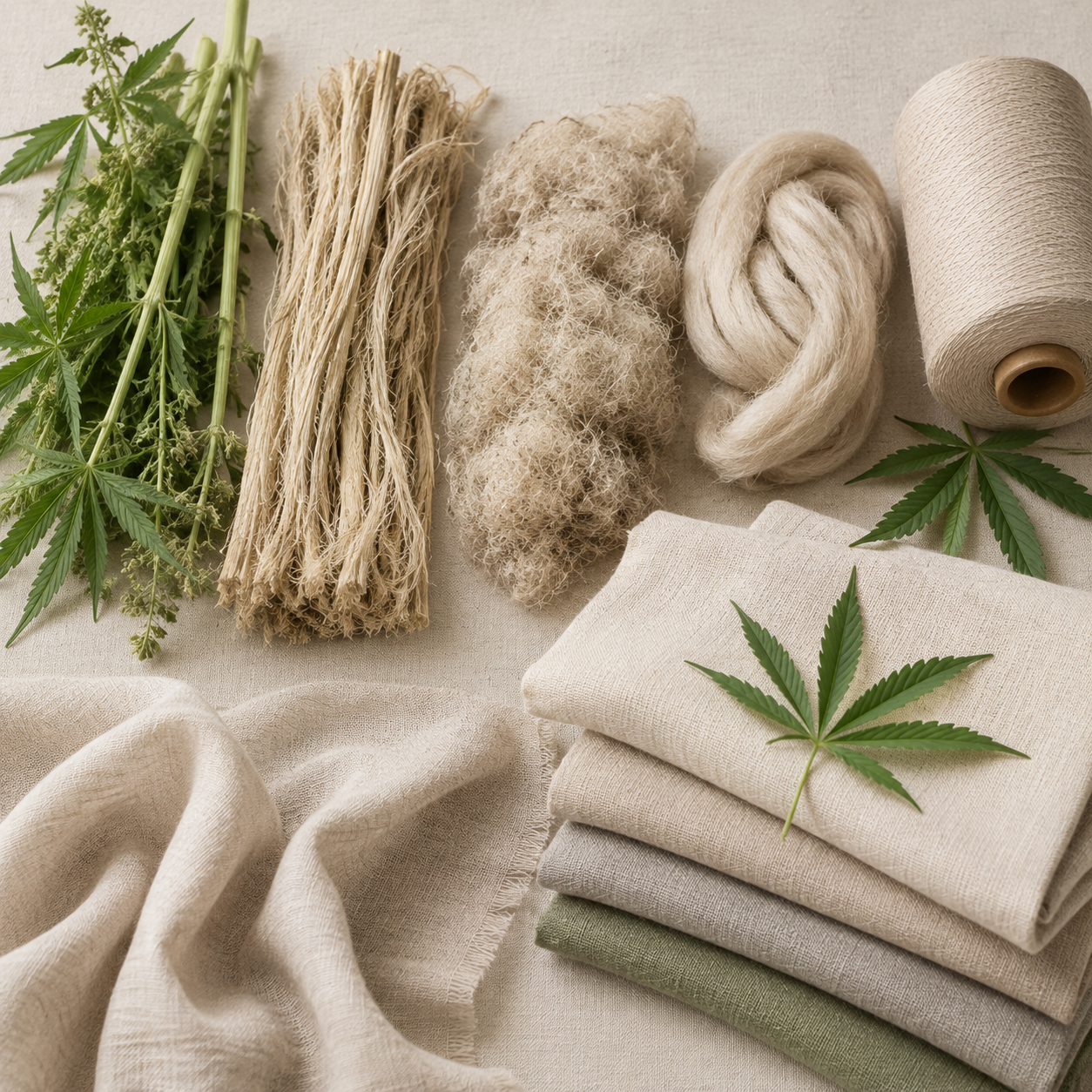
Hemp is having a moment. From luxury fashion houses to sustainable sleepwear startups, brands are falling over themselves to add hemp to their fabric mix. But here’s the uncomfortable truth: not all hemp fabric is created equal, and the difference isn’t in the plant — it’s in the processing. Two mills can start with identical hemp stalks and produce fabrics that feel like polar opposites: one stiff and scratchy, the other soft enough for newborn pajamas. Understanding why requires going deep into the manufacturing process.
Key Takeaways
Hemp fabric quality is determined almost entirely by processing choices, not the raw plant — the same fiber can yield coarse canvas or buttery-soft sleepwear depending on how it’s handled.
The retting stage is the first quality fork in the road: water-retted hemp produces finer, softer fibers than field-reted fiber, at the cost of higher resource use.
Fiber length management through hackling separates premium line fibers (for fine textiles) from tow fibers (for coarse goods) — the single biggest determinant of final fabric quality.
Wet spinning and enzyme finishing are the two modern techniques that transform hemp from “stiff and scratchy” into “soft and drapey” — and both require specialized equipment most general mills don’t have.
Blending strategy matters: hemp-organic cotton (55/45) and hemp-TENCEL™ blends deliver day-one softness that pure hemp can’t, making them the preferred choice for sleepwear applications.
- Working with a manufacturer who controls the full process chain — from fiber selection through finishing — is the difference between mediocre hemp and premium hemp sleepwear.
Why Processing Determines Everything
Here’s a fact that surprises most people new to hemp textiles: the hemp plant doesn’t produce soft fabric; processing does. The fibers extracted from a hemp stalk are naturally long, strong, and slightly stiff — closer to rope than to pajamas. Every property you associate with premium hemp sleepwear — the linen-like drape, the progressive softening, the cool hand feel — is engineered during manufacturing.
This is why the “hemp” label on a garment tells you almost nothing. The same crop can become:
| End Product | Process Emphasis | Result |
|---|---|---|
| Rope and cordage | Minimal processing, coarse fiber | Maximum strength, zero softness |
| Canvas and bags | Basic spinning, tight weave | Durable but stiff |
| Denim blends | Standard spinning + washing | Improved hand feel |
| Premium apparel | Wet spinning, enzyme finishing, blending | Soft, drapey, luxurious |
The gap between the first row and the last row isn’t fiber quality — it’s processing investment. That’s the core insight for anyone sourcing hemp sleepwear: you’re not buying a plant; you’re buying a process.
The 7 Stages of Hemp Fabric Production
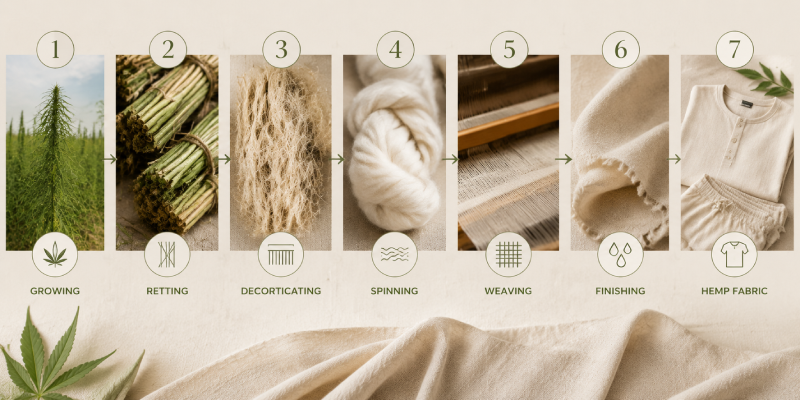
Stage 1: Cultivation and Harvesting
Industrial hemp (Cannabis sativa, cultivated specifically for fiber with THC content below 0.3%) grows rapidly — reaching 10-15 feet in just 3-4 months. It requires no pesticides, roughly 300-500 liters of water per kg of fiber (versus cotton’s ~10,000 liters), and actually regenerates soil health through its deep taproot system.
Quality-critical factors at this stage:
Sowing density: Dense planting (approximately 200-300 plants per square meter for fiber hemp) produces tall, thin stalks with long fibers — ideal for textiles. Sparse planting yields branching, woody stalks with shorter, coarser fibers suited for construction materials, not apparel.
Harvest timing: Fiber hemp is harvested when the plants begin flowering. Too early: fibers are immature and weak. Too late: fibers become lignified (woody) and difficult to process into fine yarn.
Stalk quality: Clean, straight stalks with minimal branching produce the longest, most uniform fibers.
Stage 2: Retting — The First Quality Fork
Retting is the biological process that loosens the pectin binding the bast fibers to the woody core of the stalk. This is the first stage where processing choices dramatically alter final quality:
| Method | Process | Fiber Quality | Resource Use | Typical Use |
|---|---|---|---|---|
| Dew retting | Cut stalks left in the field 2-3 weeks; dew, rain, and microorganisms break down pectin | Good but variable; can be uneven, slightly coarse | Minimal (field only) | Standard apparel, blends |
| Water retting | Stalks submerged in water (rivers, tanks) 7-14 days; bacteria do the work | Finer, softer, more uniform fibers | High water use; potential pollution | Premium apparel |
| Enzyme retting (modern) | Controlled enzyme baths break down pectin precisely | Most consistent, high-quality fiber | Moderate; controlled | Premium, high-end textiles |
| Chemical retting (rare) | Chemical baths accelerate the process | Fast but can damage fiber | Chemical-intensive | Largely phased out |
Why this matters for sleepwear: Water- and enzyme-retted hemp produce the fine, uniform fibers needed for soft, high-count yarns. Dew-retted hemp, while more sustainable in resource terms, produces more variable fiber that’s harder to spin into consistently soft fabric. Premium hemp sleepwear brands increasingly specify enzyme retting to lock in consistency.
Stage 3: Breaking and Scutching — Separating Fiber from Shive
After retting, the stalks pass through mechanical breakers that crush the woody inner core (the shive) into fragments. Scutching machines then beat and scrape the stalks, separating the long bast fibers from the broken woody pieces.
Quality-critical factors:
- Gentleness: Aggressive scutching shortens and damages fibers. Premium processors use calibrated settings to preserve maximum fiber length.
Separation efficiency: Residual shive (woody particles) in the fiber stream shows up as specks and rough spots in the finished fabric — a common quality defect in cheap hemp textiles.
Stage 4: Hackling — Where Premium Hemp Is Made
Hackling is the combing process that aligns the fibers and separates them by length:
- Line fibers (long, 1-5 meters): The cream of the crop. These aligned, long fibers spin into fine, strong, smooth yarns — the basis of premium hemp apparel.
Tow (short, broken fibers): The leftovers — used for coarser yarns, rope, and industrial textiles.
Why this matters for sleepwear: The line-to-tow ratio is the single biggest determinant of fabric quality. A mill that carefully hacks and preserves line fibers produces yarn with fewer protruding fiber ends — which means less pilling, a smoother surface, and a softer hand feel. A mill that rushes this stage produces fabric that feels rough and pills within months.
Stage 5: Spinning — The Softness Revolution
Spinning twists the aligned fibers into yarn. This is where modern technology has transformed hemp from a coarse fiber into a luxury one:
| Method | Process | Outcome |
|---|---|---|
| Dry spinning (traditional) | Fibers twisted with air; produces a slightly stiff yarn | Classic hemp texture; takes many washes to soften |
| Wet spinning (premium) | Fibers twisted through warm water, which relaxes the pectin residue and aligns fibers more tightly | Finer, smoother, softer yarn; the standard for premium hemp apparel |
| Blended spinning | Hemp fiber blended with organic cotton, TENCEL™, or modal at the spinning stage | Day-one softness; combines hemp’s strength with cotton/TENCEL’s softness |
The wet-spinning advantage: Wet spinning produces yarn that is finer (finer counts possible), rounder, and smoother than dry-spun hemp. It’s the technique that allows hemp to reach the 40-60 Ne yarn counts needed for lightweight, drapey sleepwear fabrics. Dry-spun hemp typically tops out at coarser counts, limiting it to heavier, stiffer fabrics.
Stage 6: Weaving or Knitting
The spun yarn becomes fabric through weaving (for crisp, structured fabrics) or knitting (for stretchy, soft, drapey fabrics):
Plain weave: Creates the classic linen-like hemp hand feel; crisp and breathable; the default for hemp apparel.
Twill weave: Adds drape and durability; popular for loungewear.
Jersey knit: Produces soft, stretchy fabric — increasingly popular for hemp sleepwear, though knit hemp requires careful finishing to achieve the softness consumers expect from knit products.
Stage 7: Finishing — The Second Quality Fork
Raw hemp fabric is stiff, with a slightly harsh hand feel. Finishing treatments transform it into sleepwear-grade fabric:
| Treatment | What It Does | Result |
|---|---|---|
| Enzyme wash (bio-polishing) | Enzymes (typically cellulase) digest protruding microfibers on the fabric surface | Dramatically smoother surface; reduced pilling; enhanced softness |
| Mechanical softening | Fabric passed through softening machines that flex and break down fiber stiffness | Softer drape without chemical residue |
| Washing treatments | Stone-wash or garment-wash cycles | Pre-softened, lived-in feel |
| Anti-shrink finishing | Controlled relaxation and stabilization of the fabric | Dimensional stability; predictable shrinkage after consumer washing |
The key insight: Enzyme finishing is the single most important step for making hemp feel luxurious. A fabric that skips bio-polishing feels scratchy regardless of how premium the fiber was. This is also the stage where cheap manufacturers cut corners — and why two “100% hemp” garments can feel completely different.
How Processing Choices Map to Fabric Outcomes
| Processing Decision | Low-End Choice | Premium Choice | Impact on Sleepwear |
|---|---|---|---|
| Retting method | Dew retting (variable) | Enzyme or water retting | Fiber uniformity, softness ceiling |
| Hackling care | Rushed, high tow content | Line-fiber focused | Pilling resistance, surface smoothness |
| Spinning | Dry spinning, coarse counts | Wet spinning, fine counts | Drape, softness, lightweight options |
| Finishing | Minimal or skipped | Enzyme + mechanical softening | Hand feel, day-one comfort |
| Blending | Pure hemp, no blend strategy | Hemp-organic cotton or hemp-TENCEL™ | Immediate softness, wash durability |
Common Hemp Fabric Defects
Knowing what can go wrong is part of sourcing expertise. These are the defects that distinguish professional manufacturers from generalists:
| Defect | Cause | Impact |
|---|---|---|
| Surface specks / shive contamination | Incomplete scutching; woody particles left in fiber | Rough feel; visible dots; dye irregularities |
| Pilling | High tow content from rushed hackling; weak yarn structure | Balls of fiber on surface after washing |
| Uneven dye uptake | Inconsistent fiber quality or poor scouring | Patchy color, especially in dark shades |
| Excessive shrinkage | Skipped anti-shrink finishing | Garments shrink 5%+ after first wash |
| Stiffness that never softens | No enzyme finishing; dry-spun coarse yarn | Harsh hand feel regardless of wash count |
| Weak yarns / breaking seams | Over-aggressive scutching damaged fibers | Garment failure at stress points |
Blending Strategy: The Practical Path to Premium Hemp Sleepwear
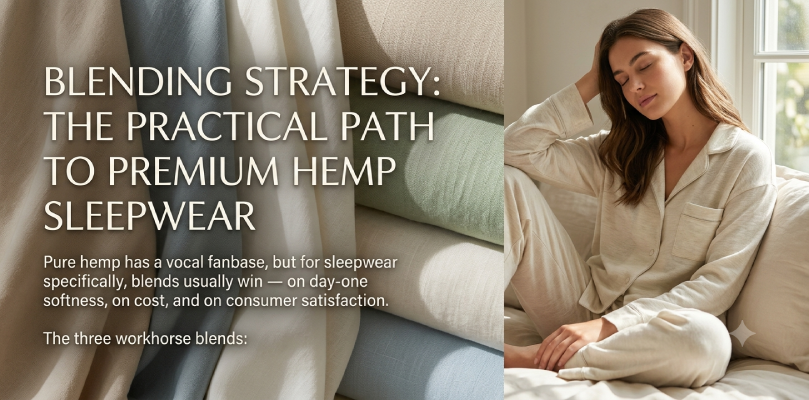
Pure hemp has a vocal fanbase, but for sleepwear specifically, blends usually win — on day-one softness, on cost, and on consumer satisfaction. The three workhorse blends:
| Blend | Ratio (typical) | Why It Works | Best For |
|---|---|---|---|
| Hemp + Organic Cotton | 55/45 | Cotton softens hemp’s initial hand feel; hemp adds strength and durability; fully natural | Classic two-piece pajama sets |
| Hemp + TENCEL™ Lyocell | 50/50 or 55/45 | TENCEL adds immediate softness and moisture management; premium eco story | Luxury sleepwear, nightgowns |
| Hemp + Modal | 50/50 | Modal’s drape and softness balance hemp’s structure; cost-effective | Loungewear, relaxed sets |
The hemp percentage still drives the sustainability story — even a 55% hemp blend uses a fraction of the water and zero pesticides compared to an equivalent cotton garment — while the blend partner delivers the sensory experience consumers expect from sleepwear.
Quality Testing for Hemp Sleepwear
Before committing to production, a professional sourcing process verifies these properties:
| Test | What It Verifies | Target for Sleepwear |
|---|---|---|
| Tensile strength | Fiber and yarn strength | Hemp should exceed cotton benchmarks by 2-3x |
| Shrinkage test | Dimensional stability after washing | ≤3-5% after first wash with proper finishing |
| Pilling test (Martindale) | Surface resistance to abrasion | Grade 3-4 or better after 2,000-5,000 cycles |
| Moisture management (wetting time, wicking rate) | Breathability and sweat management | Meets or exceeds cotton; approaches TENCEL benchmarks |
| Colorfastness | Dye resistance to washing, light, crocking | Grade 4+ on standard scales |
| OEKO-TEX® Standard 100 | Harmful substance screening | Certification required for skin-contact sleepwear |
How Friendtex Produces Premium Hemp Sleepwear
At Friendtex, we’ve spent the past 15+ years manufacturing sleepwear for global brands, and our hemp program is built on the understanding that processing quality is the product. Here’s what our production chain includes:
Certified fiber sourcing: Organic hemp and hemp blends with full traceability, from selected fiber suppliers
Controlled finishing line: Enzyme bio-polishing and mechanical softening as standard for all hemp apparel — because we know skipping this stage ruins the product
Blend expertise: In-house capability to develop and produce hemp-organic cotton and hemp-TENCEL™ blends at consistent quality
Knit and woven capability: Both jersey knit (soft, stretchy sleepwear) and woven constructions (crisp, linen-like styles) under one roof
OEKO-TEX® Standard 100 certification: Full documentation for every hemp garment, meeting US, EU, and Canadian market requirements
- Sampling program: Small-batch samples that let you evaluate hand feel, drape, and wash performance before committing to production
Flexible MOQs: Starting from 300 pieces per design, so you can test hemp products in the market without large inventory risk
If you’re evaluating hemp for a sleepwear collection — or wondering why a previous hemp sample felt rough — our team can walk you through fabric selection, blend ratios, and finishing options. Contact us to discuss your hemp project.
FAQ
Why is some hemp fabric scratchy while other hemp feels soft?
The scratchiness has nothing to do with the plant — it’s about processing. Hemp that skips enzyme finishing, uses dry spinning, or relies on low-grade tow fibers will always feel coarse, no matter how many times you wash it. Premium hemp fabric goes through wet spinning and bio-polishing, which smooth the fiber surface and produce the soft, linen-like hand feel. If a hemp garment feels rough, the mill cut corners in finishing.
What’s the difference between pure hemp and hemp blends?
Pure hemp offers maximum strength and the strongest sustainability story, but it starts stiff and takes 5-10 washes to reach peak softness. Hemp blends — typically 55% hemp with 45% organic cotton, or 50-55% hemp with TENCEL™ or modal — deliver day-one softness while retaining most of hemp’s durability and environmental benefits. For sleepwear, blends usually win because consumers judge softness on the first touch.
Does hemp fabric shrink after washing?
Properly finished hemp shrinks minimally — typically 1-3% after the first wash — because anti-shrink finishing stabilizes the fabric during production. Unfinished or cheaply finished hemp can shrink 5% or more. Washing in cold or warm water (up to 40°C) and avoiding high-heat drying keeps shrinkage negligible. Always request shrinkage test data from your supplier before production.
Why is wet spinning better for hemp?
Wet spinning runs the fibers through warm water during twisting, which relaxes residual pectin and aligns the fibers more tightly. The result is finer, rounder, smoother yarn that can reach the high counts needed for lightweight, drapey sleepwear. Dry spinning produces coarser, stiffer yarn that tops out at heavier fabric weights — fine for canvas, wrong for pajamas.
Does hemp fabric pill?
Hemp pills less than cotton and modal because its long fibers mean fewer protruding ends to tangle into pills. That said, poorly processed hemp with high tow content (short broken fibers) will pill noticeably. A Martindale pilling grade of 3-4 or better after 2,000-5,000 cycles is the benchmark for sleepwear-grade hemp.
What is enzyme finishing and why does it matter?
Enzyme finishing (bio-polishing) uses natural enzymes to digest the microscopic protruding fibers on the fabric surface. It’s the single most important step for making hemp feel luxurious — without it, even premium hemp feels slightly harsh. It also reduces pilling and enhances the fabric’s drape. It’s also the step cheapest manufacturers skip, which is why two “100% hemp” garments can feel completely different.
Is hemp sleepwear worth the higher cost vs. cotton?
For durability and sustainability, yes. Hemp fabric lasts 2-3 times longer than comparable cotton under equivalent care, requires roughly 95% less water to produce, and softens with age instead of degrading. The higher unit cost is offset by the garment’s longer lifespan and the premium positioning hemp gives your brand. For brands, hemp’s eco-story also justifies a higher retail price point with the right market.
The Bottom Line
Hemp is genuinely one of the most sustainable, durable fibers in the textile industry — but its reputation for “scratchiness” is a processing artifact, not a property of the fiber. Modern techniques — enzyme retting, careful hackling, wet spinning, and bio-polishing — produce hemp fabrics soft enough for premium sleepwear, while blends make the transition to consumer-friendly softness immediate.
For brands, the practical implication is simple: when sourcing hemp, you’re choosing a process chain, not a fiber. The same plant can yield scratchy canvas or buttery-soft pajamas. The difference is in the mill — and in the questions you ask before you commit.