The way clothing gets made is changing faster than at any point in the past 30 years. If you’re evaluating custom clothing manufacturers in 2026, the old model — big minimums, long lead times, one-size-fits-all sourcing — is giving way to a new reality driven by direct-to-consumer brands, digital design tools, and a generation of founders who refuse to bet their entire budget on a single 5,000-piece order. The rules of the game have shifted — and knowing which trends are real will save you both time and money.
Key Takeaways
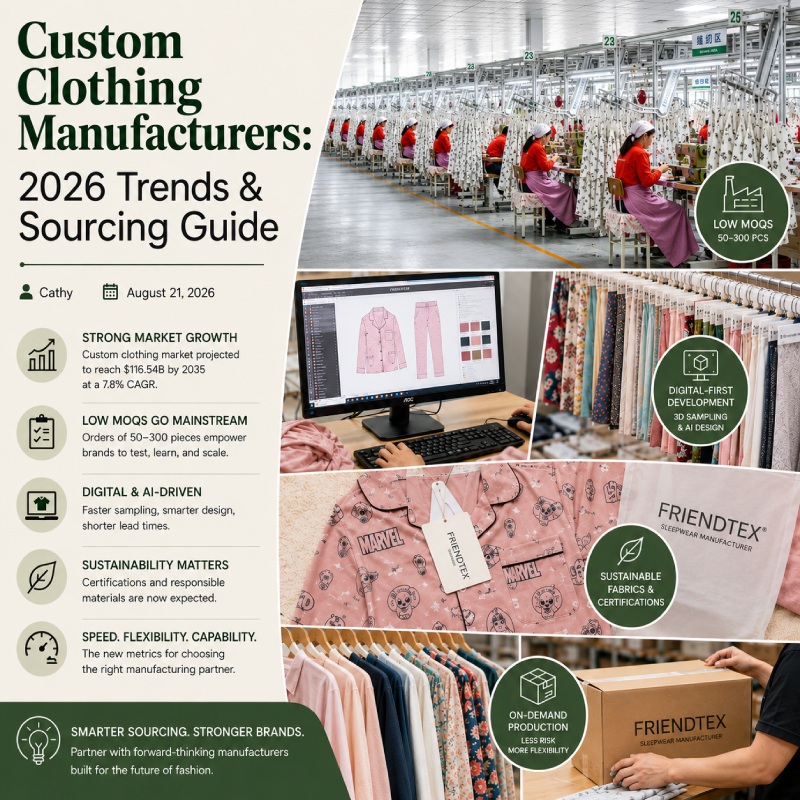
The custom clothing (made-to-measure) market is projected to grow from $59.25 billion in 2026 to $116.54 billion by 2035 — a 7.8% CAGR that reflects the structural shift toward made-to-order production.
Low MOQs have gone mainstream**: manufacturers now routinely accept orders of 50-300 pieces, enabling the test-and-scale playbook that DTC brands depend on.
On-demand and made-to-order production is reducing inventory risk, with brands increasingly ordering only what sells.
Digital-first development — AI-assisted pattern making, 3D virtual sampling, digital tech packs — is now the primary driver of faster lead times and lower sampling costs.
Sustainability is baked into sourcing decisions: sustainable fashion is growing at ~10.8% CAGR, and buyers now treat certifications (OEKO-TEX®, GOTS) as a baseline requirement, not a premium feature.
- The brands winning in 2026 choose manufacturers on speed, flexibility, and digital capability — not price alone.
The Market Context
The Custom Manufacturing Shift by the Numbers
| Metric | Value | Source |
|---|---|---|
| Custom clothing (made-to-measure) market, 2026 | $59.25 billion | Business Research Insights |
| Custom clothing market, 2035 (projected) | $116.54 billion | Business Research Insights |
| Custom clothing CAGR (2026-2035) | 7.8% | Business Research Insights |
| Sustainable fashion market, 2026 | ~$10-11 billion | Roots Analysis / Coherent Market Insights |
| Sustainable fashion, 2040 (projected) | $46 billion (10.81% CAGR) | Roots Analysis |
The headline: custom clothing is a $59 billion market growing at 7.8% — and the growth is being pulled by forces that look structural rather than cyclical. DTC brands, on-demand production models, and digital design tools are all converging on the same conclusion: making less, making it faster, and making it to order is the winning production model.
Why This Matters for Your Sourcing
For an apparel brand — whether you’re launching your first line or expanding an existing one — these trends translate into concrete sourcing decisions: how many pieces to order, how fast you need samples, what certifications matter, and which manufacturer can actually deliver the flexibility the market now demands.
Trend 1: Low MOQs Have Gone Mainstream
The Old Model
Historically, custom clothing manufacturing meant committing to 500-3,000+ pieces per design. That model worked for established brands with predictable demand — and crushed everyone else. A first-time founder couldn’t test a market without risking their entire budget on inventory that might not sell.
The 2026 Reality
Manufacturers now routinely accept MOQs of 50-300 pieces — and the threshold keeps dropping. The change is driven by three forces:
DTC economics: Brands that sell through their own site need small batches to test designs, measure conversion, and scale only what works
On-demand production technology: Digital pattern files and flexible manufacturing cells make small runs economically viable
Supplier competition: With brands demanding flexibility, manufacturers who refuse low MOQs lose the business to those who accept them
What It Means for You
| MOQ Level | What You Can Do With It |
|---|---|
| 50-100 pieces | Test a design with real customers before committing |
| 100-300 pieces | Launch a capsule collection; serve a niche audience |
| 300-1,000 pieces | Scale a proven design; test wholesale accounts |
| 1,000+ pieces | Full-scale production for established SKUs |
The sourcing question to ask: “What’s your MOQ, and does it include sampling?” — because a low bulk MOQ with expensive or slow sampling defeats the purpose. The best partners combine low MOQs with fast, affordable sampling.
Trend 2: On-Demand and Made-to-Order Production
From Forecasting to Responding
The traditional apparel model is built on forecasting: predict demand, order inventory months ahead, and pray the prediction is right. Overproduction is the industry’s dirty secret — estimates suggest up to 30% of produced garments never sell.
On-demand and made-to-order production inverts this: produce only what’s already sold, or in batches small enough to reorder quickly. The benefits:
Zero dead stock: every produced piece has a buyer
Cash flow efficiency: money isn’t locked in unsold inventory
Market responsiveness: best-sellers can be reordered within weeks, not months
Sustainability story: made-to-order is inherently waste-reducing — a message that resonates with the 2026 consumer
The Hybrid Model Most Brands Actually Use
Few brands run 100% on-demand. The practical 2026 model is hybrid: order a small first batch (100-300 pieces) to validate, then use quick-reorder cycles to scale best-sellers. This requires a manufacturer who can:
Hold pattern and material setups between orders
Quote reorders at production speed, not first-order speed
Maintain color and quality consistency across batches
Trend 3: Digital-First Development
The End of the 5-Round Sample Loop
Sampling has historically been the slowest, most expensive part of development — 3-5 physical rounds, each taking 2-4 weeks and costing $200-500 per style. Digital tools have collapsed this loop:
| Digital Capability | What It Does | Impact |
|---|---|---|
| AI-assisted pattern making | Generates base patterns from sketches; learns from pattern libraries | Cuts first-pattern time by up to 70% |
| 3D virtual sampling | Fits garments on avatars before fabric is cut | Reduces physical sample rounds to 1-2 |
| Digital tech packs | Spec sheets generated from 3D/pattern data | Fewer errors, faster factory communication |
| Digital color communication | Calibrated color data replaces verbal descriptions | Fewer color-approval rounds |
For brands, the practical result: development cycles that used to take 3-4 months now take 6-8 weeks — and the first physical sample arrives much closer to final.
The Question to Ask Your Manufacturer
“How many sample rounds does a typical development take — and do you offer 3D virtual fitting?” The answer tells you whether your manufacturer is running a 2020 workflow or a 2026 one. (We cover this in detail in our AI in sleepwear design analysis.)
Trend 4: Sustainability Is Now a Sourcing Requirement
The Certification Baseline
Sustainable fashion is growing at ~10.8% CAGR — more than double the apparel category average. In 2026, that growth has translated into concrete sourcing expectations:
| Certification | What Buyers Expect It To Prove |
|---|---|
| OEKO-TEX® Standard 100 | No harmful substances — the baseline for any skin-contact apparel |
| GOTS | Genuine organic fiber content + responsible processing |
| BSCI / SA8000 | Ethical factory practices and labor standards |
| FSC | Sustainable sourcing (packaging, wood-derived fibers) |
| CPC (children’s) | CPSC flammability compliance for kids’ apparel |
Buyers increasingly treat these as prerequisites, not differentiators. A manufacturer without OEKO-TEX® documentation is simply off the shortlist for most brands — especially those selling in the US and EU.
Made-to-Order Is the New Sustainability Story
Beyond certifications, the production model itself is now part of the sustainability pitch. Made-to-order reduces overproduction waste; low MOQs prevent dead stock; digital sampling saves fabric. Brands marketing sustainability in 2026 can now point to their supply chain design — not just their fabrics — as evidence.
Trend 5: The Private Label Explosion
DTC Brands Reshaping the Supplier Landscape
The rise of direct-to-consumer brands — thousands of small, focused labels launched annually — has fundamentally changed the customer base of apparel manufacturers. The 2026 manufacturer serves:
First-time founders launching a 5-style capsule
Influencers converting audiences into brands
Established DTC brands expanding into adjacent categories
Retailers building exclusive private-label lines
Each of these customers needs the same thing: custom design support, low MOQs, fast sampling, and the ability to iterate based on market feedback. The manufacturer who serves this segment well is the one who wins the decade’s growth.
What Private Label Buyers Look For
Design support: pattern-making and sampling that works from rough ideas, not just complete tech packs
Transparency: honest lead times, clear pricing, no hidden costs
- Responsiveness: fast answers to emails and revision requests
Quality consistency: the same standard on a 100-piece order as on a 5,000-piece order
- Scalability:a partner who can grow with you from capsule to container
Trend 6: The One-Stop Factory
The End of Fragmented Sourcing
Brands used to juggle multiple vendors: one for fabric, one for sampling, one for production, one for labels and packaging. The 2026 trend is consolidation — one factory that handles pattern-making, sampling, bulk production, finishing, and packaging under one roof.
The benefits are real:
Fewer handoffs —fewer quality and communication failures
Faster turnaround — no waiting for a third-party finisher
Lower cost — no middleman margins
Better consistency — the same team controls every stage
Easy to clean and maintain
The sourcing question: “Do you handle everything in-house — pattern, sampling, production, finishing, packaging?” A genuinely integrated factory answers with confidence and evidence.
Trend 7: Compliance as a Competitive Requirement
The Documentation Standard
Compliance documentation was once something only large retailers demanded. In 2026, DTC brands — who face liability directly and who market to safety-conscious consumers — demand it as standard:
OEKO-TEX® certificates for every fabric
GOTS documents for organic lines
GCC/CPC and flammability certificates for kids’ apparel
Test reports (shrinkage, colorfastness, strength) for key materials
The 2026 buyer expectation: complete documentation, proactively provided, for every order. A manufacturer who treats compliance as an afterthought is a liability; one who treats it as standard practice is a partner.
What This Means for Your 2026 Sourcing Strategy
The New Manufacturer Checklist
When evaluating custom clothing manufacturers in 2026, the decision criteria have expanded:
| Criterion | 2020 Thinking | 2026 Thinking |
|---|---|---|
| MOQ | 1,000+ pieces | 50-300 pieces, flexible |
| Sampling | 3-5 physical rounds | 1-2 rounds + 3D virtual fitting |
| Lead time | 3-4 months | 6-10 weeks for development |
| Certifications | Nice to have | Baseline requirement |
| Model | One big seasonal order | Test → scale → reorder cycles |
| Scope | Fabric or production only | One-stop: pattern through packaging |
The Three Questions That Decide
“What’s your minimum order, and does it work for a test capsule?” — tests flexibility
“How many sample rounds, and do you do 3D fitting?” — tests digital capability
“What certifications do you hold, and what documentation ships with an order?” — tests compliance readiness
A manufacturer who answers all three with specifics — not sales talk — is a 2026-ready partner.
How Friendtex Matches the 2026 Trends
At Friendtex, we’ve spent 15+ years adapting our manufacturing model to what brands actually need — and the 2026 trends are where we operate:
Low MOQs: From 300 pieces per design, with sampling support that lets you test before committing — the test-and-scale playbook, in practice
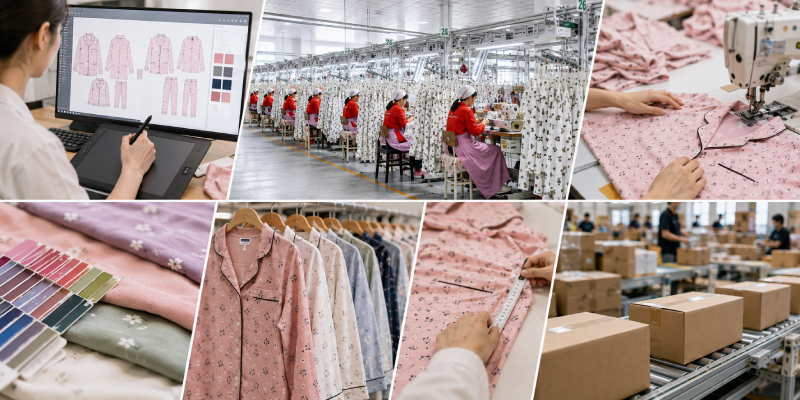
One-stop capability: Pattern-making, sampling, bulk production, finishing, and packaging under one roof — no fragmented sourcing
Digital-first development: AI-assisted pattern generation and 3D virtual fitting reduce sample rounds (see our AI in sleepwear design analysis)
Certified standard: OEKO-TEX® Standard 100, GOTS organic cotton, BSCI — with full documentation shipped with every order
Children’s compliance: CPC and flammability certificates for kids’ and family apparel
- Category breadth: Sleepwear, robes, nightgowns, underwear, nursing — one partner for your entire line
If you’re planning a capsule launch, expanding a DTC line, or evaluating manufacturers for 2026-2027, contact our team — we’ll walk you through how our production model fits your plan.
FAQ
What does MOQ mean in clothing manufacturing?
MOQ (Minimum Order Quantity) is the smallest number of pieces a manufacturer will produce per design. In 2026, the range has dropped dramatically — many manufacturers now accept 50-300 pieces, enabling small-batch testing that wasn’t possible when 1,000+ was the norm.
Why are MOQs dropping in 2026?
Three forces: DTC brands need small batches to test designs before scaling; on-demand production technology makes small runs economically viable; and supplier competition means manufacturers who refuse low MOQs lose business to those who accept them. The result is a market where flexibility is the new competitive advantage.
What is on-demand clothing manufacturing?
On-demand (or made-to-order) production means garments are produced only after they’re sold — or in batches small enough to reorder quickly. It eliminates dead stock and overproduction, improves cash flow, and has become a sustainability story in its own right. Most brands run a hybrid model: small first batches to validate, quick reorders to scale.
How is AI changing custom clothing manufacturing?
AI accelerates the development front end: AI-assisted pattern making generates base patterns up to 70% faster, 3D virtual sampling replaces physical sample rounds, and digital tech packs reduce errors. The result is development cycles that dropped from 3-4 months to 6-10 weeks, with fewer physical samples.
What certifications should a custom clothing manufacturer have?
OEKO-TEX® Standard 100 is the baseline for skin-contact apparel. GOTS for organic lines, BSCI for ethical practices, and — for kids’ apparel — CPC/flammability certificates (16 CFR 1615/1616 in the US). In 2026, buyers treat these as prerequisites and expect documentation to ship with every order.
What’s the difference between private label and custom manufacturing?
Private label means producing a product under your brand using existing or semi-custom designs; custom manufacturing means creating garments to your specifications — your patterns, fabrics, and details. Most DTC brands start with private-label-style development and move toward fully custom as they grow.
How do I choose a clothing manufacturer in 2026?
Evaluate on four axes: MOQ flexibility (can they do a test capsule?), digital capability (3D fitting, sample rounds), certifications (OEKO-TEX®/GOTS/compliance documents), and scope (one-stop vs. fragmented). Then ask for references and a sample of their documentation — a 2026-ready manufacturer answers with specifics, not promises.