Every sleepwear brand faces the same fork in the road: do we design our own pajamas from scratch, or adapt what the factory already makes? The industry calls these two paths OEM and ODM — Original Equipment Manufacturing and Original Design Manufacturing — and the choice between them shapes everything downstream: your development budget, your time to market, your level of design control, and even your legal protection. There’s no universally “right” answer — only the right answer for your brand’s stage, budget, and ambition.
Key Takeaways
- OEM (Original Equipment Manufacturing) means you bring the design: your patterns, your tech pack, your specifications. The factory makes exactly what you design. Maximum control, higher development cost, longer lead time.
- ODM (Original Design Manufacturing) means the factory brings the design: you select from existing styles and customize them — fabric, color, trim, branding. Faster and cheaper to start, less design exclusivity.
- Private label and white label sit alongside these: private label is your brand on a product made for you; white label is a generic product any brand can rebrand.
- The choice drives your cost structure: full-package OEM development can run significantly higher than CMT-style or ODM alternatives — you’re paying for design ownership.
- Most successful brands sequence the models: start with ODM to launch fast and learn the market, then move to OEM once a design proves itself and exclusivity becomes worth the cost.
- The decision isn’t permanent — but switching models means changing how you work with your factory, so choosing deliberately the first time saves months.
Defining the Four Models
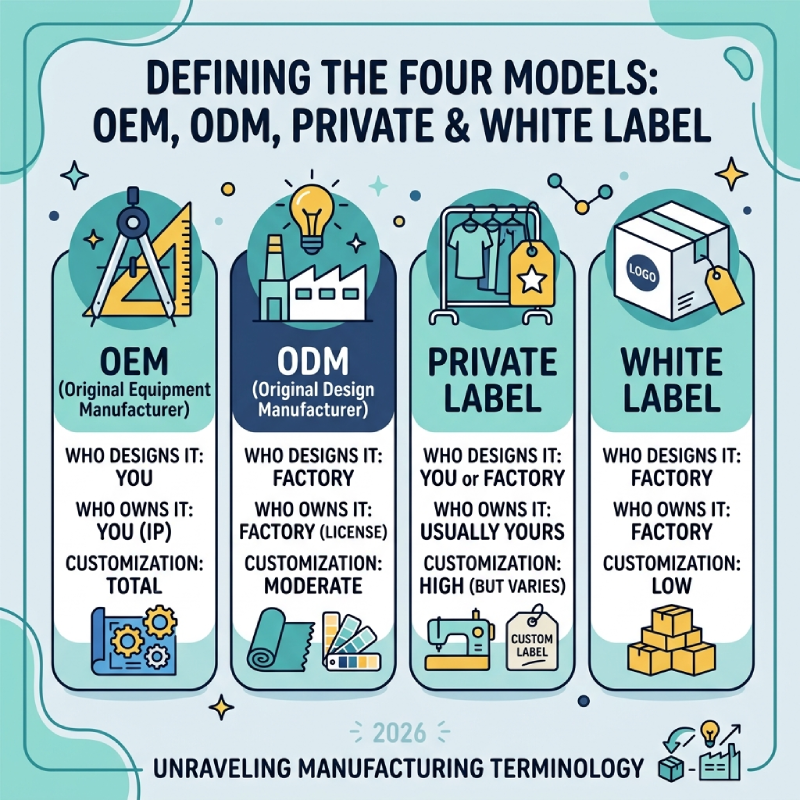
The terminology gets muddled across the industry, so let’s set clean definitions:
| Model | Who Designs It | Who Owns the Design | Your Customization Level |
|---|---|---|---|
| OEM | You | You (with a proper agreement) | Total — your patterns, your specs, your IP |
| ODM | Factory | Factory (you license the use) | Moderate — fabric, color, trim, branding |
| Private Label | You or factory | Usually yours (varies) | High — but often built on factory base styles |
| White Label | Factory | Factory | Low — rebrand an existing generic product |
In practice, most brands operate somewhere on a spectrum. A “private label” program might be built on ODM base styles with custom fabric and branding — or it might be true OEM with entirely original patterns. The labels matter less than the underlying question: who owns the design, and how much control do you have over it?
OEM vs ODM: The Core Trade-offs
The two models look similar on paper but differ in nearly every dimension that matters to a brand:
| Dimension | OEM | ODM |
|---|---|---|
| Development cost | Higher — you pay for pattern-making, sampling rounds, and revisions | Lower — the factory amortizes design cost across many customers |
| Time to market | Longer — 6 to 17 days for first samples, then revisions, then production | Shorter — sample selection can happen in days, not weeks |
| Design exclusivity | Full — your pattern is yours alone | Partial — your version is unique, but the base style may be sold to other brands |
| Risk of mismatched expectations | Higher — sampling rounds can drift if tech packs are vague | Lower — you’re working from a known, factory-validated style |
| IP protection | Requires a written agreement and clear design ownership | Inherent in the model — factory already owns the design |
| MOQ | Varies, often higher per style because each style is a fresh setup | Often lower per style because tooling and patterns already exist |
| Best for | Brands with a clear design vision and budget to protect it | New brands, market tests, capsules, and any launch where speed matters more than exclusivity |
Note on CMT (Cut, Make, Trim): sometimes listed as a fourth model, CMT is technically a sub-type of OEM where you supply the fabric and the factory only cuts, sews, and trims. CMT pricing is lower but you take on fabric sourcing, which is its own rabbit hole — minimum fabric orders, dye-lot consistency, and quality control all become your problem.
How OEM Development Actually Works
If you go the OEM route, here is what a realistic OEM development cycle looks like — using Friendtex as a concrete example of how the timeline compresses when a factory has digital-first development infrastructure:
Stage 1 — Tech pack intake (Day 0 to Day 3)
You send a complete tech pack: flat sketches, measurement spec sheet, grading rules, fabric composition and weight, color references (Pantone or lab dips), construction notes, trim specs. The more complete your tech pack, the fewer rounds later. At Friendtex, our pattern makers review and confirm the pack within 48 to 72 hours.
Stage 2 — Pattern refinement and proto sample (Day 6 to Day 10)
Our pattern makers refine your specs and cut a first sample. First samples ship in 6 to 10 days for standard sleepwear. This is where the “first version is rarely the last version” reality of OEM becomes tangible — expect 2 to 3 proto rounds before the sample is production-ready.
Stage 3 — Fit, photo, and final approval (Day 10 to Day 17)
You receive the sample, try it on your fit model, write fit comments, send them back. We adjust the pattern, produce a second proto. For most styles, samples reach pre-production approval within 6 to 17 days total, depending on the complexity of the design and how clear your comments are.
Stage 4 — Production (Day 30 to Day 60 after final sample)
Once you sign off on the sample, bulk production begins. Standard lead time is 30 to 60 days for bulk production, depending on fabric availability, order quantity, and surface decoration (printing, embroidery, special trims add time).
Realistic OEM timeline from tech pack to delivered goods: roughly 8 to 14 weeks for a first order, faster for repeat orders where the pattern is already locked.
If you don’t have a tech pack yet, ODM is almost always the better starting point — and that’s exactly what the ODM model is designed for.
When ODM Is the Right Starting Point
ODM works best when:
- You’re launching a new brand and need a market presence in the next 60 to 90 days
- You don’t yet have a clear design vision, or your vision is more “elevated basics” than “signature design”
- You want to test a category (e.g., women’s sleepwear vs. loungewear) before committing to a full custom development cycle
- Your budget doesn’t support the development cost of a full custom collection
- You’re building a capsule or seasonal drop around proven silhouettes
A real ODM catalog gives you a range of base styles so you can pick what fits your brand positioning — and the best catalogs are organized around fabric families, because fabric is the first thing your customer will feel.
For example, the current Friendtex sleepwear ODM catalog (July 2026 collection) organizes 21 base styles across these fabric families:
| Fabric Family | Composition | Knit / Weave | Hand Feel | Best For |
|---|---|---|---|---|
| Stretch rib essentials | 95% Polyester / 5% Elastane | 2×2 rib | Smooth, light stretch | All-season basics, prints, stripes, dots |
| Cool-touch performance | 95% Polyester / 5% Spandex | Cool touch yummy | Cool, buttery, drapey | Summer, hot-sleepers, menopause market |
| Yummy cotton-feel | 95% Polyester / 5% Spandex | Yummy | Soft cotton-like, matte | Elevated everyday, gift market |
| Viscose woven | 100% Viscose | Woven | Fluid, breathable, drape-forward | Summer nightgowns, lightweight sets |
| Viscose single jersey | 95% Viscose / 5% Spandex | Single jersey | Soft, fluid, breathable | V-neck sets, drapey silhouettes |
| Pointelle knit | 85% Polyester / 15% Viscose | Pointelle | Openwork, feminine, breathable | Romantic/lace look without lace cost |
| Cotton-rich jersey | 60% Cotton / 40% Polyester | Single jersey | Soft, easy-care | Men’s basics, unisex sets |
| Cotton poplin | 60% Cotton / 40% Polyester | Poplin | Crisp, lightweight, structured | Men’s summer sets, contrast trim details |
That last column — “best for” — is where ODM customization usually starts. You pick a base style from the catalog (e.g., a women’s cami-and-short set in the cool-touch fabric), then customize: swap the color, add contrast piping, embroider your logo on the chest pocket, change the button color. The factory’s design team can also tweak the pattern within the existing style — adjust the short inseam, change the neckline depth, add a sleeve — for an additional sampling fee.
A 21-style ODM catalog organized this way covers roughly 80% of what a new sleepwear brand needs to launch. The remaining 20% — your signature details, your branded trims, your exclusive prints — is where you can start layering OEM development on top of the ODM base, without paying for a full pattern from scratch.
The Hybrid Path: How Most Brands Actually Grow
In practice, very few brands stay in pure ODM or jump straight to pure OEM. The more common trajectory is hybrid:
Phase 1 (launch) — ODM with custom branding. You select 3 to 5 base styles from the ODM catalog, customize fabric color and trim, add your woven labels and branded packaging. Low risk, fast to market, low inventory commitment. This is where most independent brands and Amazon FBA sellers start.
Phase 2 (prove it) — ODM with custom details. Once you know which styles sell, you start customizing more aggressively: exclusive prints developed with the factory’s design team, custom buttons and trims, branded piping. Still ODM in structure, but with a unique identity that other brands in the ODM catalog can’t replicate.
Phase 3 (own it) — OEM for hero styles. When a design proves itself — when it becomes the “reason people buy from you” — you invest in making it truly yours: original pattern, exclusive fabric, full IP. At this stage, OEM development is justified by the sales volume the hero style generates.
A European boutique brand in our partner network ran this exact path. They launched with five ODM cami sets in 2024, learned that their customer responded to muted neutrals and a specific short inseam, then in 2025 developed a custom ODM program with three exclusive color stories and branded trims. By 2026, they had moved their best-selling style — a women’s short set — into full OEM, with an original pattern, a custom-developed viscose-poly blend, and a co-branded fabric label. Same factory relationship, three different manufacturing modes over 24 months.
The point isn’t that every brand should follow this exact path. The point is that the model you start with is not the model you have to stay in — and a factory that’s good at both OEM and ODM is the kind of partner that lets you transition as your brand grows.
How to Evaluate a Sleepwear Factory (5 Questions to Ask)
Before you commit to OEM or ODM with any factory, ask these five questions. Their answers will tell you more than any sales pitch or marketing page.
1. Show me your development timeline with stage gates.
A confident factory will answer in days, not vague phrases like “around a month.” You want specifics: “First samples in X days, revisions in Y days, bulk in Z days.” Friendtex publishes this — first samples in 6 to 10 days, sampling rounds complete in 6 to 17 days, bulk in 30 to 60 days. If a factory can’t answer this clearly, they probably can’t manage it clearly.
2. Can you share an OEM tech pack example or template?
A factory that does real OEM has a tech pack template they’ve refined over dozens of brands. If they don’t have one — or worse, tell you to “just send sketches” — they’re not set up for serious OEM work.
3. Walk me through how you handle a sample revision cycle.
OEM always involves revisions. The question isn’t whether revisions will happen but how they’re managed: how revisions are documented, who pays for additional sample rounds, what the timeline is. A good factory has a clear revision process with photos, written notes, and version tracking.
4. What’s your MOQ per style, per color, and per size run?
ODM usually has lower MOQs because the pattern already exists. OEM MOQs depend on the fabric minimum (most knit fabrics have a 50 to 100 kg dye-lot minimum, which translates to roughly 200 to 500 pieces per color). Ask for the full breakdown — style, color, and size — so you can model your inventory commitments.
5. Can I see a sample of a similar style you’ve already produced?
This is the single best predictor of what you’ll get. Ask for a sample of a comparable fabric, weight, and silhouette to what you want. If they can show you a finished, production-quality sample in 48 hours, they’re organized. If they need to “make one for you,” they’re not.
Friendtex: An OEM + ODM Partner for Sleepwear Brands
Friendtex is a sleepwear and underwear manufacturer based in Shandong, China, with 20+ years of production experience for global sleepwear, loungewear, and underwear brands. We run both OEM and ODM programs out of the same facility, which means a brand can start with ODM and transition to OEM without changing factories.
- OEM support: We work from your tech pack — our pattern makers refine your specs, sampling rounds run 6 to 17 days for first approval, and bulk production is 30 to 60 days. Standard sleepwear MOQs start at 300 pieces per design per color, with lower MOQs available for repeat orders. Production runs under OEKO-TEX® Standard 100 certified processes, and the factory holds BSCI, SEDEX, and GOTS certifications.
- ODM support: Our in-house design team maintains the current 21-style base catalog (2026.07 collection) organized across 8 fabric families (see table above) — covering women’s cami sets, button-front PJ sets, nightgowns, pointelle romantics, and men’s cotton-rich jersey sets. You select the base style, then customize fabric color, contrast piping, button/trim, branded labels, and packaging.
- Transition support: We support brands moving from ODM to OEM as their hero styles mature — pattern ownership transfers cleanly, fabric developments can be carried over, and the production team that ran your ODM orders runs your OEM orders too.
A note on Merino and other specialty fibers: This guide focuses on the polyester, viscose, and cotton families that make up the bulk of our sleepwear ODM catalog. If your brand is built around Merino wool, silk, or other specialty fibers, the development cycle is longer and the MOQs higher — talk to us before assuming either model applies. The ODM catalog above is not a Merino catalog.
For technical questions or to request an ODM lookbook, contact helen@friendtex.com.cn.
Frequently Asked Questions
What’s the difference between OEM and private label?
In strict usage, OEM means you own the design and the factory makes it. Private label means you put your brand on a product — which may have been designed by you, by the factory, or by a third party. In practice, the labels overlap and many brands use the terms interchangeably. The legal question is always: who owns the IP?
How much does OEM development cost compared to ODM?
ODM development is usually included in the unit price or charged as a small one-time fee. OEM development includes pattern-making (often $200 to $800 per style, depending on complexity), sampling rounds (typically 2 to 4 rounds at $30 to $100 per sample), and any fabric or trim development. The total OEM development cost for a single style is usually $500 to $2,000 before any bulk order — which is why sequencing ODM first, then moving to OEM for proven styles, is so common.
Can I do OEM without a tech pack?
Technically yes — a good factory’s design team can help you develop a tech pack — but it adds cost and time. If you’re starting from a sketch or a reference photo, expect to pay for “tech pack development” as a service, and budget an additional 1 to 2 weeks before the sampling cycle begins. If you have a clear vision but no technical drawing skill, hire a freelance tech pack designer — the investment pays for itself in fewer sample rounds.
How long does it take to switch from ODM to OEM for an existing style?
Once your ODM style is in production, switching to OEM is faster than starting from scratch. Pattern refinement takes 1 to 2 weeks, first sample 6 to 10 days, and approval in 6 to 17 days total. The real time sink is exclusive fabric development if you want a custom blend — add 4 to 8 weeks for fabric sourcing, lab dip, and bulk fabric production.
What’s a realistic MOQ for a new sleepwear brand?
For ODM, MOQs typically start at 200 to 500 pieces per style per color. For OEM, MOQs are usually higher — 300 to 1,000 pieces per style per color — because each style is a fresh setup. The most common mistake new brands make is over-ordering to “hit MOQ” and getting stuck with slow-moving inventory. Start smaller, validate, then scale.
What does a tech pack need to include?
A complete tech pack includes: flat sketches (front and back), measurement spec sheet with tolerances, grading rules across the size run, BOM (bill of materials: fabric composition, lining, trims, labels, packaging), color references (Pantone TPX or lab dips), construction notes (stitch type, seam allowance, topstitch details), and care label requirements.
How to Choose: A 2-Minute Decision Tree
Answer these questions in order — the first one that lands on “Yes” tells you which model to start with:
- Do you have a clear, original design vision that’s central to your brand? → OEM (and accept the development cost and timeline)
- Do you have a vision but no tech pack or pattern-making experience? → OEM with factory’s design development service
- Do you just want to launch a solid sleepwear line quickly, with your branding on quality basics? → ODM with custom branding
- Are you testing a category or running a capsule drop? → ODM, lowest commitment
- Are you reselling under your own label at scale (Amazon, retail) and the product itself is not the differentiator? → Private label on ODM base styles
The only wrong choice is making the decision without seeing actual samples and asking the five questions above. A 15-minute call with a factory’s sales team — and a $50 sample order — will tell you more than any guide.