The first time many new importers see the full cost of shipping pajamas from China, it is on the customs broker’s invoice — after the goods have sailed. Freight, documentation, and compliance decisions that were never discussed at the quotation stage all surface at once, and they can add 10–25% to the landed cost of a program.
Shipping sleepwear is not complicated, but it has its own logic: the goods are light and bulky, the compliance rules sharpen the moment kids’ sizes enter the carton, and the difference between Incoterms decides who pays for every step between our sewing floor and your warehouse. Here is the complete picture, from the factory side, so nothing on that broker invoice is ever a surprise again.
What Is Actually Inside the Carton
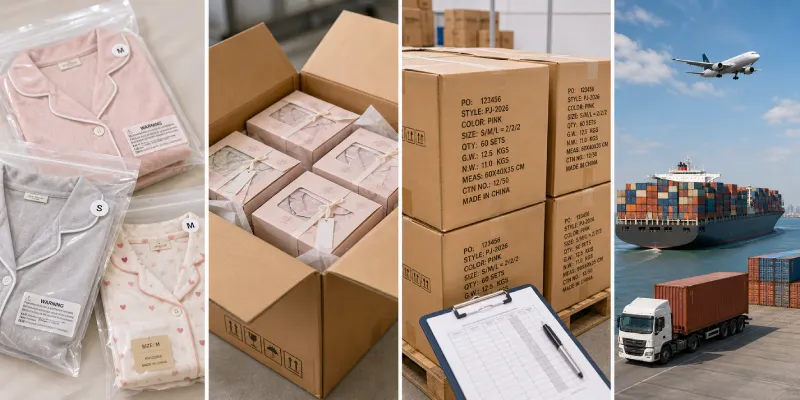
Before anything ships, each garment travels through three levels of packing:
- Poly bag (individual). Each set is folded into a poly bag with a size sticker. For children’s sleepwear sold in the US, that bag carries a suffocation warning, and the garment itself must carry a CPSIA tracking label — more on compliance below.
- Inner box (optional). Retail-ready programs often specify individual printed boxes or tissue; this can double packing time per carton, so it must be agreed at the quotation stage.
- Master carton. Standard export cartons are 5-ply corrugated, typically 50–80 sets per carton depending on the style, with shipping marks (PO number, style, color, size ratio, carton number, CBM, gross weight) printed on three sides.
Two details worth insisting on: a size ratio inside every carton (e.g., S/M/L = 2/2/2) so you can pick mixed cartons at your warehouse, and carton numbers in sequence so a partial delivery can be checked against the packing list in minutes.
Carton Math: How Many Pajamas Fit in a Container?
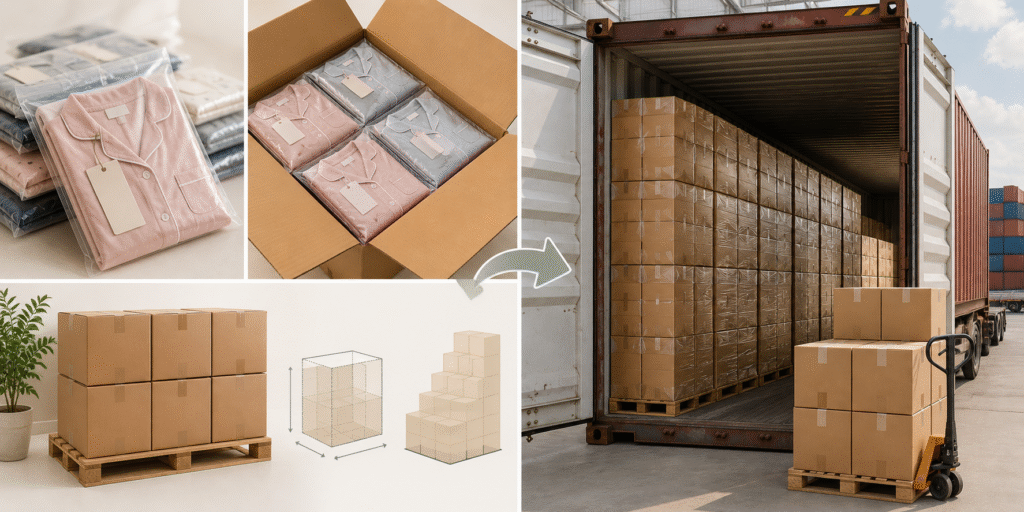
Sleepwear is a “cubing-out” cargo: containers fill up by volume long before they hit weight limits. A worked example:
- One folded set in a poly bag: ~0.35 kg, folded footprint roughly 30 × 25 × 5 cm
- One master carton 60 × 40 × 40 cm = 0.096 CBM, holding ~50 sets → ~18 kg gross per carton
| Container | Usable volume | Cartons (60×40×40) | Approx. pajama load |
|---|---|---|---|
| 20 GP | ~28 CBM | ~260–280 | ~13,000–14,000 sets / ~5 t |
| 40 GP | ~58 CBM | ~540–560 | ~27,000–28,000 sets / ~10 t |
| 40 HQ | ~68 CBM | ~630–650 | ~31,000–32,500 sets / ~12 t |
Real loads run lower than the theoretical maximum — cartons are not perfect cubes, and mixed styles need sorting space — so we plan on 90–95% fill. If you are shipping one style at 50 sets per carton, the arithmetic above is nearly exact; with 12 styles and 4 colors, expect a few “part cartons” and plan the container accordingly.
Incoterms: Who Pays for What
The Incoterm on the quotation decides where the factory’s responsibility ends. The four you will actually encounter:
| Term | Factory delivers | You handle | Best for |
|---|---|---|---|
| EXW (Ex Works) | Goods packed at our gate | Everything: trucking, customs, freight | Importers with a China-based agent |
| FOB (Free on Board) | Loaded on the vessel at the Chinese port | Ocean freight, insurance, destination costs | Most first-time and mid-size importers |
| CIF (Cost, Insurance, Freight) | Ocean freight + insurance to your port | Destination customs, duties, delivery | Buyers who want one fewer negotiation |
| DDP (Delivered Duty Paid) | All the way to your door, duties included | Almost nothing | Buyers testing the waters, small orders |
We quote most programs FOB from Qingdao, our local port in Shandong. FOB is the sweet spot for new importers: you (or your forwarder) control the ocean freight and destination costs — where margins hide — while the factory handles export customs and container loading.
DDP looks tempting, but remember that the factory is not a licensed customs broker in your country; DDP quotes bundle third-party costs with a safety margin, and you lose visibility. If you want DDP-level simplicity, ask your forwarder to quote the destination leg against our FOB offer and compare.
HS Codes: Getting Sleepwear Through Customs
Every pajama shipment is classified under the Harmonized System, and sleepwear’s codes split four ways: knitted vs. woven, and men’s vs. women’s. The six-digit international codes are:
| Product | Knitted (Ch. 61) | Woven (Ch. 62) |
|---|---|---|
| Women’s/girls’ nightdresses & pajamas | 6108.31 cotton / 6108.32 man-made fibres / 6108.39 other | 6208.21 cotton / 6208.22 man-made fibres |
| Men’s/boys’ nightshirts & pajamas | 6107.21 cotton / 6107.22 man-made fibres | 6207.21 / 6207.22 |
| Babies’ sleepwear (under ~86 cm) | 6111 (e.g., 6111.20 cotton) | 6209 |
| Bathrobes / dressing gowns | 6108.91–.99 | 6208.91–.99 |
Three practical notes from twenty years of export paperwork:
- Knit vs. woven decides the chapter. The vast majority of modern sleepwear — jersey, rib, pointelle — is knitted (Chapter 61). Woven viscose sets go to Chapter 62. Classify by the fabric construction, not the garment’s look.
- Robes are not pajamas in customs terms. A bathrobe in the same program needs its own line on the invoice under 6108.9x/6208.9x.
- Your country adds digits. The six-digit code is international; the US (HTS), EU (CN), and others add national digits that determine duty. Duty rates vary by line — some cotton knits land in single digits, many man-made fibre lines run mid-teens — so confirm the exact rate with your broker against the current schedule before you price your retail.
Misclassification is not a shortcut; it is the most common cause of customs holds and retroactive duty bills. We declare by actual fabric composition on every invoice.
The Paperwork That Rides with the Shipment
A standard ocean shipment from us includes:
- Commercial invoice — values, HS codes, Incoterm
- Packing list — carton-by-carton contents, weights, CBM
- Bill of lading (B/L) — issued by the carrier; also the document your bank may require under letter of credit
- Certificate of origin — where a trade agreement gives you a reduced duty (worth asking: several markets have China FTA rates that cut duty meaningfully)
- Test reports — for regulated categories, on request
The Compliance Layer: Especially for Kids’ Sleepwear
Adult sleepwear is straightforward. Children’s sleepwear is a regulated product in most Western markets, and the paperwork starts at the factory:
- United States: children’s sleepwear (sizes 9 months–14) must meet flammability standards 16 CFR 1615/1616 — either pass flame-resistance testing or qualify for the snug-fitting exemption (with the required yellow hangtag). The CPSIA tracking label (permanent label with batch/lot info) is mandatory on the garment.
- European Union: children’s nightwear falls under EN 14878, with different requirements for nightwear vs. “loose” daywear used as sleepwear.
If your program includes kids’ sizes, tell the factory at the quotation stage — testing happens on fabric lots before cutting, not after sewing. We covered the general inspection framework in our quality control checklist; flammability is the one test that cannot be retrofitted.
Sea, Air, or Express: Choosing the Mode
| Mode | Door-to-door from Qingdao | Relative cost | Best for |
|---|---|---|---|
| Sea freight (FCL) | US West Coast ~3–4 weeks; US East Coast / North Europe ~5–6 weeks, incl. customs & delivery | 1× (baseline) | Bulk production |
| Sea freight (LCL) | +1–2 weeks consolidation | ~1.5–2× FCL per CBM | Sub-container programs |
| Air freight | ~5–8 days | ~8–12× sea per kg | Urgent top-ups, launch quantities |
| Express (DHL/FedEx) | 3–5 days | Highest per kg | Samples, PP samples, documents |
Sleepwear’s low weight-to-volume ratio is your friend at sea and your enemy in the air: a 40 HQ container of pajamas weighs about 12 tons, but those same sets cost a fortune by air. The disciplined pattern we see among good buyers: book sea freight for bulk, and keep a small air-freight budget (5–10% of units) for reorders of early bestsellers.
A Realistic Door-to-Door Timeline
Qingdao → Los Angeles, FOB, 40 HQ, confirmed order to warehouse:
- Week 0 — PO confirmed, deposit received, fabric booked
- Weeks 1–2 — fabric in-house, cutting starts
- Weeks 2–6 — sewing, inline QC, finishing
- Week 6 — final inspection passed, cartons sealed, booking confirmed
- Week 7 — container loaded, export customs cleared, vessel sails
- Weeks 9–10 — vessel arrives at LA/Long Beach
- Weeks 10–12 — customs entry, duties paid, drayage to warehouse
Twelve weeks from PO to shelf — which is exactly why the sourcing calendar matters, and why “just-in-time” works only for the second order of a program whose fabric is already stocked.
Frequently Asked Questions
How much does it cost to ship a container of pajamas from China?
Ocean rates move with the market, so ask your forwarder for the current week — but budget by ratio: a full 40 HQ from North China to North America or Europe is typically a mid-three to four-figure sum per container in normal years, which works out to a small fraction of a dollar per garment.
What Incoterm should a first-time importer use?
FOB. You control the freight leg where margins are decided, while the factory handles export customs and loading. EXW only makes sense with a China-based agent; DDP bundles too many third-party costs.
What HS code are pajamas?
Knitted women’s/girls’ nightdresses and pajamas: 6108.31 (cotton) or 6108.32 (man-made fibres); knitted men’s/boys’: 6107.21/6107.22; woven equivalents sit in 6208/6207; babies’ garments in 6111. The six-digit code is international — your broker applies the national digits and duty rate.
Do I need special certificates to import children’s pajamas?
For the US: flammability compliance (16 CFR 1615/1616 or the snug-fit exemption) and CPSIA tracking labels. For the EU: EN 14878. Ask the factory to run these tests on the fabric lot before bulk cutting.
Can I mix styles in one container?
Yes — mixed-style loading is normal. Keep the size ratio consistent per carton and the packing list clean, and your warehouse can receive it without a sorting project.
Ship the Next Program on Schedule
If you have a sleepwear program in the pipeline, send us the styles, quantities, and destination port — we will come back with an FOB quote, a carton plan, and a production schedule that lands before your selling window opens.