Every November, my inbox fills with the same message: “Can you make 20,000 sets of matching family pajamas and deliver them to Europe by the end of November?” The answer is almost always no — not because we don’t want the order, but because a sleepwear sourcing calendar exists whether buyers follow it or not. The brands that follow it get factory capacity at normal prices. The brands that ignore it pay air-freight premiums and still miss their launch window.
After two decades of running production schedules for sleepwear brands and retail chains, I want to lay out the calendar the way we actually live it on the factory floor: when to develop, when to sample, when to place the order, and when to ship — for spring/summer and fall/winter lines alike.
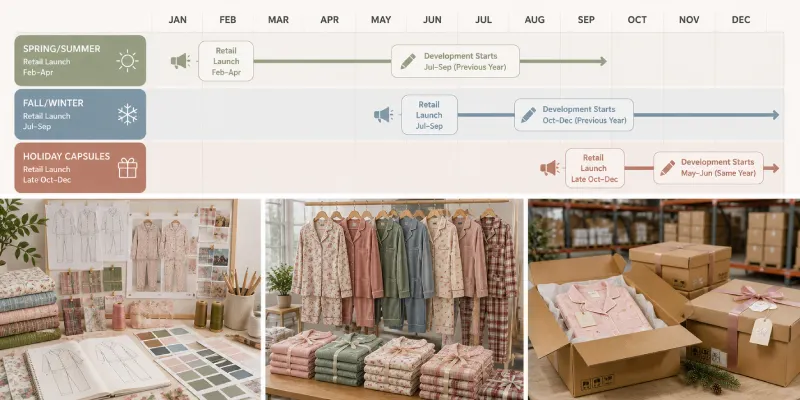
Two Seasons, Two Production Windows
Sleepwear retail runs on two main selling windows, and factory capacity is planned around them:
- Spring/Summer (SS): retail launch February–April. Development starts July–September of the previous year.
- Fall/Winter (AW): retail launch July–September. Development starts October–December of the previous year.
On top of those, there is a third, non-negotiable window: holiday capsules (Christmas, matching family programs, gift sets). These sell from late October, but they are produced in the middle of the year — and they compete with AW bulk for the same sewing lines.
The pattern to remember: the factory calendar runs roughly six months ahead of the retail calendar. If your launch date is fixed, everything else must be planned backwards from it.
Reverse-Planning from Your Launch Date
Here is the timeline we recommend to every brand, using our real production numbers (sampling runs 6–17 days depending on complexity; bulk production runs 30–60 days depending on order size and decoration):
| Working backwards from launch | Time needed | What happens |
|---|---|---|
| Retail launch | Day 0 | Goods on the floor (or online) |
| Land + receive | −2 to −4 weeks | Sea transit, customs, QC on arrival |
| Ship ex-factory | −6 to −10 weeks | Final inspection passed, cartons sealed |
| Bulk production | −14 to −22 weeks | Cutting, sewing, finishing, inline QC |
| Order confirmed | −18 to −26 weeks | Deposit paid, materials booked |
| Samples approved | −22 to −32 weeks | 1–3 sampling rounds, fit finalized |
| Line development | −30 to −40 weeks | Fabrics, colors, styles selected |
A simple rule of thumb: start developing an SS line in July–August; start AW in October–November. Buyers who start development three months before launch are not shortening the process — they are removing their own options, one by one: the good fabric lots are gone, the decoration capacity is booked, and the shipping schedule is tight.
Lead-Time Budgets by Program Type
The reverse-planning table above describes a new program. Most buyers run a mix of program types, and each has its own budget:
| Program type | Development → launch | Order → ex-factory | What drives it |
|---|---|---|---|
| New line (new fabrics, new fits) | 5–7 months | 30–60 days | Sampling rounds + fabric pipeline |
| Repeat program, stocked fabric | 2–3 months | 30–45 days | Greige already on the shelf |
| Holiday capsule (new styles) | 4–5 months | 45–60 days | Ratios across men’s/women’s/kids’ + compliance |
| In-season top-up (air freight) | 2–4 weeks | 15–25 days | Must reuse approved styles and stocked fabric |
The second line is the quiet profit-maker: a repeat order on stocked fabric skips the two longest stages entirely — fabric procurement and sampling — which is why our longest-running partners reorder every one to two months instead of twice a year. If you plan to reorder, say so at the quotation stage; fabric stocking is negotiated once, then saves weeks on every order after it.
The Month-by-Month Sleepwear Sourcing Calendar
Here is the same logic laid out across a full year. Adjust by a few weeks depending on your market and launch dates.
| Month | What you should be doing |
|---|---|
| January | Approve AW samples; confirm AW bulk orders before Chinese New Year freezes capacity (see below) |
| February | CNY transition — factories restart mid-month; AW orders in the queue get first capacity |
| March | AW bulk in production; SS development briefs go out (fabric direction, color stories) |
| April | AW bulk shipping; SS fabric selection and proto samples |
| May | SS samples approved; SS orders confirmed; holiday capsule development begins |
| June | SS bulk in production; Christmas pajama orders must be confirmed by now |
| July | SS bulk production; AW retail launch happens for early brands |
| August | SS bulk shipping; holiday capsules in production |
| September | SS repeat orders (smaller, faster); holiday capsules shipping; AW development briefs |
| October | Holiday goods shipping; AW fabric selection; SS27 concepts reviewed |
| November | AW orders confirmed before capacity tightens; SS sampling |
| December | Last pre-CNY production slots; AW samples in progress |
Two things surprise buyers in this table. First, Christmas pajamas are a June conversation — not an October one. Second, January is not a production month; it is a booking month. The orders that ship in February–March are the ones confirmed in November–December.
Where Calendars Actually Slip: Approval Time on Your Side
Here is the uncomfortable arithmetic from twenty years of schedules: the factory controls weeks 1 through 8 of any sampling round, and the buyer controls the gaps between rounds. Each sample round takes us 6–17 days; each approval on your side is unbounded.
- Lab dips (color approval on fabric) run 7–10 days per round. Three rounds because feedback came in fragments — that’s a month.
- Fit samples need one decision-maker. When comments arrive from three people in two emails over two weeks, the round doubles.
- PP samples (pre-production, sewn from bulk fabric) are the last gate before cutting — approve them fast and mass production starts that week; sit on them and every downstream date moves.
- Mid-production PO changes are the most expensive slip of all: swapping a colorway or a size ratio after cutting means rebooking fabric, re-cutting, and re-planning the container. Each amendment typically costs a week.
The buyers with the cleanest calendars share three habits: one named approver per program, consolidated feedback in a single document, and a reply-by date written into the PO. Same factory, same styles — different calendar, because the calendar was protected on their side of the ocean.
Fabric: The Long Pole in the Tent
Garment sewing is fast; fabric is not. A knitted sleepwear program has a fabric pipeline that looks like this:
- Greige (undyed) fabric — knitting mills run base fabrics continuously, but special gauges or compositions can take 3–6 weeks.
- Dyeing and finishing — 2–4 weeks per lot, longer for color matching across lots.
- Shrinkage stabilization and testing — a few days, but it must pass before cutting.
Add it up and fabric alone can consume 5–9 weeks before a single garment is cut. This is why we keep greige fabric stocked in our warehouse for our long-running programs: one of our buyers — a retail chain we have served for over twenty years — reorders every one to two months partly because the base fabric is already on our shelves, and bulk production starts the day their PO lands. (That partnership is a case study in itself.)
If your program uses a special fabric — a particular rib structure, a specific hand-feel finish, a certified fiber — assume the fabric lead time doubles, and plan your sleepwear sourcing calendar accordingly.
The Chinese New Year Reality Check
Chinese New Year is the single biggest scheduling event in the factory year, and it deserves its own section.
- CNY 2027 falls on February 6. Factories typically close for two to three weeks around it, and many workers travel long distances home — reopening ramps up gradually for another two weeks.
- Capacity crunch: export orders surge 6–10 weeks before CNY as everyone tries to ship before the break. Sewing lines, inspection tables, and container bookings all compete.
- The practical rule we give buyers: confirm orders by early December to ship before CNY. After mid-December, you are usually looking at a February restart and a March shipment.
- Fabric before the break: if your style needs a custom fabric, the greige must be knitted and dyed before mid-January — which pushes the real order deadline into November.
Buyers who plan around CNY don’t experience it as a disruption; they experience it as a deadline that everyone shares. Buyers who don’t, spend February watching air-freight quotes.
One Calendar, Two Hemispheres
A detail most sourcing guides miss: the calendar shifts if you sell in the Southern Hemisphere. Chile, Peru, Australia, New Zealand, and South Africa run winter pajama season in June–August — which means their fall/winter production lands in the Northern spring, when Chinese factories are between the CNY crunch and the Northern AW rush.
The practical consequences:
- Southern Hemisphere buyers get off-peak capacity. AW-equivalent orders placed March–April hit sewing lines at their least congested — often with better pricing and faster fabric allocation.
- Your seasons don’t change the physics — fabric pipelines, sampling rounds, and CNY all apply the same — only the launch date slides roughly six months.
- Mixed-hemisphere portfolios smooth the factory’s load, which is one quiet reason a supplier will prioritize a buyer who orders through the year over one who orders twice annually. Our twenty-year Chilean partnership (told in full in our case study) runs on exactly this opposite-season rhythm.
If you sell across hemispheres, run two calendars six months apart and review them together — the slack in one season covers the crunch in the other.
Holiday Capsules: The June Order You’ll Be Glad You Made
Matching family pajamas and Christmas gift programs have become the fastest-growing corner of the sleepwear market — and they are the least forgiving to schedule, because the selling window is brutally short. A set that arrives on November 25 instead of October 25 has missed most of its season.
The working rules we use:
- Confirm by June, ship by late September. That leaves a full month of sea transit and customs before retail windows open in early November.
- Book family-size curves early — a matching program needs men’s, women’s, and kids’ sizes produced in ratio, and kids’ sleepwear may need extra compliance testing (worth checking our quality control checklist).
- Repeat winners early. If a program sold through last year, lock the repeat in May–June with the fabric stocked; that’s how you get a 30–45 day refresh instead of a 90-day scramble.
In-Season Replenishment: The Calendar Nobody Writes Down
The launch calendar gets all the attention; the reorder calendar is where programs are actually won. Once a season goes live, the question changes from “when can you make it” to “when will I run out”:
- Know your reorder cycle length. For a repeat program on stocked fabric: production 30–45 days + sea transit 3–5 weeks = an 8–12 week loop from PO to warehouse door. That number decides everything below.
- Set the reorder point, not the reorder date. When remaining stock covers fewer weeks than your loop length (plus a 3–4 week safety margin), the PO goes out — whatever the calendar says. A program selling 5,000 sets a month with a 10-week loop reorders at roughly 30,000 sets on hand.
- Push winners early in the season. The styles that sell through in the first three weeks are your repeat candidates — confirm them while the season’s fabric is still in the mill’s rotation, not after it.
- Reserve air freight for the gap, not the plan. A small top-up by air (the shipping-side economics are in our guide to shipping pajamas from China) bridges a hot style while the sea-freight repeat sails. Air-freighting the whole reorder is what destroys margins.
The factories that can honor fast reorders are the ones that kept your fabric — which loops back to the stocking conversation at the quotation stage.
Two Brands, Same Launch Date
A short story that puts the whole calendar in one frame. Two brands wanted AW sets on the floor by September 1:
- Brand A sent its brief in January, approved samples in March, confirmed the order in April. Fabric was knitted from greige on the shelf, production ran through June at standard prices, the container sailed in July with room to spare, and the line launched on time at full margin.
- Brand B sent the identical brief in June. The base fabric needed a special knit (5 weeks), samples went through two extra rounds (fragmented feedback), and the order was confirmed in late July — landing in the pre-CNY capacity crunch. The goods finished in October: three weeks of air freight to salvage half the quantity, the rest arrived to a discounted end-of-season shelf.
Same factory, same styles, same launch target. The difference wasn’t manufacturing speed — it was which side of the calendar each brand stood on in January.
What Lateness Actually Costs
When a program enters production late, the money leaks out in four places:
- Air freight. For light, bulky goods like sleepwear, air freight can multiply your logistics cost per set by ten or more versus sea.
- Expedited materials. Fabric lots needed “now” command premiums, and dye lots get split — which adds shade-matching risk.
- Missed retail windows. The discounting at season’s end is the market’s way of pricing out the goods that arrived late.
- Diluted factory attention. Late orders land in peak season, when your program competes with every other urgent order for the same lines.
None of these show up on the quotation sheet — which is why the cheapest quote on paper and the cheapest program in reality are rarely the same factory. We covered the quotation side in detail in our factory cost breakdown; the calendar side is the other half of landed cost.
Frequently Asked Questions
How many months ahead should I order pajamas from a factory?
For a new program: 5–7 months from development start to retail launch. For a repeat program with stocked fabric: 2–3 months is realistic. For anything that must ship before Chinese New Year: confirm by early December.
What is the latest month to order Christmas pajamas?
June for sea freight. July is the borderline and usually means partial air freight or a shortened selling season. August is effectively next year’s program.
When should I start developing a spring/summer sleepwear line?
July–September of the previous year. Fabric selection and color stories in July–August, samples by October, orders confirmed by December–January, production February–April, shipping April–May.
How long does bulk production of sleepwear take?
Thirty to sixty days depending on order size, decoration, and how busy the factory calendar is. Sampling adds 6–17 days per round before that.
Can factories hold fabric for repeat programs?
Many do for their long-term customers — usually greige fabric, dyed per order. It is worth asking upfront, because it cuts weeks off every subsequent order.
How early should I confirm a repeat order?
For a stocked-fabric program: 8–12 weeks before you need it in the warehouse (30–45 days production plus 3–5 weeks sea transit). Anything that must ship before Chinese New Year follows the early-December rule instead.
Do Southern Hemisphere buyers follow the same calendar?
Shifted about six months. Their winter pajama season runs June–August, so their “AW” orders are placed March–April — which conveniently lands in Northern factories’ off-peak capacity.
What is a PP sample and when should I approve it?
A pre-production sample sewn from bulk fabric after the fabric is in-house and before mass cutting. It is the last quality gate — approve it fast, because mass production starts the week it clears.
How much buffer should I add for shipping?
One to two weeks on top of normal transit for port congestion, typhoon season, and customs variance — and more before Chinese New Year. The full door-to-door math is in our shipping guide.
Plan the Next Season Now
If your 2027 lines are still on a whiteboard, the calendar above is the conversation to have with your factory this month. Send us your concept and target launch date — we will map it backwards into a sampling and production schedule you can plan retail around.
By Helen, Co-founder, Friendtex — helen@friendtex.com.cn