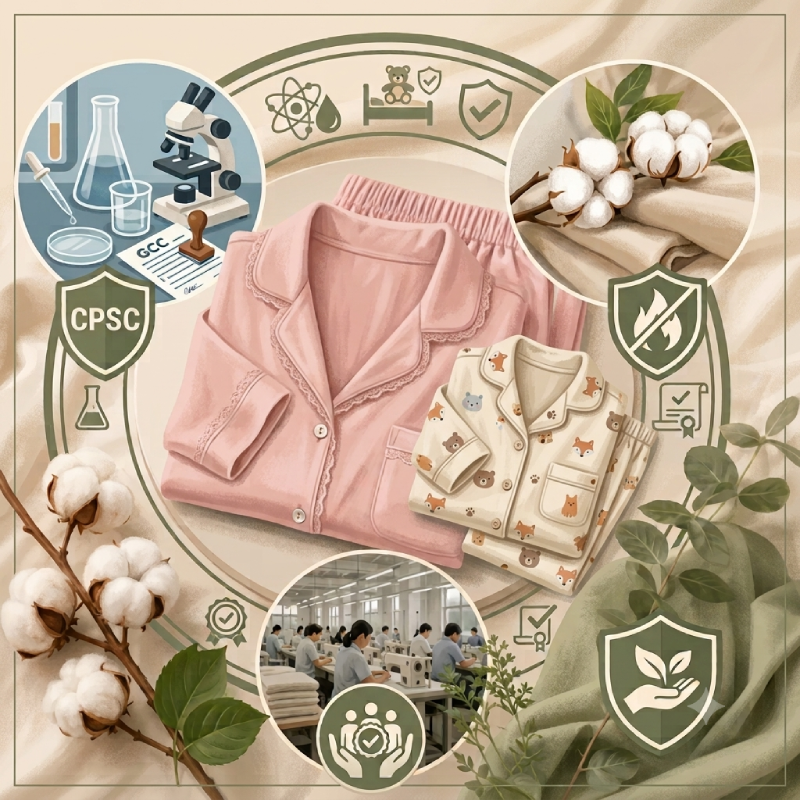
You want pajamas that are not only comfortable but legally safe for the US market. Whether you are a brand buyer sourcing sleepwear or a retailer stocking shelves, understanding CPSC regulations and GCC requirements is not optional — it is the foundation of selling pajamas in the United States. Every sleepwear product that enters the country must meet federal safety standards, and the paperwork must back it up.
Many importers underestimate how strict US sleepwear rules can be. A single missing certificate or a failed flammability test can mean blocked shipments, costly recalls, or even legal liability. Friendtex helps you navigate these waters with sleepwear that is manufactured to meet CPSC and GCC standards from the start.
Key Takeaways
CPSC is the federal agency that sets and enforces safety rules for all consumer products sold in the United States, including every type of pajama and sleepwear.
GCC stands for General Certificate of Conformity — a mandatory document that certifies adult pajamas meet all applicable CPSC safety regulations.
Children’s sleepwear faces additional, stricter requirements under 16 CFR Parts 1615 and 1616, including a separate CPC (Children’s Product Certificate) that must be backed by third-party laboratory testing.
Flammability testing under 16 CFR Part 1610 applies to all general wearing apparel, including adult pajamas. Children’s sleepwear must meet far tighter self-extinguishing standards.
Choosing a manufacturer like Friendtex that understands US compliance from fiber to finished product saves you time, avoids legal risk, and gives you confidence that your sleepwear meets every federal requirement.
Understanding US Sleepwear Compliance
What Are CPSC and GCC?
The CPSC — the US Consumer Product Safety Commission — is the federal watchdog that protects American consumers from unreasonable risks of injury or death from consumer products. Established by Congress in 1972, the CPSC has jurisdiction over thousands of product categories, and sleepwear is firmly in its scope. If you sell pajamas in the United States, you answer to the CPSC.
The GCC, or General Certificate of Conformity, is a document that the CPSC requires for every general-use product sold in the US. When you import adult pajamas, you — or your manufacturer or importer — must issue a GCC. This certificate declares, based on testing or a reasonable testing program, that your pajamas comply with all applicable safety rules.
Here is how the two relate:
Term | Role |
|---|---|
CPSC | Federal agency that writes and enforces safety regulations. |
GCC | Required certificate that proves general-use products (like adult pajamas) meet CPSC rules. |
CPC | Required certificate for children’s products, backed by mandatory third-party lab testing. |
Think of the CPSC as the rule-maker and the GCC as the evidence you hand over to prove you followed the rules. Without both, your pajamas cannot legally reach US shelves.
Why Compliance Standards Protect You
Sleepwear compliance is not just about avoiding legal trouble — it is about protecting the people who wear your products. Pajamas sit against the skin for hours every night. If the fabric is treated with unregulated chemicals, fails flammability standards, or contains restricted substances, the health consequences can be serious.
Here are some risks of skipping US compliance:
Fabrics that ignite too easily can cause severe burn injuries — the very reason flammability standards were created.
Uncertified dyes or finishes may contain lead, phthalates, or formaldehyde at levels that violate CPSIA limits.
Products without proper tracking labels become untraceable, making recalls impossible and exposing your business to liability.
Customs authorities can seize non-compliant shipments, costing you inventory and reputation in one stroke.
Retail partners increasingly audit their supply chains — missing documentation can terminate relationships overnight.
When you source from a manufacturer that builds compliance into production, you protect not only your customers but also your brand’s future. Certified pajamas with complete GCC or CPC documentation give you a competitive edge in a market where buyers are increasingly educated about safety.
CPSC and GCC Explained
When you bring pajamas into the US market, three acronyms dominate the compliance conversation: CPSC, GCC, and CPC. Each plays a distinct role, and understanding how they connect is essential for anyone sourcing sleepwear. Friendtex approaches US compliance as a core production requirement, not an afterthought — every shipment is backed by the right documentation for the right product category.
CPSC: Your Safety Guardian
The Consumer Product Safety Commission oversees the safety of more than 15,000 types of consumer products. For the sleepwear industry, the CPSC enforces several critical regulations that directly affect how pajamas are designed, tested, and labeled.
Here are the key CPSC regulations that touch pajamas:
Regulation | What It Covers |
|---|---|
CPSIA (Consumer Product Safety Improvement Act) | Lead content limits (100 ppm in substrates), phthalate restrictions, mandatory tracking labels, and third-party testing requirements for children’s products. |
16 CFR Part 1610 | Standard for the flammability of clothing textiles — applies to adult pajamas and general wearing apparel. |
16 CFR Part 1615 | Flammability standard for children’s sleepwear, sizes 0 through 6X. |
16 CFR Part 1616 | Flammability standard for children’s sleepwear, sizes 7 through 14. |
16 CFR Part 423 | Care labeling rule — requires permanent care labels on all textile apparel. |
The CPSC does not pre-approve products. Instead, it holds manufacturers and importers responsible for certifying that their products comply. If a violation is found after products reach the market, the CPSC has the authority to issue recalls, impose civil penalties, and coordinate with Customs and Border Protection to block future shipments.
Tip: Working with a manufacturer that understands CPSC requirements from the design stage helps you avoid the most common pitfall — discovering a compliance gap only after production is complete.
GCC: The Mandatory Certificate for Adult Pajamas
The General Certificate of Conformity is the document that certifies your adult pajamas meet all applicable CPSC safety rules. Every general-use product — including adult sleepwear, loungewear, robes, and pajama sets — must be accompanied by a GCC before it can be sold in the United States.
Here is what a compliant GCC must include:
GCC Requirement | Description |
|---|---|
Product Identification | A clear description of the product covered by the certificate. |
Applicable Rules | A citation to each CPSC rule, regulation, or standard the product meets (e.g., 16 CFR Part 1610). |
Importer or Manufacturer Information | Name, full mailing address, and telephone number of the US importer or domestic manufacturer certifying compliance. |
Contact for Test Records | Name, address, and contact details of the person maintaining test records. |
Date and Place of Manufacture | Production date (at least month and year) and manufacturing location (city and country). |
Testing Information | Date and place where the product was tested for compliance. |
Third-Party Lab (if applicable) | For adult general-use products, third-party testing is not mandatory, but the certificate must still be based on a reasonable testing program. |
Unlike a children’s product certificate, the GCC for adult pajamas does not require third-party laboratory testing. However, you must still have a reasonable basis for certifying compliance — which means you need some form of testing or evidence that your fabric meets the flammability requirements of 16 CFR Part 1610.
Friendtex provides complete GCC documentation with every adult sleepwear order destined for the US market, so you never face uncertainty at customs.
CPC: Children’s Product Protection
If you sell children’s sleepwear, the requirements jump significantly. A Children’s Product Certificate, or CPC, is required instead of a GCC. The CPC must be supported by testing conducted at a CPSC-accepted third-party laboratory — self-testing or in-house testing is not allowed.
Here are the mandatory requirements for a CPC:
Regulation | Details |
|---|---|
Third-Party Testing | All testing must be performed by a CPSC-accepted laboratory. No exceptions. |
Lead Content | Substrate must not exceed 100 ppm total lead. Surface coatings must not exceed 90 ppm. |
Phthalates | Children’s sleepwear must comply with limits on eight specified phthalates (each ≤ 0.1%). |
Tracking Label | Every children’s product must carry a permanent tracking label with manufacturer name, production date, batch number, and other identifying information. |
Flammability Testing | Must pass the stringent requirements of 16 CFR 1615 or 1616 depending on size range. |
The CPC is not a one-time document. You must issue a new CPC for each production batch, and you must maintain test records for at least five years. The CPSC can request these records at any time, and failure to produce them carries significant penalties.
Children’s sleepwear is subject to the highest level of regulatory scrutiny in the apparel category.
Tight-fitting children’s pajamas may qualify for an exemption from the flammability testing requirements, but they must meet specific dimensional standards and carry a hangtag warning.
Every children’s garment must have a permanent tracking label — this is not optional and is frequently audited.
Note: If you are sourcing children’s pajamas from Friendtex, you receive CPC documentation backed by CPSC-accepted third-party laboratory reports. Compliance is built into the production process, not patched on at the end.
Flammability Standards That Matter
Flammability is the issue that launched modern sleepwear regulation in the United States. In the 1940s and 1950s, a series of tragic incidents involving highly flammable fabrics led to the Flammable Fabrics Act and, eventually, the standards that govern every pair of pajamas sold in the US today. Understanding these standards — and how they differ for adults and children — is essential for anyone buying or selling sleepwear.
16 CFR 1610 for General Wearing Apparel
The 16 CFR Part 1610 standard applies to all clothing textiles, including adult pajamas, robes, and loungewear. It is the baseline flammability rule — if your fabric cannot pass this test, it cannot be used in wearing apparel sold in the United States.
The test itself is straightforward in principle: a standardized flame is applied to a fabric sample at a 45-degree angle, and the time it takes for the flame to travel a specified distance is measured.
Here is how the standard classifies fabrics:
Classification | Burn Rate | Meaning |
|---|---|---|
Class 1 (Normal Flammability) | > 3.5 seconds for surface flash; > 4 seconds for smooth fabrics | Acceptable for all wearing apparel, including pajamas. |
Class 2 (Intermediate Flammability) | 4-7 seconds for raised-surface fabrics | May be used with caution; requires careful assessment. |
Class 3 (Rapid and Intense Burning) | < 3.5 seconds for surface flash; < 4 seconds for smooth fabrics | Prohibited for wearing apparel. Cannot be sold in the US. |
Most polyester-based fabrics, including polar fleece and coral fleece, pass 16 CFR Part 1610 comfortably because the fibers melt and shrink away from flame rather than sustaining combustion. Natural fibers like cotton, unless treated, can present more complex flammability profiles — which is why testing is non-negotiable for all fiber types.
Tip: Never assume a fabric is compliant just because it “feels safe.” Flammability behavior depends on fiber type, fabric weight, surface finish, and construction — all of which must be verified through testing.
16 CFR 1615 and 1616 for Children’s Sleepwear
When it comes to children’s sleepwear, the standard is dramatically higher. 16 CFR Part 1615 (sizes 0-6X) and 16 CFR Part 1616 (sizes 7-14) require that children’s sleepwear self-extinguish when exposed to a small open flame — the kind that could come from a candle, a match, or a stove burner.
The children’s standard is a vertical flame test, which is far more rigorous than the 45-degree test used for adult apparel. The fabric must stop burning on its own, and the char length — the distance the fabric burns before self-extinguishing — must not exceed a specified maximum.
Here is a side-by-side comparison of the adult and children’s standards:
Aspect | 16 CFR 1610 (Adult) | 16 CFR 1615/1616 (Children) |
|---|---|---|
Test Orientation | 45-degree angle | Vertical |
Pass Condition | Burn rate within Class 1 limits | Self-extinguishing with limited char length |
Third-Party Testing | Not mandatory | Mandatory — must be CPSC-accepted lab |
| Exemptions | None — all apparel must comply | Tight-fitting sleepwear may be exempt with dimensional compliance and proper labeling |
Certificate Required | GCC | CPC |
Most synthetic fleece fabrics pass children’s flammability standards without chemical flame retardants — the fabric’s inherent melting behavior provides natural flame resistance. However, the testing must still be performed and documented. The tight-fitting exemption is an important pathway: if children’s pajamas meet precise dimensional standards and carry the required yellow hangtag warning, they are exempt from the flammability testing requirements.
You should never guess about children’s sleepwear compliance. The stakes — both legal and human — are too high. Always work with a manufacturer who tests through accredited laboratories and provides complete CPC documentation.
How Friendtex Ensures US Compliance
How Friendtex Meets the Standards
You need a manufacturing partner who treats US compliance as part of the product, not as extra paperwork. Friendtex integrates CPSC requirements into every stage of production — from fabric sourcing to final inspection — so the pajamas you receive are ready for the US market without remediation or delays.
Here is how Friendtex approaches compliance:
All fabrics are tested for flammability against 16 CFR Part 1610 before production begins, ensuring every material meets Class 1 requirements.
Children’s sleepwear fabrics undergo third-party laboratory testing to 16 CFR 1615/1616 standards, with reports from CPSC-accepted labs provided with each order.
Every production batch is screened for lead content, phthalates, and other restricted substances in accordance with CPSIA limits.
Tracking labels with batch numbers and manufacturing dates are affixed to all children’s products as a permanent CPSIA requirement.
Care labels are designed to conform to 16 CFR Part 423, with clear washing and drying instructions that US consumers can follow.
GCC and CPC documentation is prepared and delivered with shipment — you do not need to chase paperwork after the fact.
Friendtex operates from a fully equipped manufacturing facility established in 2003, with quality management systems that align with international standards. The company’s technical team stays current on regulatory changes, so your products remain compliant as rules evolve.
Verifying Compliance Documentation
You should never take compliance claims at face value. Genuine GCC and CPC documentation must be verifiable, and you have the right — and the responsibility — to confirm that your sleepwear meets US standards before it reaches your customers.
Here is how you can verify compliance:
Review the GCC or CPC for completeness. Every required field — product description, applicable regulations, importer details, test date, and manufacturing location — must be filled in. Blank fields or vague entries are red flags.
Request the underlying test reports. A GCC should be backed by a reasonable testing program. A CPC must be backed by third-party lab reports from a CPSC-accepted laboratory.
Check that the CPSC-accepted laboratory is listed on the CPSC website. The agency maintains a public directory of accepted labs — cross-referencing takes seconds and confirms legitimacy.
Verify tracking labels on the actual product. Hold a garment in your hand and confirm the label matches the batch number on the certificate. Discrepancies indicate a documentation gap.
Contact the manufacturer directly to confirm the certificate details. A responsive partner like Friendtex welcomes verification — it demonstrates your commitment to quality.
Tip: Keep your certificates and test reports organized and accessible. The CPSC can request documentation at any time, and you must respond promptly. A five-minute document check today can prevent weeks of legal headaches tomorrow.
Adult vs. Children’s Sleepwear Requirements
Different Rules, Different Stakes
Not all pajamas face the same level of regulatory intensity. The CPSC draws a clear line between adult sleepwear and children’s sleepwear, and the gap in requirements reflects the gap in vulnerability. Children cannot recognize or escape fire hazards the way adults can, so the standards for their sleepwear leave far less to chance.
Here is a summary of how the requirements compare across the two categories:
Requirement | Adult Pajamas | Children’s Pajamas (0-14) |
|---|---|---|
Certificate Type | GCC (General Certificate of Conformity) | CPC (Children’s Product Certificate) |
Third-Party Testing | Not mandatory | Mandatory — CPSC-accepted lab required |
Flammability Standard | 16 CFR Part 1610 | 16 CFR Parts 1615 or 1616 |
Lead Limits | 100 ppm (CPSIA) | 100 ppm substrate, 90 ppm surface coating |
Phthalate Limits | Not specifically regulated for adult apparel | Eight phthalates, each ≤ 0.1% |
Tracking Label | Not required | Mandatory and permanent |
Tight-Fitting Exemption | Not applicable | Available with dimensional compliance and warning labeling |
You may notice that adult pajamas face simpler requirements — but “simpler” does not mean “optional.” A missing GCC for adult sleepwear is still a violation, and CBP can hold your shipment just as firmly as it would for a children’s product.
Matching Compliance to Your Product Type
You should align your compliance strategy with the specific products you are sourcing. A one-size-fits-all approach to certification will either leave you under-documented for children’s products or over-investing for adult sleepwear.
Here is a practical guide:
If You Source… | You Need… | Key Watchpoint |
|---|---|---|
Adult pajama sets and loungewear | GCC backed by 16 CFR 1610 testing | Confirm Class 1 flammability for all fabric components, including trims. |
Adult robes and sleep shirts | GCC + care labeling compliance | Check that care labels follow 16 CFR 423 format. |
Children’s two-piece pajama sets | CPC + third-party lab reports | Verify the lab is on the CPSC accepted list before testing. |
Children’s tight-fitting pajamas | CPC with exemption documentation | Dimensional compliance must be exact — even small deviations void the exemption. |
Mixed adult and children’s shipments | Separate GCC and CPC per product type | Never group adult and children’s certificates together — they serve different legal requirements. |
Friendtex helps you navigate these distinctions with product-specific documentation that matches exactly what your shipment needs. You receive the right certificate for the right product — no confusion, no gaps, no surprises at the port.
Conclusion
US sleepwear compliance is not a hurdle to clear once — it is an ongoing commitment that protects your customers, your brand, and your access to the world’s largest consumer market. GCC and CPC certificates are not just paperwork; they are proof that you take safety seriously.
Friendtex brings deep manufacturing expertise and a compliance-first approach to every pajama order. With CPSC-aligned testing protocols, complete GCC and CPC documentation, and a production facility built on quality management principles, you can source sleepwear with confidence.
To keep your US-bound pajamas compliant:
Issue a GCC for every adult sleepwear shipment and a CPC for every children’s sleepwear order.
Maintain test records for at least five years — the CPSC can audit you at any time.
Work with manufacturers who test fabrics before production, not after problems arise.
- Verify every certificate and tracking label before products reach your warehouse.
Prioritize compliance documentation at the sourcing stage, and you turn a regulatory burden into a competitive advantage. Your customers sleep better knowing their pajamas meet the highest safety standards.
FAQ
What is the difference between a GCC and a CPC?
A GCC certifies that a general-use product — like adult pajamas — meets all applicable CPSC safety rules. It does not require third-party lab testing but must be based on a reasonable testing program. A CPC is required for children’s products and must be supported by testing from a CPSC-accepted third-party laboratory. The CPC also covers additional requirements like lead and phthalate limits that do not apply to adult products.
Does adult sleepwear need flammability testing?
Yes. While adult pajamas do not require third-party lab testing, you must still have a reasonable basis for certifying compliance with 16 CFR Part 1610. This means you need some form of flammability testing to confirm the fabric meets Class 1 requirements. Shipping untested pajamas is a compliance risk that can result in refused entry at US ports.
What are the tight-fitting pajamas rules for children?
Tight-fitting children’s sleepwear can be exempt from the flammability testing requirements of 16 CFR 1615/1616 — but only if the pajamas meet precise dimensional standards set by the CPSC and carry a permanent label plus a yellow hangtag that warns: “For child’s safety, garment should fit snugly. This garment is not flame resistant. Loose-fitting garment is more likely to catch fire.” The exemption is technical and must be verified by measurement, not assumption.
How can I verify Friendtex pajamas are CPSC compliant?
Contact Friendtex directly to request GCC or CPC documentation for your order. Cross-check the certificate details — including the laboratory name and certification number — against the CPSC’s public directory of accepted testing labs. Confirm that tracking labels and care labels on the physical product match the information on the certificate. Friendtex provides full documentation transparency and welcomes verification.
Can I sell uncertified pajamas in the US market?
No. Every pajama product sold in the United States — whether adult or children’s — must be covered by a valid certificate of conformity. Selling without a GCC or CPC is a violation of federal law and can result in CPSC enforcement action, customs seizure, mandatory recalls, and civil penalties. There are no exceptions for small businesses, sample orders, or first-time importers.