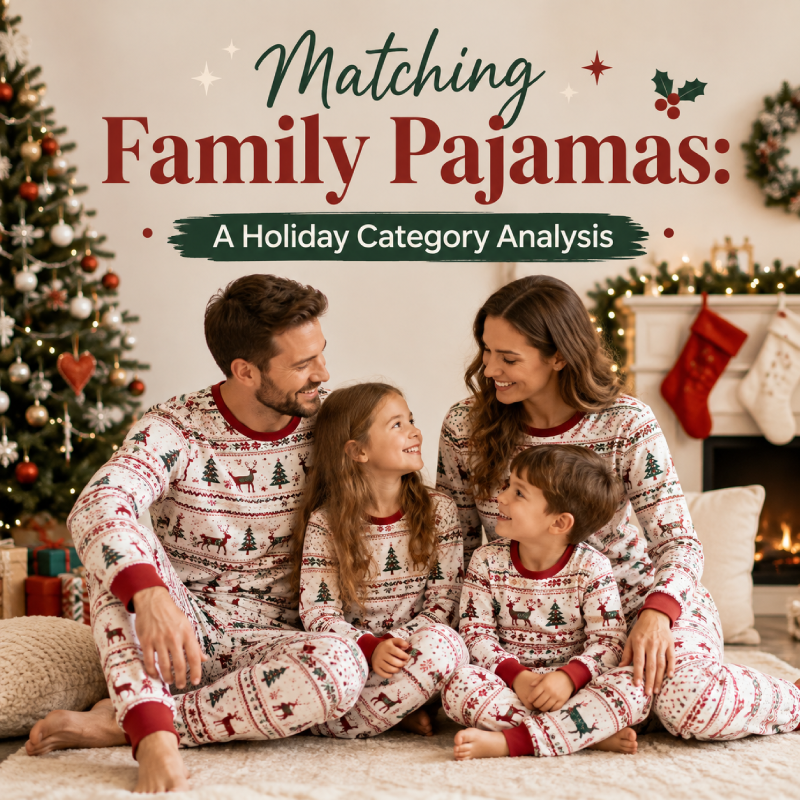
If you’ve scrolled through any social feed between November and December in the past decade, you’ve seen the photo: a family — parents, kids, sometimes the dog — all in matching plaid or reindeer pajamas, gathered on a couch with perfect lighting. What looks like a wholesome seasonal snapshot is actually the visible tip of a retail juggernaut. Matching family pajamas have grown from a niche Scandinavian-inspired novelty into one of the most reliably explosive categories in the entire sleepwear market — and for brands and manufacturers who understand the mechanics, it’s a holiday revenue engine that fires every single year.
Key Takeaways
Matching family pajamas generated $2.6 billion in 2025, holding a 38.2% share of the total holiday pajama market — the largest segment in the category.
The category was effectively invented by Hanna Andersson 30 years ago and has since grown into a cultural tradition, with social media (Instagram, TikTok, Pinterest) compounding demand every holiday season.
The category has expanded far beyond Christmas — Hanukkah, Kwanzaa, Halloween, Thanksgiving, and year-round “family night” sets now sell alongside the classic holiday patterns.
Children’s components carry CPSC flammability compliance obligations (16 CFR 1615/1616), which many general sleepwear suppliers are not equipped to handle.
For sleepwear brands, family pajamas represent a predictable annual spike — a category that sells itself through tradition and emotional gifting, with customers returning every November.
The Size of the Opportunity
Market Data
| Metric | Value | Source |
|---|---|---|
| Family pajamas market, 2025 | $2.60 billion | MarketIntelo Holiday Pajama Market Report |
| Share of total holiday pajama market | 38.2% | MarketIntelo Holiday Pajama Market Report |
| Category pioneer | Hanna Andersson (launched matching family sleepwear ~30 years ago) | Retail Brew |
| Key demand drivers | Holiday family photos, gifting tradition, social media (Instagram/TikTok/Pinterest), influencer content | Growth Market Reports; IZEA |
The headline number: $2.6 billion and 38.2% of the holiday pajama market. No other sub-segment of sleepwear comes close to commanding that kind of share within a seasonal window. And unlike novelty-driven fashion categories, family pajamas benefit from a self-reinforcing cultural loop — every year, the new generation of parents adopts the tradition their own families practiced, and social media turns each family’s photo into an advertisement for the category.
A Category Born 30 Years Ago
Understanding family pajamas means understanding its origin story. In the early 1990s, Hanna Andersson — a Portland-based children’s clothing brand named after its founder’s Swedish grandmother — introduced matching family sleepwear inspired by Swedish family traditions. The concept was simple: coordinated pajamas that families wore together on special nights.
What happened next was unforeseen: the matching pajama became the centerpiece of a family ritual. First it was Christmas morning photos. Then it spread to Thanksgiving, Hanukkah, and Halloween. By the mid-2010s, Instagram and Pinterest turned the tradition into a social phenomenon — family photos in matching pajamas became among the most-shared seasonal content, and retailers from Old Navy to Kohl’s to Lazy One built entire holiday programs around them.
Today, family pajamas are no longer a children’s brand novelty. They’re a mainstream seasonal category with dedicated retail programs, influencer campaigns, and — crucially for the industry — a predictable annual demand spike that brands plan their entire Q4 around.
Why This Category Keeps Growing
1. It’s a Tradition, Not a Trend
Trends fade; traditions compound. Family pajamas have crossed the threshold from fad to ritual — the kind of purchase families repeat annually without thinking about it. Once a family starts the “matching pajamas on Christmas Eve” tradition, they buy new sets every year (children outgrow theirs annually, which conveniently forces repeat purchase). This creates a built-in repurchase cycle that most apparel categories would envy: a family of four buying new sets each holiday season.
2. Social Media Multiplies Demand
Family pajamas are one of the most photogenic products in retail. A matching set generates content — the family photo, the unwrapping video, the dog-in-pajamas clip — that gets shared organically across Instagram, TikTok, and Pinterest. Influencer campaigns during November-December routinely feature family pajamas, and user-generated content costs brands nothing while doing the selling. The category essentially markets itself through its own customers.
3. The Category Has Diversified Beyond Christmas
The modern family pajama market is no longer December-only:
| Occasion | Peak Season | Notes |
|---|---|---|
| Christmas / Holiday | November-December | The dominant segment: plaid, reindeer, Santa prints |
| Hanukkah | December | Growing segment: menorah prints, blue-and-white palettes |
| Halloween | October | Newer but fast-growing: matching family costumes-adjacent sets |
| Thanksgiving | November | Turkey and fall-leaf prints; the “pre-game” to Christmas sets |
| Year-round “Family Night” | All year | Neutral, non-holiday prints for weekly movie nights |
| Birthday / Photo-ops | Year-round | Custom and personalized sets |
This diversification stretches the selling season from a 6-week window into a year-round category — and gives brands more reasons to carry the product permanently rather than as a seasonal line.
4. It’s a Gift Purchase
Family pajamas are one of the few apparel products that function as a gift for the entire family simultaneously. Instead of buying individual gifts for each member, a family member (or the parents themselves) can buy one set that covers everyone. The gift narrative — “our family’s matching jammies for the holidays” — makes it an emotional, story-driven purchase that justifies premium pricing. Retailers also love the category because it drives higher average order value: a family set costs 3-5x a single adult pajama set.
The Product Challenge: Why Family Pajamas Are Hard to Make Well
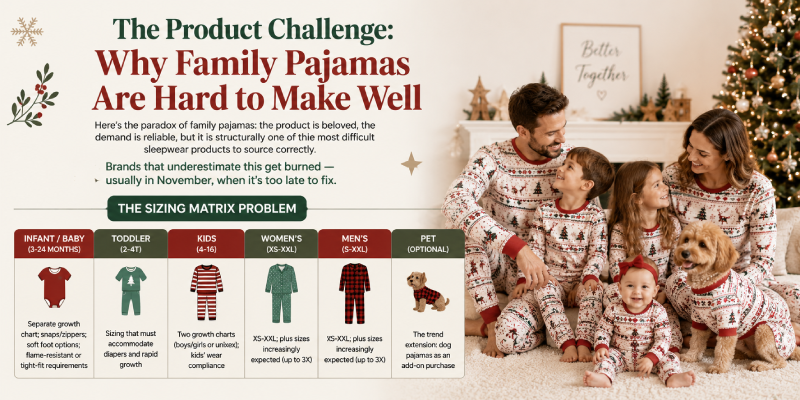
Here’s the paradox of family pajamas: the product is beloved, the demand is reliable, but it is structurally one of the most difficult sleepwear products to source correctly. Brands that underestimate this get burned — usually in November, when it’s too late to fix.
The Sizing Matrix Problem
A single matching family set must coordinate across radically different body types:
| Component | Sizing Complexity |
|---|---|
| Infant / Baby (3-24 months) | Separate growth chart; snaps/zippers; soft foot options; flame-resistant or tight-fit requirements |
| Toddler (2-4T) | Sizing that must accommodate diapers and rapid growth |
| Kids (4-16) | Two growth charts (boys/girls or unisex); kids’ wear compliance |
| Women’s | XS-XXL; plus sizes increasingly expected (up to 3X) |
| Men’s | S-XXL; plus sizes increasingly expected (up to 3X) |
| Pet (optional) | The trend extension: dog pajamas as an add-on purchase |
Coordinating prints and colors across 6 size categories — all matching perfectly — requires pattern grading expertise, consistent fabric sourcing, and a manufacturer who treats every component as part of one system. If the women’s set fits but the kids’ set runs small, the entire family purchase fails. This is why brands repeatedly source from the same manufacturer once they find one that gets the matrix right.
Compliance: The Hidden Gatekeeper
The children’s components of family pajamas trigger CPSC flammability regulations (16 CFR Part 1615/1616 for children’s sleepwear, sizes 9 months to 14 years). Two compliant paths exist:
- Tight-fitting garments (no more than a half-inch from the body in most areas) with specific labeling — the path most commercial brands use
Inherently flame-resistant fabrics (typically treated or inherently FR polyester)
Many general sleepwear suppliers simply cannot produce compliant children’s components — they lack the fabric sourcing, the testing protocol, or the CPC documentation infrastructure. For brands, this means the family pajama supplier must be verified for children’s sleepwear compliance, not just adult sleepwear quality.
Fabric Consistency Across Components
The adult sets might be brushed modal; the kids’ sets need to be the same fabric — but kids’ sleepwear may need different flame-resistance properties. The print must match across woven and knit constructions. Sourcing one fabric that works for all components while meeting compliance is a genuine supply-chain skill.
The Competitive Landscape
Who’s Winning
| Brand | Positioning | Strength |
|---|---|---|
| Hanna Andersson | The category originator; premium quality | Established tradition, loyal customer base, high price point |
| Burt’s Bees Baby | Soft organic cotton; family matching sets | Organic positioning, accessible price ($13+ per piece) |
| Primary | Playful, gender-neutral styles | Direct-to-consumer, bold colors, inclusive sizing |
| Lazy One | Fun, quirky prints for kids and adults | Humor-driven, strong niche following |
| Kohl’s (Humble Jumble) | Mass-market budget option | Wide availability, price-driven |
| Old Navy | Broad family matching programs | Scale, ubiquitous distribution |
| Target / Walmart | Private label family sets | Price point, convenience |
The Gaps
Despite the category’s size, meaningful white space remains:
Premium fabric gap: Most family pajama sets are cotton or polyester fleece. Bamboo, TENCEL™, and brushed-modal family sets — the fabrics driving premium sleepwear growth — are comparatively rare in the family category. A family set in premium bamboo at a $60-90 price point would be differentiated.
Sizing gap: Many brands stop at L/XL for adults. Families with plus-size members are underserved.
Personalization gap: Custom-embroidered family sets (names, “Est. 2018,” family initials) command premium prices but are rare among mainstream brands.
Year-round gap: Most retailers stock family pajamas only for Q4. A year-round “family night” collection with neutral prints is still largely open territory.
Coordination gap: Matching sets that extend to pajama robes and slippers — the full “family night” bundle — are underdeveloped.
For Sleepwear Brands: How to Enter the Family Pajama Category
Why This Category Rewards Brands
Predictable annual demand: Unlike trend-driven categories, family pajamas spike reliably every Q4. Brands can plan inventory with unusual confidence.
High AOV: A family set prices at 3-5x a single set.
Built-in repurchase: Kids outgrow sets annually → repeat purchase every year.
Self-marketing:Customers photograph and share the product.
Category leadership is available: No brand owns “premium fabric family pajamas” yet — the positioning is open.
Product Development Checklist
| Priority | Requirement | Why |
|---|---|---|
| 1 | Children’s sleepwear compliance (CPC, 16 CFR 1615/1616) | Non-negotiable for the kids’ components |
| 2 | Coordinated grading across 6 size categories | One bad fit ruins the family purchase |
| 3 | Fabric consistency across all components | The print must match; quality must match |
| 4 | OEKO-TEX® certification | Family product sits against kids’ skin; parents check labels |
| 5 | Premium fabric differentiation (bamboo/TENCEL™/brushed modal) | The white space; justifies $60-90 price point |
| 6 | Plus-size and pet-size options | Underserved; easy differentiation |
| 7 | Pattern design that scales prints across sizes | Print scaling across baby-to-adult is a design discipline |
| 8 | Q4 production planning (ship by August) | Retailers and DTC brands order 4-6 months ahead |
The Q4 Production Calendar
The single most important operational fact about family pajamas: the sales window is December, but the production window is August-September. Brands that source family pajamas must have samples approved, production booked, and inventory shipped by late September at the latest — often earlier for wholesale accounts. Missing this calendar means missing the entire year’s category.
How Friendtex Can Help
At Friendtex, family pajamas are one of our specialty programs. Over 15 years of sleepwear manufacturing, we’ve built the exact capabilities this category demands:
Children’s sleepwear compliance: Full CPC documentation and testing for 16 CFR Part 1615/1616, including both tight-fitting and flame-resistant construction paths — we handle the kids’ components properly
Coordinated multi-size production: Pattern grading expertise spanning infant through adult 3X-4X, with print and color matching controlled across every component
Premium fabric capability: Bamboo viscose, TENCEL™, brushed modal, organic cotton — the fabrics that differentiate family sets at premium price points
Family set design support: Print scaling, coordinating styles, and fit engineering across baby, kids, women’s, and men’s patterns
OEKO-TEX® Standard 100 certification: Every component certified for safe skin contact
- Q4 production capacity: Dedicated scheduling to meet August-September ship dates
Flexible MOQs: Starting from 300 pieces per design, so you can test a family capsule before scaling
Whether you’re a DTC brand launching your first family set or a retailer planning a Q4 program, our team can manage the full process — from print coordination across sizes to compliance documentation. Contact us to discuss your family pajama project.
FAQ
Why are matching family pajamas so popular?
Matching family pajamas tap into two of the most powerful consumer drivers: tradition and emotional imagery. A matching set creates a shared family moment — the Christmas morning photo, the holiday card, the movie night — that families repeat annually. Once established as a family ritual, the purchase becomes a tradition rather than a discretionary buy. Social media (especially Instagram and TikTok) amplifies this by turning every family’s pajama photo into shareable content that markets the category for free.
How big is the family pajama market?
Family pajamas generated approximately $2.6 billion in 2025, representing 38.2% of the total holiday pajama market — the largest single segment. The category has grown from a niche concept 30 years ago into a mainstream seasonal staple carried by nearly every major retailer.
When should brands start producing for the holiday season?
Production for December holiday sales must ship by late August or September at the latest. Wholesale accounts and retailers often finalize orders 4-6 months ahead of the season. A brand that hasn’t approved samples by early summer risks missing the entire Q4 window — family pajamas is a category where planning ahead isn’t optional, it’s everything.
What makes family pajamas hard to manufacture?
The core challenge is coordination across size categories: infant, toddler, kids, women’s, and men’s — often plus sizes and pet sizes — all in identical fabric and print. Each size category has its own fit challenges, and the children’s components carry CPSC flammability compliance obligations that many general suppliers can’t handle. A family set is essentially five garments with one quality bar and one compliance standard.
Do kids’ family pajamas need special safety compliance?
Yes. Children’s sleepwear (sizes 9 months to 14 years) sold in the US must comply with CPSC flammability standards (16 CFR Part 1615/1616), either as tight-fitting garments with proper labeling or using flame-resistant fabrics. Any brand selling family pajamas in the US must verify its supplier provides the CPC (Children’s Product Certificate) documentation for the kids’ components.
What fabrics work best for family pajamas?
Premium cotton, brushed modal, bamboo viscose, and TENCEL™ are the strongest choices — soft enough for kids’ sensitive skin, breathable for year-round family nights, and distinct enough to differentiate from the cotton-fleece crowd. Organic cotton has particular resonance with parents. Whatever fabric you choose, it must be sourced consistently so the print and hand feel match perfectly across all size components.
What’s the best strategy for a new brand entering this category?
Start with a focused capsule: 2-3 prints across the full size matrix (infant through adult, including plus sizes), in a premium fabric, with OEKO-TEX® certification and full kids’ compliance. Prioritize one differentiated angle — premium fabric, inclusive sizing, personalization, or year-round neutral prints — rather than competing with mass-market brands on price. Partner with a manufacturer experienced in coordinated multi-size production, and begin planning 6 months before your target season.