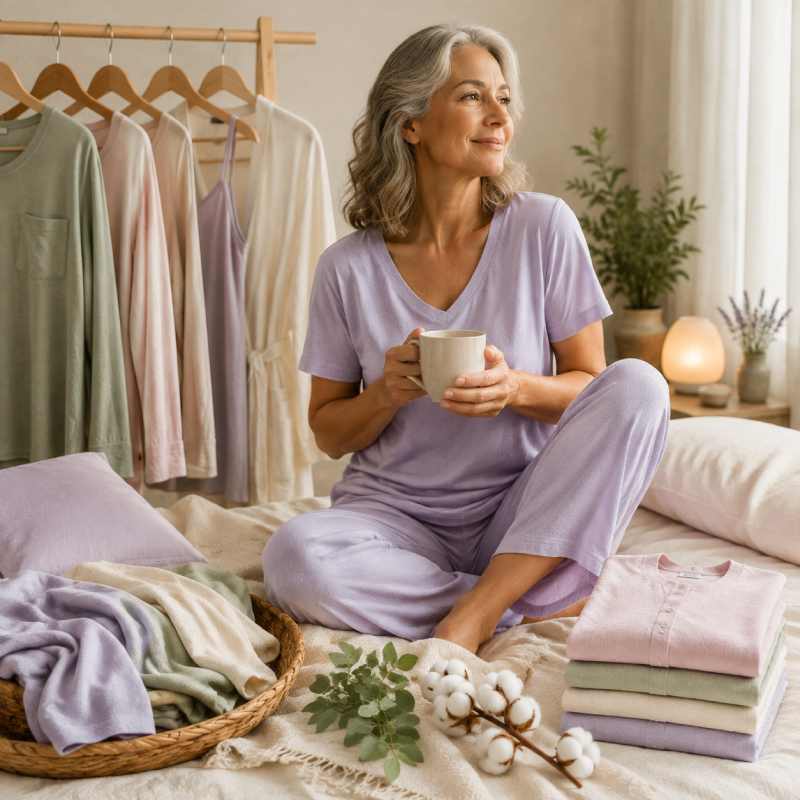
If you follow the sleepwear industry closely, you’ve probably noticed a quiet shift. The brands winning category share in 2025-2026 aren’t just selling softer pajamas — they’re selling sleep itself to women in their 40s and 50s. Menopause sleepwear has emerged as the fastest-growing niche in the entire sleepwear market, and the data suggests this is only the beginning.
Key Takeaways
The menopause cooling wearable market is projected to reach $1.67 billion in 2026, growing at a 14.0% CAGR — more than double the overall sleepwear market’s growth rate.
75-85% of women experience hot flashes and night sweats during menopause, with symptoms lasting 7-14 years on average — creating a massive, sustained demand base.
6,000 American women enter menopause every day, and the global population of menopausal women is projected to exceed 1.1 billion by 2026.
The winning products aren’t “medical” — they’re moisture-wicking bamboo, TENCEL™, and modal pajamas that manage thermoregulation without looking clinical.
For sleepwear brands, menopause sleepwear represents a white-space opportunity: existing players are few, demand is growing at 14%+ annually, and customer loyalty in this segment is exceptionally high.
The Size of the Opportunity
Market Growth Data
Let’s start with the numbers, because they tell a story that product trends alone can’t capture:
| Metric | Value | Source |
|---|---|---|
| Menopause cooling wearable market, 2025 | $1.47 billion | The Business Research Company |
| Menopause cooling wearable market, 2026 (projected) | $1.67 billion | The Business Research Company |
| CAGR (2025-2026) | 14.0% | The Business Research Company |
| Projected market size, 2030 | $2.79 billion | The Business Research Company |
| Menopausal hot flashes treatment market, 2026 | $16.88 billion | Research and Markets |
| Global sleepwear and loungewear market, 2025 | $66.5 billion | Cognitive Market Research |
| Sleepwear and loungewear CAGR (2025-2033) | 5.88% | Cognitive Market Research |
The headline number to remember: 14.0% CAGR for menopause-focused sleepwear versus 5.88% for the broader sleepwear market. The niche is growing at roughly 2.4x the rate of the category it belongs to. When a segment grows that much faster than its parent category, it’s not a fad — it’s a structural shift.
The Demand Base
Behind the market data is a demographic wave that has been building for decades:
6,000 American women enter menopause every day — that’s roughly 2.2 million new consumers per year in the US alone, each of whom will need sleepwear solutions for the next 7-14 years.
75-85% of menopausal women experience vasomotor symptoms (hot flashes and night sweats), according to clinical data from the National Institutes of Health and the SWAN Study.
Symptoms last far longer than previously believed. The landmark SWAN Study found hot flashes persist for a median of 7.4 years — and up to 14 years for some women. This isn’t a seasonal purchase; it’s a sustained, decade-long need.
10% of women experience 7+ hot flashes per day, with many reporting night sweats severe enough to soak through clothing and disrupt sleep 3-4 times nightly.
Regional prevalence varies — approximately 74% of European women, 50-68% in Latin America, and 22-63% in Asia experience hot flashes — meaning the demand is genuinely global, not US-centric.
The implications for sleepwear brands: this is a consumer base measured in the hundreds of millions, with a decade-long purchase cycle per customer, buying products designed for a need that has been historically underserved.
Why This Segment Is Growing No
1. Menopause Is No Longer Taboo
For most of modern history, menopause was a private, unmentionable subject. That’s changed dramatically in the past five years. Celebrities like Gwyneth Paltrow and Drew Barrymore have spoken publicly about their menopause journeys. Major publications run menopause health coverage. Employers are adding menopause benefits. The result: women who spent years quietly suffering from night sweats are now actively searching for solutions — and finding that dedicated menopause sleepwear exists.
This destigmatization has a direct e-commerce effect. Searches for “menopause pajamas,” “cooling sleepwear,” and “pajamas for night sweats” have grown consistently year-over-year, and the audience actively seeks out products designed specifically for their condition rather than settling for generic sleepwear.
2. Aging Demographics with Buying Power
Women aged 45-60 are one of the most financially powerful consumer demographics in Western markets. They’re at peak career earnings, their children have left home, and they have the disposable income to invest in their own wellbeing. Unlike the 25-35 demographic that dominates most DTC marketing, menopausal women are not price-sensitive in the same way — they’re buying relief, comfort, and dignity, and they’ll pay for products that deliver.
3. Product Innovation Has Finally Caught Up
The first generation of “menopause sleepwear” was essentially standard pajamas in darker colors — barely differentiated marketing. That’s no longer the case. The current generation of products is built around genuine fabric technology:
Bamboo viscose: lightweight, cool-to-the-touch, and moisture-wicking; the most common choice among both brands and consumers
TENCEL™ Micro Modal: absorbs approximately 50% more moisture than cotton and re-dries faster, keeping skin cooler (Lenzing data)
- Modal:drapes softly, feels cool, and handles moisture well
Mineral-infused technologies like 37.5® technology, which respond to heat and humidity to evaporate sweat before it accumulates
Merino wool: for women whose nights swing from sweating to chilling within minutes — merino’s temperature regulation handles both extremes
This is real fabric science, not marketing fluff — and it’s the reason the segment’s growth is sustainable rather than hype-driven.
What Women Actually Need: The Product Requirements
The Night Sweats Problem
Night sweats aren’t just uncomfortable — they’re sleep-disrupting in a way that compounds over time. A woman experiencing 3-4 night sweats per night is waking multiple times, drenching her pajamas, changing clothes, and struggling to fall back asleep. Over a year, this is the equivalent of losing weeks of sleep. The product that solves this problem — truly solves it — earns fierce loyalty.
Key Product Features That Work
Based on how the leading menopause sleepwear products perform, and on what the r/Menopause community consistently recommends, these are the features that matter:
| Feature | Why It Matters | How It’s Done |
|---|---|---|
| Moisture-wicking | Draws sweat away from skin so you don’t wake up clammy | Bamboo viscose, TENCEL™, modal; engineered knit structures |
| Fast-drying | Pajamas re-dry quickly after a sweat episode | Microfiber modal structures that release moisture rapidly |
| Breathable knit | Allows airflow instead of trapping heat | Loose knit constructions; lightweight weights (150-190 gsm) |
| Cool-to-touch hand feel | Instant comfort when skin is hot and sensitive | Bamboo and TENCEL™ surfaces |
| Adjustable layering | Body temperature swings wildly within minutes | Two-piece sets, removable sleeves, zip-front styles, lightweight robes |
| Relaxed silhouette | No tight bands or constriction; easy to remove if overheated | Loose cuts, adjustable drawstrings, no-wire construction |
| Easy care | Wash-and-wear reliability during high-usage periods | Machine washable, quick-drying fabrics |
| Non-clinical aesthetic | Women want to feel normal, not like patients | Fashion-forward prints, colors, and silhouettes |
Fabric Comparison for Menopause Sleepwear
| Fabric | Cooling | Moisture-Wicking | Fast-Drying | Skin Feel | Durability |
|---|---|---|---|---|---|
| Bamboo Viscose | ★★★★★ | ★★★★★ | ★★★★☆ | ★★★★★ | ★★★☆☆ |
| TENCEL™ Modal | ★★★★★ | ★★★★★ | ★★★★★ | ★★★★★ | ★★★★☆ |
| Modal | ★★★★☆ | ★★★★☆ | ★★★★☆ | ★★★★★ | ★★★☆☆ |
| Merino Wool | ★★★★★ | ★★★★☆ | ★★★☆☆ | ★★★☆☆ | ★★★☆☆ |
| Cotton | ★★★☆☆ | ★★★☆☆ | ★★☆☆☆ | ★★★★☆ | ★★★★☆ |
| Silk | ★★★★★ | ★★★☆☆ | ★★☆☆☆ | ★★★★★ | ★★☆☆☆ |
| Polyester Blend | ★★☆☆☆ | ★★★☆☆ | ★★★★☆ | ★★☆☆☆ | ★★★★★ |
The clear winner for the mass market: bamboo viscose and TENCEL™ modal blends — they combine the cooling and wicking performance women need with the softness and price point that makes them accessible. Silk performs well for cooling but is impractical for heavy night sweats (slow to dry, delicate care). Cotton, the sleepwear default, is actually among the worst performers for this specific use case.
The Competitive Landscape
Who’s Already Playing
The menopause sleepwear space is currently served by a mix of dedicated menopause brands and general sleepwear brands adding “cooling” lines:
| Brand | Positioning | Notable Technology |
|---|---|---|
| Lusomé | Dedicated menopause sleepwear brand | Xirotex™ moisture-wicking fabric |
| Soma | Mainstream intimates brand with cooling line | Cool Nights fabric |
| CoolJams | Affordable cooling pajamas for hot sleepers | Moisture-wicking knit |
| Sleepy Merino | Premium merino-based sleepwear | Temperature-regulating merino |
| Zed | Science-backed premium sleepwear | Performance fabric technology |
| ThirdLove | Intimates brand expanding into cooling apparel | 37.5® mineral-infused technology |
The White Space
Despite this activity, the segment remains under-served relative to its size. Key observations:
- Very few dedicated menopause sleepwear brands exist compared to, say, the dozens of nursing sleepwear brands. Most mainstream sleepwear brands — the ones dominating Amazon and department stores — have zero menopause-specific product lines.
- The mid-price gap: luxury brands target $150+ for merino or silk options, while budget brands sell generic “cooling” pajamas at $30. The $50-90 sweet spot — where bamboo/TENCEL™ quality is accessible — is comparatively underserved.
- Sizing gap: menopause happens at every body size, yet many cooling lines stop at XL. Inclusive sizing (up to 3X-4X) is a clear differentiator.
- Marketing gap: most brands sell “cooling pajamas” without speaking directly to menopause. The brands that name the condition — that say “for hot flashes and night sweats” plainly — win the search traffic and the emotional connection.
For Sleepwear Brands: How to Enter This Market
Why Your Brand Should Care
If you’re a sleepwear manufacturer, brand, or retailer, the menopause sleepwear opportunity checks every box for a strategic expansion:
Demand is growing at 14%+ annually — more than double the category average
Competition is thin — the top-10 menopause sleepwear brands control a fraction of the market share that top-10 maternity brands control in their niche
Customer loyalty is exceptional — women who find pajamas that stop their night sweats become lifelong customers and vocal advocates
It’s an adjacency, not a pivot — your existing sleepwear manufacturing capabilities, fabric sourcing, and distribution apply directly; no new infrastructure needed
It future-proofs your brand — with 6,000 American women entering menopause daily, this demographic will only grow
Product Development Checklist for Menopause Sleepwear
| Priority | Requirement | Notes |
|---|---|---|
| 1 | Bamboo or TENCEL™ modal base fabric | 95% bamboo/5% spandex or similar; 150-190 gsm for year-round weight |
| 2 | OEKO-TEX® Standard 100 certification | Non-negotiable baseline; skin contact 8+ hours nightly |
| 3 | Moisture-wicking performance test data | Test and document: wetting time, wicking rate, drying time |
| 4 | Relaxed, no-constriction silhouette | Drawstrings, loose knit, no tight waistbands |
| 5 | Inclusive sizing | XS through 3X minimum; 4X for differentiation |
| 6 | Machine-washable durability | Frequent washing cycle; test pilling and shape retention |
| 7 | Darker, pattern-rich colorways | Hide perspiration marks; feel less “clinical” |
| 8 | Direct marketing language | Say “menopause” and “hot flashes” plainly for SEO and connection |
Fabric Sourcing Considerations
The two fabrics that dominate this segment — bamboo viscose and TENCEL™ modal — are both readily available through established supply chains, but quality varies dramatically by source:
Bamboo viscose: verify the fiber supplier and processing method. Look for FSC-certified bamboo sources and closed-loop or low-impact processing where possible. Test for shrinkage and pilling across repeated washes — cheap bamboo can bag out within months.
TENCEL™ (Lenzing): premium positioning, verified sustainability credentials, and excellent moisture management. The higher cost is justified by performance and marketing value — “TENCEL™” on the label is a recognized quality signal for consumers.
- Blends:95% bamboo / 5% spandex is the workhorse; consider 47% cotton / 47% modal / 6% spandex for a different hand feel and cost point.
How Friendtex Can Help
At Friendtex, we’ve been manufacturing sleepwear for over 15 years, and we’ve seen the menopause category grow from a niche afterthought to a strategic priority for our brand partners. Here’s what we bring to the table:
Certified fabrics: OEKO-TEX® Standard 100 bamboo viscose, Lenzing TENCEL™ modal and lyocell, organic cotton — with full documentation
Performance engineering: We work with clients to specify knit structures and fabric weights that maximize moisture-wicking and breathability — the two properties that make or break menopause sleepwear
Inclusive sizing expertise: Pattern grading experience from XS through 4X, with relaxed-fit silhouettes engineered for comfort without looking clinical
Flexible MOQs: Starting from 300 pieces per design, so you can test the menopause market with a small capsule before scaling
- Compliance-ready: All certifications and testing documentation required for US, EU, and Canadian markets
Whether you’re a DTC brand launching a 4-style menopause capsule or a wholesaler adding a cooling line to your catalog, our team can guide you through fabric selection, sampling, and production. Contact us to discuss your menopause sleepwear project.
FAQ
What is menopause sleepwear?
Menopause sleepwear is pajamas, nightgowns, and loungewear designed specifically for women experiencing perimenopause and menopause — primarily to manage night sweats and hot flashes. The key difference from regular sleepwear is fabric: menopause pajamas are made from moisture-wicking, fast-drying, breathable materials like bamboo viscose and TENCEL™ modal that pull sweat away from the skin and re-dry quickly, instead of cotton or polyester which trap moisture.
What’s the best fabric for menopause pajamas?
Bamboo viscose and TENCEL™ modal are the two clear winners. Both are lightweight, cool-to-the-touch, and significantly better at moisture-wicking than cotton — TENCEL™ Micro Modal absorbs roughly 50% more moisture than cotton and re-dries faster, keeping skin cooler. Merino wool works well for women whose nights swing between sweating and chilling, since it regulates temperature in both directions. Cotton — the sleepwear default — is actually among the worst performers for night sweats because it absorbs moisture and stays damp.
Why do night sweats ruin sleep?
Night sweats are a vasomotor symptom of menopause caused by hormonal changes that disrupt the body’s temperature regulation. During a night sweat episode, body temperature spikes suddenly, triggering heavy perspiration — often enough to soak through clothing and bedding. Because 75-85% of menopausal women experience these episodes, with symptoms lasting a median of 7.4 years (and up to 14 years for some), a woman can be waking drenched 3-4 times nightly for a decade. The sleep disruption compounds: interrupted sleep, a cold wet feeling after the episode ends, and difficulty falling back asleep.
Do I need special pajamas, or will cotton do?
Cotton will technically cover you, but it makes night sweats worse. Cotton absorbs sweat and holds it against the skin, leaving you damp and chilled after a hot flash passes. Specialized menopause sleepwear uses moisture-wicking, fast-drying fabrics that move sweat away from the body and re-dry within minutes, plus loose, breathable silhouettes that let heat escape. For women experiencing 3-4 night sweats per night, the difference between waking up drenched and waking up dry is the difference between cotton and engineered sleepwear.
How can a sleepwear brand enter the menopause market?
Start with a small capsule — 3-4 styles in bamboo or TENCEL™ with a 95/5 spandex blend, OEKO-TEX® certified, sized XS through 3X minimum. The key differentiators are: (1) naming menopause directly in your marketing rather than hiding behind “cooling sleepwear,” (2) offering inclusive sizing, which most existing players skip, and (3) documenting real moisture-wicking performance data. Friendtex supports brands entering this space with certified fabrics, flexible MOQs from 300 pieces per design, and performance engineering to maximize wicking and breathability.
The Bottom Line
Menopause sleepwear is not a niche curiosity — it’s the fastest-growing segment in the sleepwear industry, backed by demographic inevitability, destigmatization, and genuine fabric innovation. The numbers are compelling: a $1.67 billion market growing at 14% annually, serving a demographic of over a billion women with a decade-long need, in a category where competition remains thin and customer loyalty runs deep.
For brands that act now — with the right fabrics, the right sizing, and the right message — the menopause sleepwear segment offers a rare combination: fast growth, limited competition, and a customer base that will reward you with loyalty for years.
The question isn’t whether menopause sleepwear will become a major category. It already is. The question is which brands will claim their share before the space fills up.