Most buyers never set foot inside a pajama factory. They see a quotation, a sample, a tracking number. Everything between those three things — the spreading table, the knitting room, the needle, the light box, the carton — stays invisible, and that invisibility is where surprises are born: a fit that drifts, a color that shifts, a lead time that stretches.
This is the walkthrough I give when a buyer visits us in Qingdao: eight stops, in the order your goods actually travel. The point is not to teach you how to run a sewing line. It is to teach you what to look at — because a pajama factory tour is the fastest way to tell the difference between a floor that is genuinely managed and one that is merely busy.
If you want the process itself explained — tech pack to delivery, stage by stage — I wrote that separately in our pajama manufacturing process guide. What follows is the physical version: what the floor looks like when you are standing on it, what the numbers on the boards actually mean, and the questions worth asking while you are there.
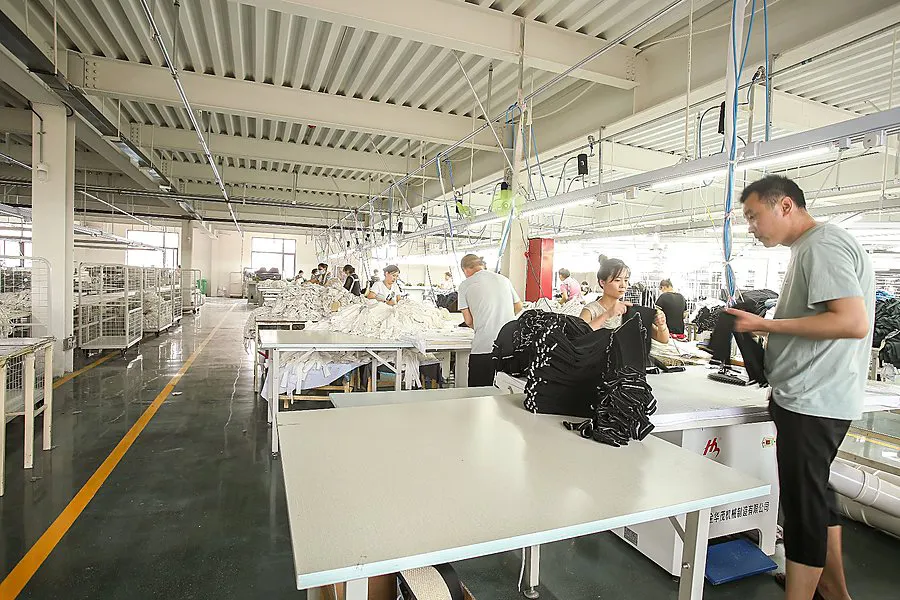
Stop 1: Development — What Should Already Exist Before You Arrive
This is the stop where nothing appears to be happening — and where most of your risk was actually created. When a buyer walks the floor, the tech pack is usually the first document put in front of them, and it is worth ten minutes, because it is the only document in the building that can stop a problem before it costs anything.
What it should contain by the time you visit: style and silhouette with a flat sketch, measurements per size with tolerances (we work to ±1 cm on most body measurements, tighter on criticals like chest and inseam), a named fabric and weight per component — “60/40 cotton-poly singel jersey, 160 gsm” for the top, “55/45 cotton-poly poplin, 115 gsm” for the shorts — plus construction details, decoration, and packing instructions.
What to ask on the floor: open the approved tech pack next to the running order. Then ask for one change made after the PO was signed, and who absorbed it. A factory with a clean change log will not surprise you with a mid-production claim.
For the full picture of what a complete pack contains, how sampling rounds are run, and how the calendar behaves around them, I have gone through it in our pajama manufacturing process guide and in the sleepwear sourcing calendar. On the tour itself, the takeaway is narrow: a vague pack is the one delay a buyer creates personally.
Stop 2: Fabric — Knit, Dye, and the Longest Lead Time in the Building
Fabric is the single biggest driver of both cost and schedule in sleepwear, and it is the stage buyers understand least.
Knitting. For jersey, rib, and interlock sleepwear, yarn goes onto circular knitting machines that produce greige fabric at 20–35 kg per hour depending on gauge and diameter. Our knitting room runs day and night, because a bulk order of 30,000 sets can consume 40–60 tonnes of greige — that is weeks of machine time, and it is booked against other customers’ orders.
Dyeing and finishing. Greige goes to dyeing in lot quantities, typically 300–1,000 kg per shade per lot. This is where the calendar gets dangerous:
| Step | Typical time | Why it slips |
|---|---|---|
| Lab dip (color approval on a small swatch) | 7–10 days per round | Buyer feedback arrives in fragments |
| Bulk dyeing | 10–18 days | Machine queue at the dyehouse, shade re-dos |
| Finishing (compacting, pre-shrinking, softening) | 3–6 days | Depends on required shrinkage standard |
| Fabric inspection and relax | 2–3 days | Roll-to-roll check against the approved standard |
Two rules that save programs: approve your lab dips within 48 hours (there is no prize for making the dyehouse wait), and never approve a color you have only seen on a phone screen. A dyed swatch under D65 light on a physical card is the only approval that survives bulk.
A note on cotton prices. Cotton is a commodity. Buyers who lock fabric price for a whole season instead of accepting lot-by-lot quotes remove a real source of cost variance — and they get first claim on the greige.
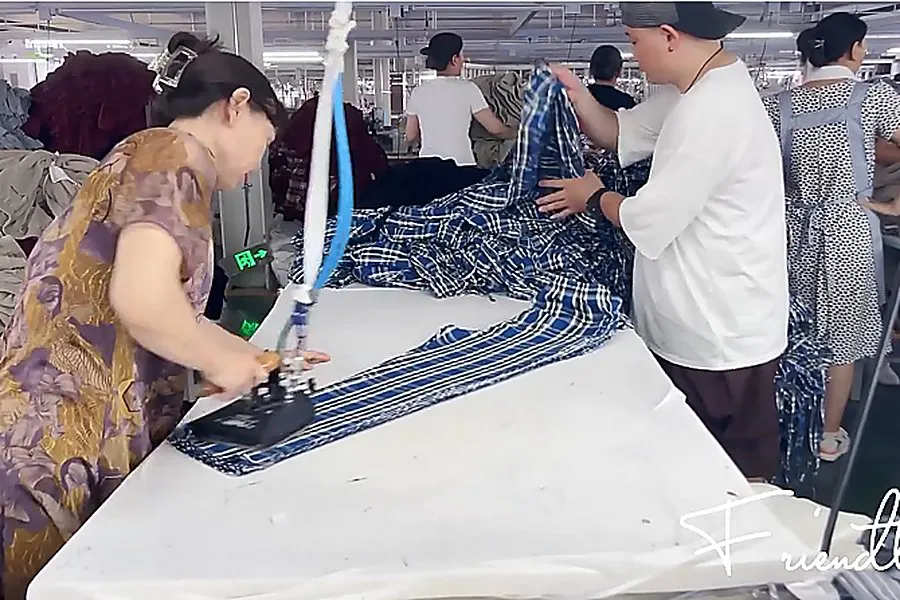
Stop 3: Spreading and Cutting — Where Precision Is Won
Cutting looks simple and is not. A 3% drift in cut width, multiplied by 30,000 pieces, is a shrinking program and a rejected shipment.
- Spreading. Fabric is unrolled across a table in layers — typically 60–100 plies for jersey, fewer for bulky fabrics. The spreader must let the fabric relax (cotton needs 12–24 hours off the roll first, or the plies shrink after cutting) and match the nap, direction, and shade band of every layer.
- Marker making. The pattern is nested on a marker to hit a target fabric utilization — 82–88% is realistic for sleepwear. Every point of utilization is money.
- Cutting. Automatic CNC cutters run most of our volume, with a hand cutter for small runs and complex parts. Accuracy target: ±2 mm.
- Bundling and ticketing. Each bundle of cut parts is ticketed with style, size, shade lot, and bundle number, and tracked from cutting to sewing. This is what makes it possible to trace a problem back to a specific roll of fabric months later.
What to ask: “What is your target fabric utilization on this style, and what happens if it comes in below?” A factory that has never measured this is not managing your cost.
Stop 4: Sewing — The Line, the SMV, and the Real Cost Driver
This is the stage everyone pictures, and it is the one that decides your cost.
Sleepwear is sewn on production lines — a line being a group of operators arranged in sequence, each performing one operation: shoulder join, sleeve set, side seam, hem, elastic, label, trim. A simple pajama short might pass through 12–18 operations; a lined robe or a set with piping can pass through 40 or more.
The productivity of that line is measured in SMV (Standard Minute Value) — the number of minutes a trained operator should need to complete one garment. SMV is the basis of every CMT quote you will ever receive, and it is the reason two factories quoting “the same” pajama can differ by 40%.
Here is the arithmetic buyers rarely see:
Daily capacity (pieces) = (operators × working minutes × line efficiency) ÷ SMV
For a 40-operator line working 600 minutes at 65% efficiency on a 12-minute SMV garment:
(40 × 600 × 0.65) ÷ 12 = 1,300 pieces per day
Change one number and everything moves. Efficiency of 50% (a struggling line) gives 1,000 pieces. Efficiency of 80% (an excellent line on a mature style) gives 1,600 pieces. Same people, same machines, same hours — a 60% swing in output, purely from line balance and how long the style has been running.
| Efficiency | What it usually means |
|---|---|
| 50% | New style, new line, or poor balance — costs are high and so is risk |
| 65% | Normal for a style in its first weeks of bulk |
| 70–75% | A well-run line on a repeat style — this is where good factories live |
| 80%+ | Mature style, invested line, high operator retention |
This is the honest version of “why did the repeat order cost less?” — the SMV is identical, but the line now runs at 78% instead of 62%, so the labor content per garment has dropped by a fifth.
What to ask: “What SMV did you use in this quote, and what efficiency have you been running on similar styles?” If the quotation is built on 85% efficiency and reality delivers 60%, the price will be renegotiated or the schedule will slip. Better to know which — and if you want to see the same arithmetic applied to a full unit price, I broke that down in why pajama quotes differ between factories.
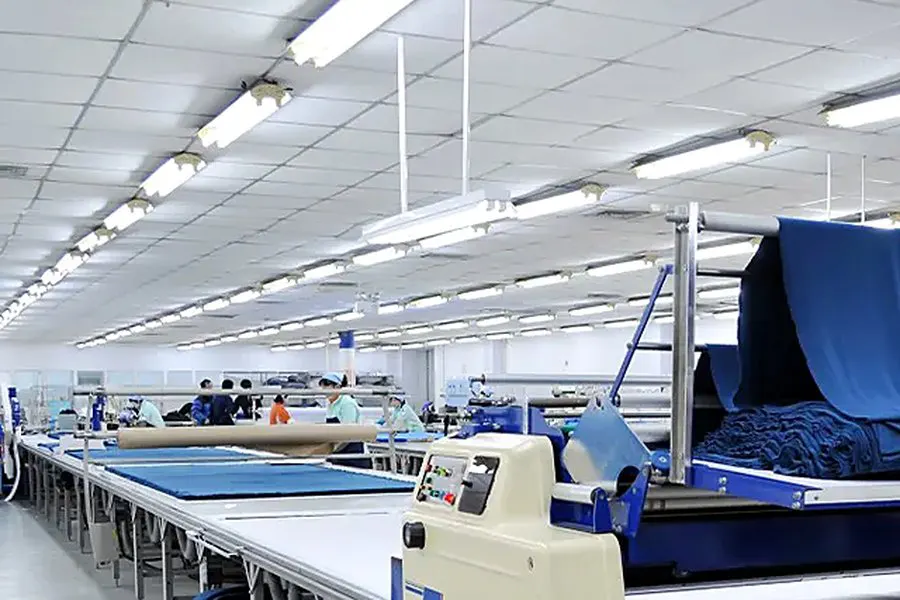
Stop 5: Inline QC — Catching Problems While They Are Cheap
Quality is not an inspection at the end. It is a set of gates along the line, because a defect caught at the sewing machine costs seconds to fix, and the same defect caught after packing costs a finished garment, a carton, and a shipping slot. The full list we work to is in our pajama quality control checklist; what follows is what those gates look like from the floor.
Our inline gates:
- Cut part check — plies counted, shade matched, measurements spot-checked against the marker.
- First-off approval — the first 5 pieces off the line are measured and compared to the spec. This is the single highest-value check in the building, because a first-off error propagates through every piece behind it.
- In-line patrol — a QC operator walks the line with the spec sheet, measuring 3–5 pieces per operation per shift, and flags drift before it becomes a bundle.
- End-of-line 100% check — every piece is checked for measurements, stitching, needle damage, and finishing.
- Needle and metal detection — every garment passes through a detector, and broken needles are logged against the machine and the operator. This is not bureaucracy; it is the control that keeps a broken needle point out of a child’s pajama.
- Final AQL audit — cartons are sampled to the AQL standard agreed in the PO, and a failed audit sends the lot back, not forward.
The gate that most often saves a program is first-off approval. When a buyer signs off on the first-off photos and measurements instead of waiting for the shipment, fit problems get solved on day one of sewing instead of week six.
Stop 6: Pressing, Trimming, and Folding
Finishing is unglamorous and it is where a garment either looks retail-ready or does not.
- Trimming — every loose thread cut by hand. Sleepwear has a lot of thread ends: waistbands, drawcords, hems.
- Pressing — steam-pressed to the specified finish. Careful here: excessive heat and pressure on poly-blends can glaze the fabric or set shine into a seam. Steam, not iron.
- Measuring and tagging — final measurement check against spec, then brand label, care label, and size label applied and verified. A swapped care label on a 60/40 poly-blend garment is a returns problem, not a paperwork problem.
- Folding — folded to the dimensions the buyer specified, because the fold decides the poly bag size, and the poly bag size decides the carton count.
Stop 7: Packing — Where the Container Gets Decided
Packing is a planning stage, not a shipping stage. Two decisions made here change your freight bill:
- Fold and bag dimensions. A set folded 30 × 25 × 5 cm and a set folded 28 × 22 × 6 cm look identical on a hanger, but they cube out a container differently. Tighter folds mean more units per carton, which means fewer cartons per order, which means a lower ocean freight cost per unit on a cubing-out cargo like sleepwear.
- Size ratio per carton. A mixed carton (e.g. S/M/L = 2/2/2) is what lets your warehouse pick without unpacking. It is agreed at the quotation stage because it changes the carton count.
Standard cartons are 5-ply corrugated, and every master carton carries shipping marks on three sides: PO number, style, color, size ratio, carton number, CBM, and gross weight. Carton numbers run in sequence so a partial delivery can be reconciled against the packing list in minutes.
Stop 8: Final Inspection and Loading
Before the container arrives:
- The final AQL audit is run on finished, packed cartons — sampled by the agreed AQL, measured, and checked for workmanship, packing accuracy, and labeling.
- Carton weights and measurements are recorded and matched against the packing list.
- Loading photos are taken — container number, seal number, floor condition, and the first, middle, and last layers of cartons. Five photos per container is enough to answer almost any question that arises later.
- Loading plan is followed so the container is balanced and the floor-load pattern matches what customs and your warehouse expect.
Then the truck leaves, and your program moves from the factory calendar into the shipping calendar — which is where lead time is either protected or lost. (I have written separately about the sourcing calendar and how shipping actually works, because the factory stage and the freight stage are two different disciplines.)
Why the Tour Matters
Picture the eight stops and you see where your program’s risk actually lives: in the tech pack gaps, in lab dip rounds, in marker utilization, in line efficiency, in first-off approval. None of those are mysterious. All of them are manageable before the order is placed, and expensive after.
The buyers whose programs land on time are not lucky. They send a complete tech pack. They approve lab dips in two days. They sign off first-off samples. They ask for the SMV. Not one of those behaviors costs them anything except attention.
One clarification, because the two visits get confused: if the purpose of your walkthrough is a social compliance audit rather than a commercial tour, the route is the same but the checklist is entirely different — fire systems, worker interviews, wage records. I wrote separately about what BSCI, WRAP and SEDEX audits actually check, since an audit day and a sourcing visit look alike from the parking lot and nothing alike from inside.
Frequently Asked Questions
What should I bring to a factory tour?
Your tech pack, your approved sample, and the two or three measurements that are non-negotiable for your fit. Then walk the route in order and ask the question at each stop — utilization at cutting, SMV and line efficiency at sewing, the change log at development. A tour without your own documents is a tour you cannot verify. (For the underlying schedule itself — sampling rounds, fabric lead time, bulk production — see our manufacturing process guide.)
What is SMV and why does it affect my price?
SMV is the standard minute value: the industry-standard time a trained operator should need to complete one garment. CMT pricing is built on SMV multiplied by a minute rate. A higher SMV means more labor per piece, so it costs more — and it is the honest reason two factories quote differently for the “same” style.
What is a realistic line efficiency?
50% is a struggling or very new line; 65% is normal for a style in its first weeks; 70–75% is a well-run line on a repeat style; 80%+ is an excellent line on a mature style. Be cautious of quotes built on efficiency assumptions no line sustains.
What is fabric utilization and what should I expect?
It is the percentage of fabric in the marker that becomes cut parts rather than waste. Realistic for sleepwear is 82–88%. Every point of utilization is fabric you pay for and do not ship.
How many operations does a pajama set need?
A simple short set passes through 12–18 operations. A set with piping, lining, or a tailored shirt front can pass through 40 or more, and each operation adds SMV, cost, and failure points.
Do you inspect during production or only at the end?
Both. In-line patrol checks run per operation per shift, end-of-line is a 100% check, and the final AQL audit samples packed cartons against the PO standard. Inspection at the end alone is too late to save the money.
How do you prevent needle accidents in children’s sleepwear?
Every garment passes through needle and metal detection, and broken needles are logged and accounted for against the machine and the operator. That log is part of our audit documentation.
Can I visit the factory during production?
Yes — and I encourage it, at two points if possible: during sampling so you can see and feel the actual fabric, and during bulk so you can watch your own first-off being approved. Bring your critical measurements and your tech pack.
Why does the same style cost less on a repeat order?
Two reasons: stocked greige skips 4–6 weeks of fabric procurement, and the line runs at higher efficiency once operators have absorbed the style. A repeat order scheduled with the same fabric and the same construction is genuinely cheaper to build — and we price it that way.
What is the biggest cause of delay you see?
Tech packs with unresolved details, and slow lab dip approvals. Both are buyer-side. The factory controls its own floor; the calendar usually slips in the handoff between the two.
Walk the Floor With Us
Send us a style, a target quantity, and your launch window, and we will come back with a quotation built on named fabric, an honest SMV, and a production schedule you can hold us to. If you are in the region, come and walk the eight stops yourself — the tour is the fastest way to understand what you are buying.
By Helen, Co-founder, Friendtex — helen@friendtex.com.cn