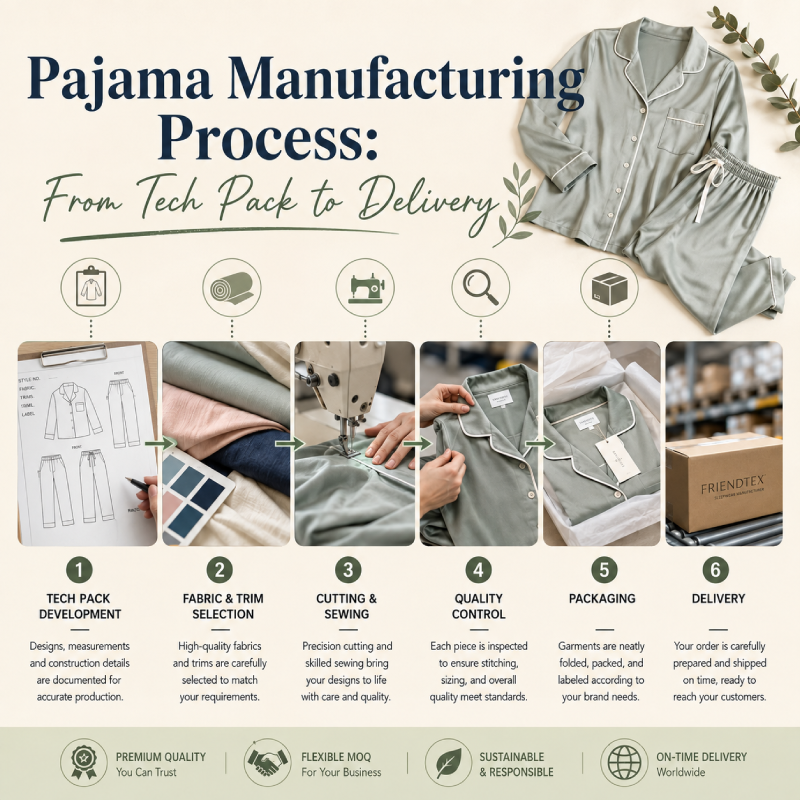
Every pair of pajamas in a store or on a website begins its life as a document. Before a single meter of fabric is cut, before the first seam is sewn, someone writes down exactly what the garment should be — every measurement, every stitch, every label, every centimeter of ease. This document is called a tech pack, and what happens between that first file and the finished cartons on a delivery truck is one of the least understood — and most important — parts of the entire sleepwear industry.
Key Takeaways
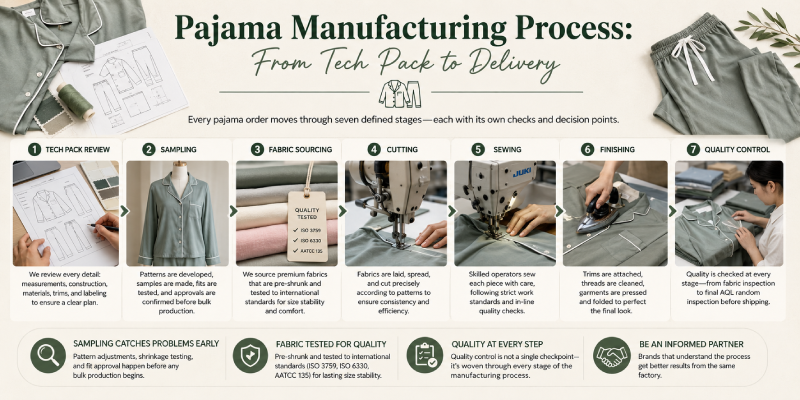
Every pajama order moves through seven defined stages: tech pack review, sampling, fabric sourcing, cutting, sewing, finishing, and quality control — each with its own checks and decision points.
The sampling stage is where most problems should be caught: pattern adjustments, shrinkage testing, and fit approval happen before any bulk production begins.
Fabric is pre-shrunk and tested against international standards (ISO 3759, ISO 6330, AATCC 135) before production, so garments stay true to size after consumer washing.
Quality control is not a single checkpoint — it’s woven through every stage, from incoming fabric inspection to final AQL random inspection before shipping.
For brands, understanding this process is the difference between being a passive order-placer and an informed sourcing partner — the brands that understand the stages get better results from the same factory.
Stage 1: The Tech Pack — Where Every Order Starts
The tech pack is the blueprint of the garment. It’s what tells the factory exactly what to make. A complete tech pack for a pajama set includes:
| Section | What It Contains | Why It Matters |
|---|---|---|
| Flat sketch & spec sheet | Front/back drawings, every measurement with tolerance | The factory’s pattern maker builds the pattern from these numbers |
| Bill of materials (BOM) | Fabric, thread, buttons, elastic, labels, trims | Costing and sourcing start here |
| Grade rules | How measurements change between sizes (S, M, L, XL) | Determines whether all sizes fit consistently |
| Construction details | Seam types, stitch counts, hem widths, button placement | Defines how the garment is assembled |
| Label and packaging specs | Care labels, hang tags, poly bags, carton marks | Compliance and retail requirements |
| Color standards | Pantone references, print placement | Prevents the “color came back wrong” problem |
When a tech pack arrives at Friendtex, our first step is not production — it’s review. Our product development team checks the pack for missing measurements, inconsistent grading, and details that won’t survive actual production. This review catches more problems than any later stage: a tech pack issue discovered here costs nothing to fix; the same issue discovered after cutting costs fabric, time, and money.
What brands should know: A 90% complete tech pack is one of the most common causes of sampling delays. The brands that ship a complete pack on day one typically save 1-2 weeks of development time.
Stage 2: Sampling — Where Fit Is Decided
Once the tech pack is approved, the factory makes a sample. This is where the design becomes a physical object for the first time — and where most of the garment’s quality is determined.
The First Sample
The pattern maker drafts the pattern from the spec sheet, cuts the first sample by hand or digitally, and the sample room sews it. At Friendtex, this first sample is reviewed against the spec sheet measurement by measurement — every point on the garment is compared to the numbers in the tech pack.
Fit Testing on Real Bodies
A garment can match its spec sheet and still fit badly — that’s why we test-fit samples on real people, not mannequins. The fit model wears the sample, and the development team checks: Does the neckline sit right? Do the sleeves have enough room? Do the pants rise correctly? Does the fabric ease feel right when sitting, bending, and lying down?
For pajamas specifically, the key fit questions are different from other apparel:
Does the waistband sit comfortably without digging in?
Is there enough room to move and turn in bed?
Do the armholes allow free movement?
Does the length work for the intended size and fit preference?
Sample Revisions
Most garments go through 2-3 sample rounds before approval: the first sample (fit and design confirmation), sometimes a second (revisions and fabric confirmation), and a photo/salesman sample or pre-production sample (final confirmation of color, print, and construction). Each round is a checkpoint — and skipping rounds to save time is how sizing disasters happen.
Shrinkage Testing During Sampling
While the sample is being made, the fabric itself goes through shrinkage testing. At Friendtex, fabric is tested to international standards — ISO 3759, ISO 6330, ISO 5077, AATCC 135, and AATCC 150 — using a Wascator lab washing machine that simulates real consumer washing.
The test process:
Marking: Key points on the fabric — chest, hem, sleeve, waist, hip, inseam — are marked with a sample marker
- Washing:The sample is washed in the lab washer at the temperature specified on the care label
Drying and relaxation: The sample is dried (low heat or air) and left to relax for four hours
If shrinkage exceeds the acceptable tolerance (typically under 5%), the pattern is adjusted to compensate — so the garment fits correctly after the consumer washes it, not just on the day it’s sewn.
What brands should know: The first physical sample is not the finished product — it’s the beginning of the fit conversation. A brand that approves a sample without fit-testing it is shipping its quality control responsibility to the factory and hoping for the best.
Stage 3: Fabric Sourcing and Preparation
While samples are being finalized, the production fabric is sourced and prepared. This stage has more moving parts than most brands realize:
Fabric Selection and Certification
The fabric is sourced to the tech pack’s specifications, with certifications verified at this point: OEKO-TEX® Standard 100 (harmless substances), GOTS (organic fiber content), and FSC (sustainable sourcing) documentation is collected and checked. For children’s sleepwear, flammability requirements (16 CFR 1615/1616 for the US market) determine whether tight-fitting construction or flame-resistant fabric is used.
Pre-shrinking and Pre-treatment
Before cutting, the production fabric is pre-shrunk and pre-treated. Pre-shrinking relaxes the fibers so the fabric’s remaining shrinkage after consumer washing stays within tolerance. Bamboo fabrics may receive enzyme treatments to enhance softness and stability. This is the difference between a pajama that fits after ten washes and one that shrinks into disappointment after two.
Incoming Fabric Inspection
Every fabric delivery is inspected before it enters the production line: color consistency across rolls, weight (GSM) verification, width measurement, and defect checking. A single defective roll caught here saves hours of cutting and sewing time later.
Stage 4: Cutting — Precision Before Sewing
Cutting is where fabric becomes garment parts — and where waste and error are most visible. Modern factories like Friendtex use CNC cutting machines for precision, paired with digital nesting software that arranges pattern pieces to maximize fabric utilization.
| Cutting Technology | Benefit |
|---|---|
| CNC cutting | Precision to the millimeter; consistent pieces across the entire order |
| Digital nesting | Maximizes fabric utilization — less waste, lower material cost |
| Manual marker checking | Final verification before the blade runs |
| Piece numbering | Every cut piece is tracked through sewing |
The cut pieces are bundled and numbered so that each garment’s pieces stay together through the sewing line — a small detail that prevents mismatched panels and color variation within a single garment.
What brands should know: Fabric utilization directly affects cost. A factory that nests efficiently can reduce fabric waste by 5-10%, which shows up in the unit price. The cutting stage is where that efficiency is won or lost.
Stage 5: Sewing — Where the Garment Comes Together
The sewing line is where the pajama is assembled — and where production speed meets quality control. A pajama set typically involves 30-60 individual sewing operations: shoulders, sleeves, side seams, collar, placket, cuffs, waistband elastic, hem, buttonholes, and button attachment.
Quality Control Points on the Line
At Friendtex, quality checks happen at intervals along the line, not just at the end:
Inline inspection: Operators check their own work and line supervisors spot-check output
Measurement checks: Random garments are pulled and measured against the spec sheet during production, not just at the end
Stitch and seam inspection: Seam strength, stitch density, and consistent seam allowances are verified
Button and snap tension: Fasteners are tested for pull strength — a snap that pops off in week two is a defect that should never ship
For nursing pajamas and family sets, the hardware (snaps, clips, buttons) is checked against cycle-testing data — these garments are opened and closed dozens of times per week, and the hardware must survive years, not weeks.
Stage 6: Finishing and Post-Production Treatment
After sewing, garments go through finishing — the stage that determines how the product feels in the consumer’s hand:
- Washing:Garment washing softens the fabric and removes residual chemicals or loose fibers
Drying and relaxation: Controlled drying, with garments relaxing before measurement
Pressing/ironing: Garments are pressed to retail-presentable condition
- Trimming:Loose threads are trimmed — a small detail that disproportionately affects perceived quality
Final measurement verification: Finished garments are measured against the size chart before packing
What brands should know: The finishing stage is where “feels cheap” vs. “feels premium” is decided. The same fabric and pattern can produce a $15-feeling or a $50-feeling product depending on finishing quality — pressing, trimming, and fabric softening are the difference.
Stage 7: Quality Control and Inspection
Before any carton ships, the finished goods go through final quality control. This is the last line of defense — and it’s more systematic than most buyers expect:
The 4-Point Inspection System
Garments are inspected using the standard 4-point system, which assigns defect points based on size and severity (minor vs. major defects). Each garment’s defect points are totaled, and the batch is judged against the acceptance limit agreed in the contract — typically AQL (Acceptable Quality Limit) 2.5 for apparel.
Random Sampling
Finished batches are randomly sampled — typically 10-15% of the order depending on the agreed AQL level — and every sampled garment is checked:
| Check Point | What’s Verified |
|---|---|
| Measurements | Critical points vs. spec sheet within tolerance |
| Construction | Seams, stitching, hem, placket, buttonholes |
| Hardware | Snap/button attachment strength, zipper function |
| Fabric | Color consistency, print alignment, defects |
| Labeling | Care labels, size labels, hang tags — content and placement |
| Packaging | Poly bag quality, carton packing, carton marking |
Compliance Documentation
For every order, the compliance file is assembled: OEKO-TEX® certificates, GOTS documentation (for organic products), and for children’s sleepwear, the CPC (Children’s Product Certificate) documenting flammability compliance. This file ships with the order and is what retailers require before listing the product.
The Full Timeline: What a Realistic Order Looks Like
Here’s what the complete journey looks like on a calendar — a realistic timeline for a standard pajama order from tech pack to delivery:
| Stage | Typical Duration | Key Milestone |
|---|---|---|
| Tech pack review | 2-5 days | Pack approved, no open questions |
| Sampling (2-3 rounds) | 3-6 weeks | Sample approved, fit confirmed |
| Fabric sourcing + testing | 2-4 weeks (overlaps with sampling) | Fabric approved, shrinkage data in hand |
| Cutting | 3-7 days | All pieces cut and bundled |
| Sewing | 2-4 weeks | Line production complete |
| Finishing | 3-7 days | Garments washed, pressed, measured |
| Final QC + inspection | 3-5 days | Batch passes AQL inspection |
| Packing and shipping | 2-7 days | Cartons loaded, documents issued |
| Total | ~8-14 weeks | Order delivered |
This is why we always tell brands planning for a holiday season: start 4-6 months before you need inventory. There is no stage in this process that can be safely rushed without trading away quality — and the only reliable way to meet a December deadline is to start in July or August.
What This Process Means for Your Brand
Understanding the factory process transforms how you source:
You ask better questions. Instead of “how much for 1,000 sets?”, you ask about sample rounds, shrinkage tolerance, AQL levels, and compliance documentation.
You avoid the classic mistakes. Most sourcing failures — sizes that don’t fit, colors that don’t match, late deliveries — trace back to decisions made (or skipped) in the early stages.
You get better results from the same factory. Brands who understand sampling and fit testing get better-fitting products; brands who understand the timeline plan better and avoid rush fees.
You can evaluate factories properly. A factory’s real capability shows in how it handles the stages — its test standards, its QC points, its documentation discipline.
At Friendtex, we’ve run this process for 15+ years across pajamas, robes, nightgowns, and underwear for global brands. Our factory is certified OEKO-TEX® Standard 100, GOTS, and BSCI, uses ISO-standard testing (ISO 3759, ISO 6330, ISO 5077, AATCC 135/150), and produces with flexible MOQs starting from 300 pieces per design. If you’re planning a sleepwear line — or wondering how a factory should handle your current order — contact our team and we’ll walk you through what happens at each stage of your order.
FAQ
How long does a pajama order take from start to delivery?
A standard pajama order typically takes 8-14 weeks from tech pack to delivery: 3-6 weeks for sampling, 2-4 weeks for fabric sourcing and testing, 2-4 weeks for cutting and sewing, and 1-2 weeks for finishing, QC, and shipping. Rush orders can compress parts of this, but sampling and fabric testing should never be rushed — that’s where quality is decided.
What is a tech pack and why does it matter?
A tech pack is the complete specification document for a garment — measurements, construction details, materials, grading, labels, and packaging requirements. It’s the blueprint the factory builds from. A complete tech pack saves 1-2 weeks of development time; an incomplete one causes sampling delays and errors that are expensive to fix later.
How many sample rounds does a typical order need?
Most pajama orders need 2-3 sample rounds: a first sample to confirm fit and design, sometimes a second for revisions, and a pre-production or photo sample to confirm color, print, and construction. Factories promising “no samples, straight to production” are a red flag — sampling is where sizing problems are caught.
How does the factory prevent pajamas from shrinking?
Fabric is pre-shrunk before production, and shrinkage is verified by lab testing to international standards (ISO 3759, ISO 6330, AATCC 135) using a Wascator lab washer. Samples are washed, dried, relaxed for four hours, and re-measured; if shrinkage exceeds tolerance (typically under 5%), the pattern is adjusted to compensate. This ensures garments fit correctly after the consumer washes them.
What is AQL inspection?
AQL (Acceptable Quality Limit) is the industry-standard statistical sampling method for finished goods. For apparel, AQL 2.5 is typical: a random sample (usually 10-15% of the order) is inspected against defect criteria — measurements, construction, hardware, labeling, packaging — and the batch passes only if defects stay within the agreed limit.
What compliance documents should my factory provide?
For most pajama orders: OEKO-TEX® Standard 100 certification (harmless substances), plus GOTS documentation if organic. For children’s sleepwear sold in the US, the CPC (Children’s Product Certificate) documenting flammability compliance (16 CFR 1615/1616) is mandatory. BSCI certification covers ethical factory practices. Always request the actual documents, not just verbal claims.
Why does Friendtex test samples on real people?
A garment can match every number in its spec sheet and still fit badly. Fit testing on real bodies — not mannequins — catches what measurements can’t: how the neckline sits, whether sleeves allow movement, how the waistband feels when sitting, whether the rise works when lying down. For sleepwear specifically, fit in motion matters more than for most garments.