When a pajama order arrives with twisted seams, inconsistent sizing, shade differences, or the wrong care labels, the problem is bigger than a few imperfect pieces. You may face delayed launches, markdowns, returns, poor reviews, and expensive rework. A clear pajama quality control checklist helps you catch those risks before the cartons leave the factory.
This guide gives you a practical framework for custom, private-label, and wholesale pajama orders. You can use it to brief your manufacturer, align an internal QC team, or prepare a third-party inspector. It covers the full order—from approved specifications and fabric checks to workmanship, wash testing, AQL inspection, packaging, and corrective action.
Key Takeaways
- Your approved sample, tech pack, purchase order, and written tolerances should form one inspection standard.
- You should check quality before production, during sewing, and again before shipment; final inspection alone is too late for many systemic problems.
- Pajama QC must cover comfort and wash performance as well as appearance, measurements, construction, labels, and packing.
- AQL gives you a sampling decision, but it does not replace safety testing, laboratory reports, or process control.
- Your inspection agreement should state what happens after a failed result, including rework, reinspection, timing, and cost responsibility.
What Is a Pajama Quality Control Checklist?
A pajama quality control checklist is a written set of product requirements, inspection steps, test methods, and pass/fail rules for a specific order. It turns a phrase such as “high-quality pajamas” into criteria that your supplier and inspector can actually verify.
The strongest checklist is style-specific. A satin button-front set does not carry the same risks as a brushed flannel set, a knit bamboo-viscose style, or children’s sleepwear. Your document should reflect the exact fabric, construction, size range, trims, decoration, destination market, and packaging route for the purchase order.
Keep these reference documents together:
- Signed purchase order and quantity breakdown
- Latest approved tech pack and bill of materials
- Graded measurement chart with points of measurement
- Approved fit or pre-production sample
- Approved fabric swatch, lab dip, strike-off, print, and trim card
- Label and packaging artwork
- Testing and compliance requirements for the destination market
- Agreed sampling plan, defect classifications, and acceptance criteria
Mark each file with a version and approval date. If the factory floor, your buying team, and the inspector use different revisions, even a careful inspection can produce the wrong result.
Why Pajamas Need Their Own QC Standards?
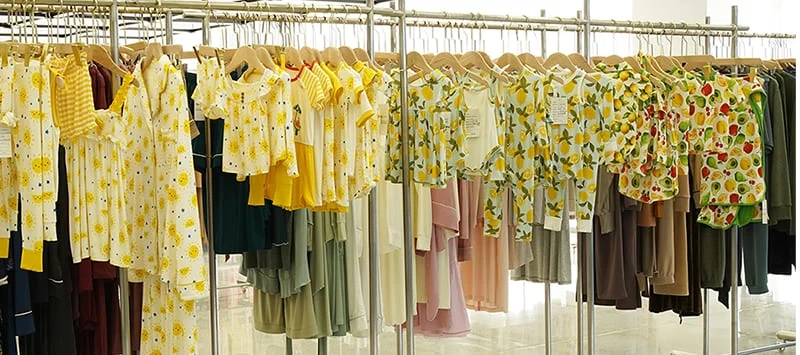
Pajamas look simple, but customers judge them for hours at a time. A small defect can become irritating during sleep, and repeated washing can expose problems that are not obvious on a fresh sample.
Your checklist should account for pajama-specific risks such as:
- Waistbands that roll, twist, pinch, or lose recovery
- Piping or lace that scratches the skin
- Side seams and leg seams that torque after washing
- Buttons, snaps, or zippers that press against the body
- Crotch, armhole, and seat seams that fail under movement
- Print placement that looks mismatched across a two-piece set
- Fabric that pills, fades, shrinks, becomes transparent, or loses its hand feel
- Neck openings, cuffs, or ankle openings that do not stretch as intended
- Loose cords, unsafe trims, or noncompliant labeling on children’s styles
This is why a generic “check stitching and packing” instruction is not enough. You need measurable standards tied to how the pajamas will be worn, washed, sold, and shipped.
Your Pajama Quality Control Checklist by Production Stage
1. Lock the Product Standard Before Bulk Production
Start QC before the factory cuts bulk fabric. Review the pre-production sample against the final tech pack and record every approved change. If you accept a deviation—perhaps a different elastic width or a revised button position—update the documents rather than relying on a message thread.
Confirm:
- Style number, colorway, size range, and order quantities
- Fiber content, fabric construction, weight, width, finish, and hand feel
- Main fabric, contrast fabric, lining, elastic, thread, buttons, zippers, lace, piping, and other trims
- Print scale, repeat, direction, placement, and color reference
- Embroidery size, location, stitch coverage, backing, and thread colors
- Seam types, stitch density, reinforcement points, and edge finishes
- Measurement method and tolerance for every critical point
- Brand label, size label, care label, country-of-origin marking, hangtag, barcode, polybag, and carton requirements
Treat the approved sample as a physical reference, but do not let it replace the written specification. A sample can show how the garment should look; your tech pack explains how the inspector should measure and judge it.
2. Inspect Fabric and Trims Before Cutting
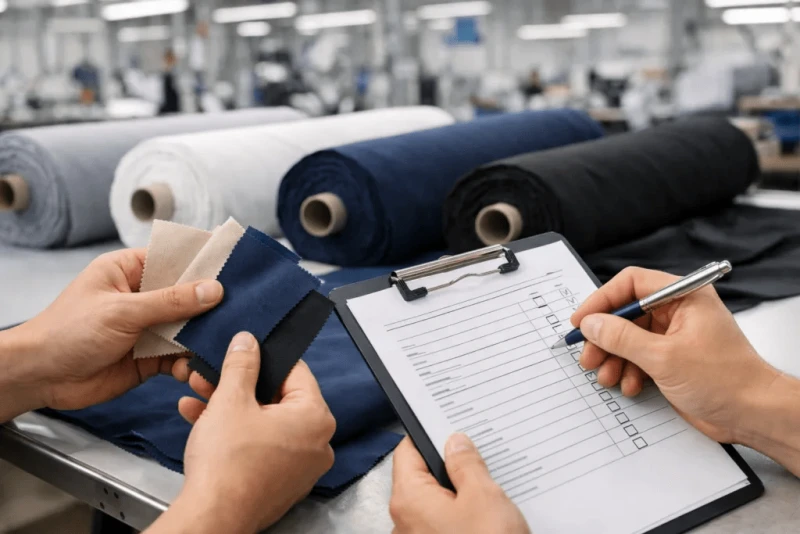
Fabric defects become expensive once hundreds of panels have been cut. Ask the factory to inspect incoming rolls and quarantine any material that does not match the approved standard.
Check the main fabric for:
- Correct fiber content and construction
- Weight or fabric mass within the agreed tolerance
- Usable width and total received quantity
- Shade consistency within and between rolls
- Holes, stains, barre, bowing, skewing, slubs, streaks, snags, or knitting and weaving faults
- Correct face and back, nap direction, and print direction
- Hand feel, drape, stretch, recovery, and opacity
- Odor, moisture, mildew, or contamination
Review trims at the same time. Confirm the width and recovery of elastic, button color and size, zipper length and function, drawcord construction, thread shade, label text, and decoration materials. For metal trims or sensitive markets, include the applicable safety and restricted-substance checks in your testing plan.
If color is important, approve a lab dip or bulk shade under an agreed light source. Do not judge a shade only from a phone photo, where screens and lighting can distort the result.
3. Check Patterns, Markers, and Cutting
A cutting or grading error repeats across the order, so early detection protects far more units than a final random check.
Your cutting-room review should verify:
- The correct approved pattern revision is in use
- Pattern pieces are complete and correctly graded
- Grainline, stretch direction, nap, and print direction are followed
- Stripes, checks, motifs, pockets, and piping are matched where specified
- Cut panels are clean, accurate, and free from fused or ragged edges
- Notches and drill marks are accurate and not visible on the finished garment
- Bundles are correctly identified by style, size, color, and lot
- Shade lots are separated to prevent visible panel mismatch
For a pajama set, make sure the top and bottom are paired from compatible shade lots. A small color difference may look minor on separate pieces but obvious when the set is worn together.
4. Run Inline Sewing Inspections
Inline inspection lets you correct the process while production is still moving. Ask for checks at the start of the line and again when enough units have been sewn to reveal recurring issues.
Inspect:
- Seam type and seam allowance
- Stitch density, thread tension, and stitch balance
- Skipped, broken, loose, or uneven stitches
- Open seams, needle holes, raw edges, and seam slippage
- Puckering, roping, twisting, and uneven hems
- Backtacking or reinforcement at stress points
- Crotch, seat, armhole, underarm, pocket, waistband, placket, and button areas
- Piping width, lace application, topstitching, and decorative consistency
- Button and buttonhole alignment
- Zipper, snap, hook, tie, and drawcord function
- Elastic joining, distribution, extension, and recovery
Pull gently at stress seams and operate closures several times. If the order needs a defined seam-strength, attachment-strength, or stretch test, specify the method and acceptance value instead of relying on an informal hand pull.
Record defects by operation and production line. “Twenty skipped stitches found” is less useful than knowing that most occurred at one cuff operation on one machine. The second record points to a fix.
5. Verify Measurements and Fit
Pajamas may have a relaxed silhouette, but relaxed does not mean uncontrolled. Your customers still expect consistent sizing from one color and reorder to the next.
Measure garments on a flat surface without stretching them unless the point of measurement specifically requires extension. Follow the same diagram and method every time.
Typical points include:
- Chest, waist, hip, and sweep
- Shoulder width and across-back width
- Body length and sleeve length
- Armhole, bicep, cuff, and neck opening
- Waistband relaxed and extended measurement
- Front rise, back rise, inseam, outseam, thigh, knee, and leg opening
- Pocket size and placement
- Button, piping, embroidery, and print placement
Set tolerances by point of measurement. A critical fit point may need a tighter tolerance than a decorative placement or noncritical length. Also define the measurement sample by size and color; checking only the base size can miss a grading problem.
Fit review should go beyond the tape measure. Check balance, ease, mobility, neckline comfort, waistband pressure, crotch comfort, sleeve movement, and whether the garment rides up or twists. For a two-piece set, confirm that the top and bottom size labels and proportions match.
6. Test Fabric and Finished-Garment Performance
Visual inspection cannot tell you how pajamas will behave after laundering or repeated wear. Build performance testing around the fiber, finish, decoration, care instruction, price point, and destination market.
Depending on the product, your plan may include:
- Dimensional stability or shrinkage after laundering
- Spirality or twisting after wash
- Colorfastness to washing, rubbing, perspiration, water, or light
- Pilling and abrasion resistance
- Seam strength or seam slippage
- Bursting or tensile strength
- Stretch and recovery, especially at waistbands, cuffs, and neck openings
- Print, embroidery, foil, or heat-transfer durability
- Button, snap, zipper, and trim attachment performance
- Appearance after laundering, including puckering and hand-feel change
- Fiber composition and restricted-substance testing
- Flammability and other mandatory safety testing where applicable
State the test method, conditioning, number of wash cycles, care procedure, acceptance limit, and laboratory requirement in writing. “Wash tested” is not a useful standard unless everyone knows how the item was washed and what result counts as a pass.
Do not treat an old report for a similar fabric as automatic proof for a new order. Confirm that each report matches the relevant material, color, finish, trim package, production lot, and market requirement.
7. Conduct a Finished-Pajama Workmanship Check
At end-line and final inspection, examine the pajamas inside and out under suitable lighting. Compare them with the approved sample and specification.
Look for:
- Correct style, color, size, and set combination
- Clean, balanced silhouette and symmetrical panels
- Smooth seams, hems, plackets, collars, cuffs, and waistbands
- No holes, cuts, stains, oil, chalk, scorch marks, or unwanted shine
- No loose threads, raw edges, fabric caught in seams, or visible repairs
- Secure buttons, snaps, bows, elastic, lace, and decorative parts
- Even pocket placement and matching left/right details
- Correct print direction and acceptable motif placement
- No sharp points, broken needle fragments, or other contamination
- Clean pressing without distortion, glazing, or seam impressions
- Acceptable odor and dryness before packing
Comfort deserves a separate check. Run a hand along the inside seams, labels, lace, piping, zipper guards, and embroidery backing. Anything that feels sharp or scratchy on the inspection table may feel worse after a full night’s wear.
8. Confirm Labels, Packaging, and Cartons
The garment can be well made and still be unsellable if the barcode, size sticker, fiber label, or carton assortment is wrong.
Verify:
- Brand, size, fiber-content, care, and origin information matches approved artwork and market rules
- Labels are in the correct position, orientation, language, and sequence
- Tracking or batch information is present where required
- Hangtags, spare buttons, stickers, warning labels, and inserts are correct
- Barcodes scan and match the SKU, color, and size
- Pajama tops and bottoms are paired correctly
- Folding, tissue, banding, polybag size, ventilation, and sealing follow the pack instruction
- Polybag warnings and material markings are correct where applicable
- Inner-pack and carton assortments match the purchase order
- Carton dimensions, weight, quantity, shipping marks, and destination labels are accurate
- Cartons are clean, dry, strong, and sealed for the planned transport route
Perform a quantity reconciliation across the packing list, finished-goods count, and carton markings. If your warehouse or marketplace has routing requirements, add them to the checklist rather than treating them as a separate last-minute task.
9. Check Safety and Market Compliance
Compliance depends on the product, age group, claims, and country of sale. You should identify applicable rules during product development, not after the goods are packed.
Children’s sleepwear requires particular care. In the United States, products within the scope of 16 CFR Parts 1615 and 1616 are subject to specific flammability, production-unit, testing, and labeling requirements. Tight-fitting or otherwise excepted garments follow different conditions and still have applicable requirements. Work with a qualified compliance specialist and a properly accepted laboratory to confirm the route for your exact style.
Your compliance file may need:
- Applicable test reports tied to the actual product or production unit
- Certificates required for the destination market
- Accurate fiber, care, origin, tracking, and warning labels
- Restricted-substance and chemical test evidence
- Records for trims, coatings, prints, and accessories
- Product, batch, factory, and testing traceability
Never assume that a supplier’s general factory certificate proves that your finished pajama style complies. Factory systems, material certifications, product tests, and legal certificates serve different purposes.
How to Use AQL for a Wholesale Pajama Inspection?
Acceptance sampling lets you draw a structured pass/reject decision from randomly selected units without inspecting every piece. Standards such as ISO 2859-1 or ANSI/ASQ Z1.4 are commonly used, but you and your supplier must agree on the version, lot definition, inspection level, and AQL values before production.
Many apparel buyers use separate limits for critical, major, and minor defects. For example, a buyer might require no critical defects and choose stricter acceptance for major defects than for minor defects. The right plan depends on your product risk, price point, customer requirements, order history, and legal obligations.
Use practical defect definitions:
| Defect class | What it means | Pajama examples |
|---|---|---|
| Critical | Unsafe, illegal, or likely to cause serious harm | Sharp metal, broken needle fragment, noncompliant safety feature, serious mandatory-label failure |
| Major | Likely to cause a return, make the item unusable, or prevent sale as intended | Open seam, wrong size, severe measurement failure, broken closure, wrong fabric or color |
| Minor | Cosmetic or workmanship issue that does not materially affect use or saleability | Small loose thread, slight nonprominent stitch variation, minor removable mark |
Do not describe AQL as a promise that the shipped lot contains only a certain percentage of defects. It is an acceptance-sampling tool with producer and consumer risk. Safety-critical requirements, laboratory tests, and any characteristics you require on every unit need their own controls.
For very small orders, luxury styles, high-risk children’s products, or a supplier with repeated failures, you may choose tighter sampling, targeted checks, or 100% inspection for selected characteristics.
What to Do When an Inspection Fails?
A failed inspection should trigger a controlled response, not a debate over photos.
Follow this sequence:
- Put the affected lot on hold and stop shipment.
- Confirm the defect, quantity affected, size/color pattern, and likely root cause.
- Separate isolated defects from systemic failures.
- Agree on sorting, repair, replacement, recutting, retesting, or rejection.
- Require a corrective-action record with owner and completion date.
- Reinspect the repaired lot using an agreed sampling plan.
- Release payment or shipment only after the required evidence is accepted.
Write these rules into your purchase agreement. State who pays for reinspection, rework, replacement, expedited freight, or testing when the supplier caused the failure. Also set a deadline, because a technically repairable order can still miss its selling season.
Questions to Ask Your Pajama Manufacturer
Before you approve a wholesale order, ask:
- Which QC checkpoints do you use for fabric, cutting, sewing, finishing, and packing?
- Will you use my approved sample and current tech pack at every inspection point?
- How do you separate shade lots and control matching within a pajama set?
- Which measurements do you audit inline, and how many pieces do you check?
- Which wash, colorfastness, pilling, seam, and trim tests can you perform in-house?
- Which tests require an independent laboratory?
- How do you manage broken needles and metal contamination?
- Can you provide dated inspection reports with photos and defect quantities?
- What AQL plan do you normally use, and can it be adjusted to my requirements?
- What is your rework and reinspection procedure after a failed result?
- How do you keep labels, barcodes, size ratios, and carton assortments accurate?
- Can you trace finished goods back to fabric, trim, production, and testing records?
A capable supplier should answer with documents and examples, not only assurances.
FAQ
When should you inspect a pajama order?
You should check materials and approvals before cutting, inspect workmanship and measurements during production, and complete a final inspection before shipment. Add laboratory testing and loading checks when the product or order risk requires them.
Is a final random inspection enough?
Not by itself. It may find finished-goods defects, but it cannot efficiently correct fabric, pattern, grading, or repeated sewing problems after the order is complete. Early and inline checks give you time to fix the process.
Should you hire a third-party inspector?
A third-party inspection can be useful when you cannot visit the factory, the order is high value, the supplier is new, or an independent release decision is important. You still need to provide the inspector with your approved documents and pass/fail rules.
What documents should you receive after inspection?
Ask for the inspection date, factory and order details, available and packed quantities, sampling plan, measurement results, test results, defect counts by class, photos, packing findings, overall result, and corrective actions.
How do you control quality across repeat orders?
Keep the approved sample and specifications under version control, compare bulk materials with previous approvals, review defect trends, and repeat performance testing at an agreed frequency. A reorder should not be accepted solely because the first order passed.
Final Pajama Quality Control Checklist
Before you release a shipment, confirm that:
- The current purchase order, tech pack, bill of materials, and approved sample match
- Bulk fabric, shade, print, trims, and labels are approved
- Patterns, grading, cutting direction, and shade grouping are correct
- Inline inspections show stable sewing and measurement results
- Finished pajamas meet appearance, construction, fit, and comfort standards
- Required wash, performance, chemical, and safety tests have passed
- Measurements fall within the agreed tolerances across selected sizes and colors
- Defects meet the agreed sampling and acceptance plan
- Labels, barcodes, packaging, assortments, quantities, and cartons are correct
- Compliance and traceability records match the actual order
- Any failed items were corrected, documented, and reinspected
- Shipment release is recorded by the authorized buyer or QC representative
Conclusion
A useful pajama quality control checklist does more than help an inspector find loose threads. It gives you and your manufacturer one shared definition of an acceptable product, one method for checking it, and one agreed response when the result falls short.
Build the checklist before bulk production, tailor it to the style and destination market, and use it at several production stages. When your specifications, samples, tests, inspection records, and corrective actions all connect, you can approve wholesale pajama shipments with far more confidence.
If you are developing a custom or private-label pajama collection, Friendtex can review your tech pack, material choices, testing needs, and quality requirements before production. Send your style details, size range, target market, quantities, and packaging brief to start a practical sourcing discussion.