Every sourcing team has heard the pitch. The fabric is “premium,” the construction is “high-end,” the finish is “luxury.” Almost none of it survives contact with a purchase order, because these words describe a feeling, and a factory cannot sew a feeling. What a factory can do is sew ten stitches to the inch instead of seven, enclose a raw edge in a French seam instead of running it through an overlocker, and hold a color difference to ΔE 0.8 instead of shrugging at 2.5. The gap between an ordinary pajama and a premium pajama manufacturer’s output is not mystique. It is a stack of measurable specifications, each one of which costs time, thread, or fabric — which is exactly why the price is higher and why the price is fair.
This article translates “premium” into the six specification groups where the money actually goes: fabric, stitch density, seam construction, trims, finishing, and acceptance tolerances. At the end there is a spec block you can paste directly into a tech pack, and a two-step way to verify any supplier without leaving your desk — one garment and one document.
Key Takeaways
- “Premium” is verifiable: stitch density, seam construction, trim grade, finishing, and color tolerance all have industry-standard numbers.
- Mass-market sewing runs 6–8 stitches per inch (SPI); premium construction runs 10–12 and higher, which slows the line and raises cost honestly.
- The inside of the garment is the fastest audit: French seams, bound edges, and clean overlock density separate premium from mass-market in ten seconds.
- Trims — mother-of-pearl buttons, self-fabric bindings, tag-free labels — are where shortcuts hide, because they are cheap to swap and easy to overlook in sampling.
- Color is where premium is enforced: a ΔE tolerance of 0.5–1.0 versus 2.0–3.5 for fast fashion is the single clearest technical divide.
- A premium spec is worthless unless it is written into the tech pack and checked at inline inspection — sampling promises drift by bulk.
The Fabric Layer: Fiber Grade, Yarn, and Weight
Premium starts before the cutting table, at the yarn. Three numbers do most of the work.
Fiber grade. For cotton, long-staple varieties (Supima, Egyptian Giza) produce smoother, stronger yarns than commodity upland cotton, and they resist pilling through dozens of washes. For silk, the grade of the mulberry fiber and the weave weight matter more than the word “silk” itself — more on that below. For regenerated fibers like lyocell and modal, fiber producer and solvent-recovery process matter to both hand-feel and compliance.
Yarn count. Two 160 gsm jerseys do not feel the same if one is knit from 40s yarn and the other from 60s. Higher-count combed yarns are more expensive, produce a finer surface, and take dye more evenly. If a quotation does not state yarn count, it is usually because the mill is holding the cheaper option open.
Weight — and the right unit. Knits are specified in GSM (grams per square meter). Sleepwear jerseys typically run 140–200 gsm; premium winter interlock or brushed programs run heavier. Silk has its own unit, the momme, which measures the weight of a 45-inch by 100-yard piece of silk in pounds. One momme is roughly 4.3 GSM. The practical ladder:
| Silk weight | ≈ GSM | Character | Typical use |
|---|---|---|---|
| 16 momme | ~69 | Light, semi-transparent | Summer chemises, camisoles |
| 19 momme | ~82 | Balanced drape and durability | The everyday standard for silk sleepwear |
| 22 momme | ~95 | Denser, more opaque, more durable | Premium and gifting programs |
| 25 momme | ~108 | Substantial | Robes, statement pieces |
A brand that specifies “19 momme” in a silk tech pack, rather than “premium silk,” has removed the single most common dispute in the category before it starts. The same logic applies to every fiber: premium fabric is not a vibe, it is a stated count, a stated weight, and a stated grade — with a lab report attached when it matters.
Stitch Density: The Number That Predicts Everything
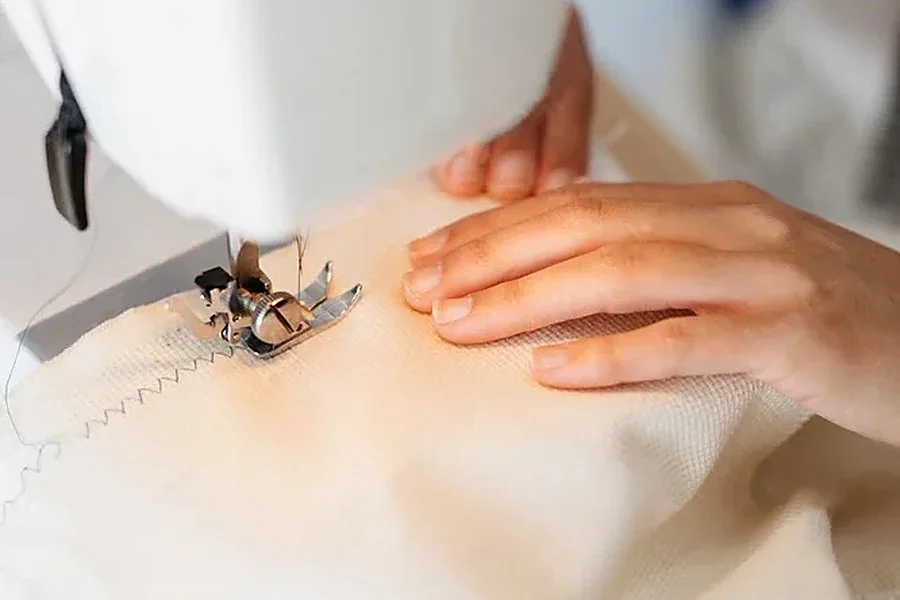
If you only learn one construction number, learn SPI — stitches per inch. It is the most reliable single indicator of how a factory is built, because it converts directly into machine time, thread consumption, and operator skill.
| Construction tier | Typical SPI | What it means on the floor |
|---|---|---|
| Mass-market | 6–8 | Machines run at maximum speed; seams are serviceable but prone to grinning (visible gaps when stretched) |
| Mid-range | 8–10 | Standard for private-label basics |
| Premium | 10–12 | Slower machine speed, more thread, trained operators; seams stay flat under tension |
| Haute/luxury houses | 12–14+ | Hand-finishing territory for critical seams |
Why higher SPI costs more: the machine must move slower, consumes roughly 30–50% more thread, and punishes any error in tension — which means operators must actually know what they are doing. A seam sewn at 11 SPI with balanced tension survives years of washing and pulling without puckering. The same seam at 7 SPI can open visibly at the first tug.
Premium sleepwear programs also tend to specify single-needle topstitching on visible seams, which tracks straight and looks deliberate, versus chainstitch shortcuts that can wander. And they specify the stitch type by name — lockstitch for wovens, coverstitch with specific needle count for knits — because “neat stitching” is not a specification; “301 lockstitch, 11 SPI, single needle” is.
What to ask a supplier: “What SPI do you run on side seams and topstitching for this program?” A factory that quotes a number instantly is running a calibrated line. A factory that says “good quality” is not.
Seams: The Ten-Second Audit
Turn any pajama inside out and you can grade the factory that made it. The finishing inside a garment is the part no consumer sees before buying — which is precisely why it is the most honest indicator of the maker’s priorities.
| Seam finish | What it looks like | Where premium programs use it |
|---|---|---|
| French seam | Raw edge fully enclosed inside a folded second seam; inside is smooth to the touch | Silk and lightweight wovens — the premium default |
| Bound edge (Hong Kong finish) | Raw edge wrapped in a thin bias strip, often self-fabric or rayon | Unlined wovens, robes, statement pieces |
| Flat-felled seam | Two parallel rows on the face, layers interlocked | Heavy cottons, pyjama outseams that must survive years |
| Dense multi-thread overlock | 4–5 threads, tight cage, thread color matched to fabric | Knits — acceptable finish when executed well |
| Loose 3-thread overlock, generic gray thread | Shaggy edge, visible contrast | Mass-market. This is what “premium” is defined against |
Two details separate real premium construction from sampling-theater:
Bar tacks at stress points. Pocket corners, placket ends, fly bases, drawstring channels — every point where fabric meets repeated force should carry a dense reinforcement stitch. They cost seconds per garment; their absence costs returned garments.
Pattern matching. Stripes, checks, and prints that align across side seams and pocket faces mean the cutter spent 15–20% more fabric to place panels on-grain and on-pattern. Budget programs never do this. If pattern pieces are tilted off-grain to squeeze yield, the garment will torque after washing — side seams migrating forward, hems twisting. On-grain cutting is invisible at delivery and obvious after the third laundry cycle.
Trims: Where Shortcuts Hide
Trims are individually cheap and collectively decisive. This is where a program that samples beautifully can quietly degrade by bulk, because trims are the easiest line item to substitute mid-production.
Buttons. Genuine mother-of-pearl (MOP) buttons have depth and iridescence; each one is slightly different, and they survive washing and dry-cleaning without chalking. Acrylic “pearl-look” buttons are uniform, lightweight, and lose their coating within a season. A premium spec names the material (“4-hole MOP, 16L”), not the appearance.
Waistbands and bindings. Self-fabric bindings match and age with the garment. Imported contrast binding in a cheaper poly blend puckers at a different shrinkage rate than the body fabric — visible after the first wash.
Labels. Premium programs sew woven labels into a folded hem or use tag-free heat-transfer neck labels. Scratchy sewn-in size tags against the back of the neck are a mass-market fingerprint, and for children’s programs they are a comfort defect with a name.
Drawstrings and cords. Tipped ends (metal or heat-sealed aglets), consistent cord diameter, and secure bartacks in the channel. Untipped, fraying cord ends are among the most common photo-complaints in sleepwear reviews.
Zippers. YKK or equivalent branded zippers with guarded tops for children’s styles; generic unbranded zips are the first component to fail.
The verification move is simple: write the trim spec into the tech pack with brand or material names, then check it again at the mid-line inspection, not only on the golden sample.
Finishing: The Half You Cannot See in a Sample Photo
Two identical-cut garments can diverge completely in hand-feel depending on finishing — the processes applied after sewing.
Pre-shrinking. Premium knits are compacted (mechanically pre-shrunk) so that residual shrinkage lands inside 5%, often 3%, across three washes instead of a single-wash surprise. Wovens are sanforized or garment-washed to stabilize. A tech pack should state the test it will be held to — typically ISO 6330 wash procedures — and the residual limit it accepts.
Bio-polishing and softening. An enzyme wash removes surface micro-fibrils from cotton, producing a smoother hand and dramatically less pilling — at the cost of a small weight reduction and another process step. Silicone softeners adjust drape and skin contact. Cheap programs skip both, which is why two garments of identical composition can feel a generation apart.
Pressing and setting. Proper steam pressing sets collars, plackets, and hems so the garment holds its geometry through shipping. On silk, pressing temperature and steam control are where inexperienced factories scorch or water-spot an otherwise perfect set.
Packing. Premium programs specify fold dimensions, tissue interleaving, poly bag thickness, and hanger vs flat packing. It is part of the product experience and part of the spec — as covered in our pajama manufacturing process guide, packaging is a production step, not an afterthought.
Acceptance Tolerances: Where “Premium” Is Actually Enforced
This is the group that most brands never specify — and the one that most cleanly separates a premium pajama manufacturer from the rest, because tolerances are written into contracts, and contracts change behavior.
Color tolerance (ΔE). Modern factories measure color with spectrophotometers under defined formulas (CMC or CIEDE2000) and light sources. The industry ladder:
| Tier | ΔE tolerance | Who works here |
|---|---|---|
| Luxury / hero colors | 0.5–1.0 | Imperceptible to nearly all observers |
| Standard apparel | 1.0–2.0 | Trained observer only |
| Fast fashion | 2.0–3.5 | Visible mismatch tolerated |
| Above 3.5 | reject / re-dip | Not commercially acceptable |
A brand holding its signature color to ΔE ≤ 1.0 — measured against a sealed master, verified under D65 daylight and retail TL84 to catch metamerism — is doing something a fast-fashion supply chain structurally cannot. Shade banding on the cutting floor (segregating rolls into shade groups so every panel of one garment comes from one band) is part of the same discipline.
Fabric inspection. The 4-Point system is the industry standard for grading fabric defects. Mass-market programs accept higher point scores per square yard; premium programs tighten the threshold and inspect 100% of rolls rather than sampling — because a defect caught before cutting costs a yard of fabric, and after cutting costs a garment.
Colorfastness. Premium specs demand grade 4–5 (of 5) on wash, rub (dry and wet), and light tests — ISO or AATCC methods named in the tech pack — rather than “good colorfastness.”
Measurements. Tolerances tighten on criticals: premium programs run ±0.5–1 cm on chest and inseam where volume programs float ±1.5. Every extra half-centimeter of tolerance is money saved by someone else.
The practical consequence: when you negotiate a premium price, you are buying tolerances. Write them down, and the price becomes verifiable. Leave them out, and “premium” is whatever arrived.
A Premium Spec Block You Can Paste Into a Tech Pack
The following is the working checklist — the numbers above, translated into line items:
| Spec group | Line item | Premium-typical value |
|---|---|---|
| Fabric | Cotton yarn count | Combed 60s or better (state count) |
| Fabric | Knit weight | 160–200 gsm, stated ±5% |
| Fabric | Silk weight | 19–22 momme, Grade A mulberry |
| Fabric | Shrinkage after 3 washes | ≤ 5% (target 3%) |
| Stitching | Side seams / topstitching | 10–12 SPI, 301 lockstitch |
| Stitching | Coverstitch on knits | 4-needle flatlock or as approved |
| Seams | Lightweight wovens / silk | French seams throughout |
| Seams | Knits | 4–5-thread overlock, matched thread |
| Reinforcement | Bar tacks | Placket ends, pocket corners, drawstring channels |
| Trims | Buttons | Genuine MOP, size stated (e.g., 16L), spare included |
| Trims | Neck label | Woven in hem or tag-free heat transfer |
| Trims | Zippers | Branded (YKK or equal), guarded for kids |
| Finishing | Bio-polish / enzyme wash | Specified for cotton knits |
| Color | ΔE vs sealed master | ≤ 1.0 hero colors; ≤ 2.0 trims/thread |
| Color | Light sources | D65 primary; TL84 and Illuminant A checks |
| Fabric QC | 4-Point inspection | 100% of rolls, tightened threshold |
| Fastness | Wash / rub / light | Grade 4–5, ISO or AATCC methods named |
| Measurements | Critical dims | ±0.5–1.0 cm |
One caution: a spec block like this raises the unit cost honestly, because every line converts into machine time, better inputs, or higher reject rates. When you receive a quote that is dramatically lower for the same spec, the spec — not the price — is what will silently change. Our breakdown of why pajama quotes differ between factories walks through exactly where those silent changes happen.
Verifying “Premium” Without a Factory Visit: One Garment, One Document
Because “premium” is now a set of checkable numbers, verification does not require a plane ticket or a lab. Two artifacts do most of the work:
1. A bulk garment from a recent order — inside out. Not the golden sample, which was sewn slowly by the best operator in the sample room. Ask the supplier to show a finished piece pulled from a recent bulk run — photos or a video call work, a courier works better. Turn it inside out and read what cannot be faked at scale: stitch density and consistency along the side seams, bar tacks at placket ends and pocket corners, whether overlock threads match the fabric, and whether stripes and checks actually meet where panels join. Golden samples are made; bulk garments are produced. The inside of a bulk garment does not lie.
2. Your spec block, pasted into the RFQ. The numbers that cannot be seen in any garment — residual shrinkage and its test method, colorfastness grades, measurement tolerances, the fabric-inspection threshold — should never be settled in a phone call. Put them into the inquiry as line items (the spec block in Section 7 exists for this) and compare how each quotation responds. A factory that prices the spec line by line has read it; a factory that returns a single number and the word “premium” is quoting the golden sample, not the production order.
The bulk garment shows what the line does by default. The quote response shows what the factory does when asked. Between the two, the “premium” debate is settled in a week — no flight required.
FAQ
Is a higher GSM always a premium fabric?
No. Weight is density, not quality. Yarn count, twist, knit density, and finishing decide how a given GSM feels and ages. Two 160 gsm jerseys from different mills can feel a generation apart; this is why the spec names count and finish alongside weight.
What momme is best for silk pajamas?
19 momme is the everyday standard for silk sleepwear, balancing drape, opacity, and durability. 22 momme is the premium upgrade — roughly 16% more silk per square meter, more opaque and more durable — and is common in gifting and luxury programs. Below 16 momme, fabric is too light for weekly washing.
Why does premium sleepwear use French seams?
French seams enclose the raw edge inside the seam itself, so the inside is smooth against skin and the edge cannot fray or itch. On silk and lightweight wovens, it is the mark of a maker finishing the garment for the person wearing it rather than the inspector shipping it.
What ΔE color tolerance should I require?
Hold hero colors and brand-signature shades to ΔE ≤ 1.0 (CMC or CIEDE2000, under named light sources), and allow ≤ 2.0 on secondary components like rib, thread, and zip tape. Specify the formula and the light sources — a tolerance without them is unenforceable.
Is 10-12 SPI really necessary, or is 8 fine?
8 SPI is serviceable — most of the world’s sleepwear is sewn at 6–8. But premium positioning is partly felt through construction: higher SPI seams stay flat under tension, resist grinning, and survive years of washing. If your price point promises it, the sewing floor must deliver it.
How do I stop quality drifting between sample and bulk?
Put every number in this article into the tech pack, seal a golden sample, and re-verify trims, SPI, and color at inline inspection — not only at final. Sample-room promises drift by bulk; written tolerances and mid-line checks are the fix.
Conclusion
Premium is not a fabric choice or a price point — it is a contract. Long-staple yarn and 22-momme silk, eleven stitches to the inch, French seams on silk, mother-of-pearl buttons, enzyme-polished cotton, and a signed ΔE of 1.0: every one of these is a decision that costs the factory something, which is why garments built this way hold their shape, their color, and their price. The brands that get premium consistently are the ones who stop asking suppliers to “make it high-end” and start asking them to hit numbers — then check those numbers on the floor, mid-line, against a sealed sample.
If you are planning a premium sleepwear program and want a quotation built against the spec block above, send us the fabric, the target price point, and the tolerances you care about — and pull one bulk garment off your current shelf before you compare any quotes.