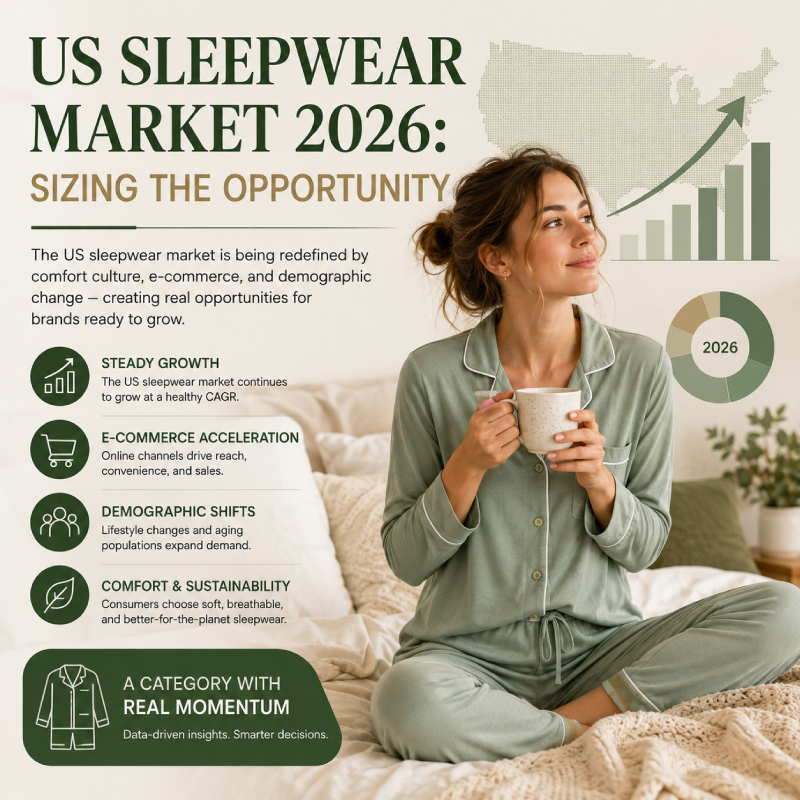
The US sleepwear market is easy to underestimate. It’s not flashy like athleisure, not disruptive like fast fashion — but it’s quietly compounding at a steady clip, and the forces reshaping it right now are creating real opportunities for brands that understand where the growth is coming from.
Whether you’re launching a DTC sleepwear brand, expanding an existing line, or sourcing for a retail program, the 2026 US market data tells a clear story: this is a category being redefined by comfort culture, e-commerce, and demographic change.
Key Takeaways
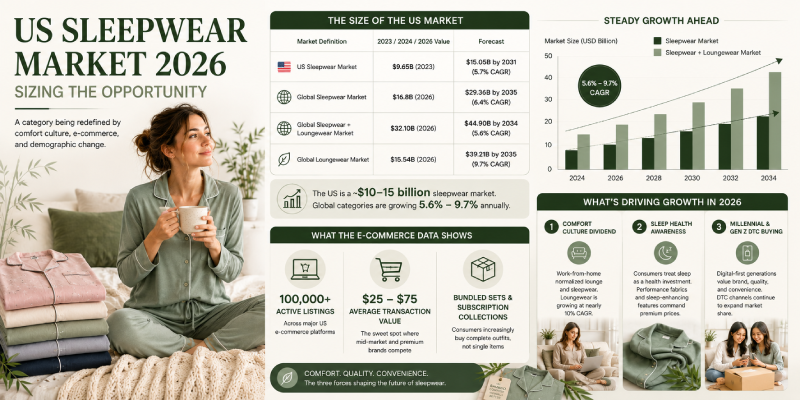
The US sleepwear market was valued at approximately $9.65 billion in 2023 and is projected to reach $15.05 billion by 2031, a 5.7% CAGR — with the global market growing faster in 2025-2026 than earlier forecasts expected.
E-commerce dominates discovery and purchase: major US platforms list 100,000+ active sleepwear SKUs, with average transaction values of $25-75 per order.
Comfort culture is the structural driver: the global loungewear segment is growing at 9.7% CAGR, significantly outpacing traditional sleepwear — blurring the line between sleepwear and everyday clothing.
Three high-growth niches are outperforming the category: menopause sleepwear (14% CAGR), premium/luxury sleepwear (6.25% CAGR), and family/holiday sets — each with identifiable white space.
Millennial and Gen Z buyers are buying through direct-to-consumer channels, shifting the sourcing model toward lower MOQs, faster lead times, and digital-first manufacturing partnerships.
The Size of the US Market
Market Size Data
Market size estimates vary by research firm due to different definitions (sleepwear-only vs. sleepwear + loungewear), so it’s worth seeing the range:
| Market Definition | Value | Forecast | Source |
|---|---|---|---|
| US sleepwear market | $9.65B (2023) | $15.05B by 2031 (5.7% CAGR) | GII Research / The Insight Partners |
| North America sleepwear | $4.4B (2020) | $9.4B by 2028 | ResearchDive |
| Global sleepwear + loungewear | $32.10B (2026) | $44.90B by 2034 | Fortune Business Insights |
| Global sleepwear | $16.8B (2026) | $29.36B by 2035 (6.4% CAGR) | MarkWider Research |
| Global sleepwear | $17.2B (2026) | $33.0B by 2033 (9.7% CAGR) | Persistence Market Research |
| Global loungewear | $15.54B (2026) | $39.21B by 2035 (9.7% CAGR) | Business Research Insights |
| Global luxury sleepwear | $13.68B (2024) | $22.22B by 2032 (6.25% CAGR) | Credence Research |
The numbers tell a consistent story: the US is a ~$10-15 billion sleepwear market, the global category is growing at 5.6-9.7% annually depending on segment, and loungewear — the adjacent category that keeps absorbing sleepwear — is growing at nearly 10%.
What the E-commerce Data Shows
The Bonafide Research analysis of the US market captures how the category actually transacts:
100,000+ active sleepwear listings across major US e-commerce platforms — an enormous catalog that makes differentiation brutally important
Average transaction values of $25-75 — the sweet spot where mid-market and premium-priced sleepwear compete
Bundled sets and subscription-driven loungewear collections gaining traction — consumers increasingly buy complete outfits, not single items
For brands, the e-commerce picture is both warning and opportunity: the catalog is crowded at the commodity end ($25-40 cotton sets), but the data shows consumers spending up to $75 per transaction — headroom for differentiated, higher-value products.
What’s Driving US Sleepwear Growth in 2026
1. The Comfort Culture Dividend
The pandemic-era comfort trend didn’t fade — it became structural. Working from home normalized wearing “sleepwear-adjacent” clothing during the day, and the habit stuck. The loungewear segment (9.7% CAGR) is the visible proof: consumers now buy sleepwear that can also be worn for a video call, a grocery run, or a weekend breakfast. This blurring of sleepwear and loungewear is the single biggest force reshaping product design — and it’s why jogger sets, matching lounge sets, and elevated fabrics (bamboo, TENCEL™) keep gaining share.
2. Sleep Health Awareness
Consumers increasingly treat sleep as a health investment, not a nightly routine. Market analysts consistently cite “rising awareness of the importance of sleep quality” as a growth driver — and it shows up in purchasing behavior: temperature-regulating fabrics, ergonomic designs, and “sleep-enhancing” features command premium prices. The consumer who bought pajamas for $20 in 2019 now spends $50-75 on a set with genuine performance credentials.
3. Millennial and Gen Z DTC Buying
Millennial and Gen Z consumers are expanding their purchases through direct-to-online channels, according to MarkWider’s 2026 analysis. This generation:
Discovers brands on Instagram/TikTok, buys on the brand’s own site
Rewards brands with strong sizing inclusivity and clear fit communication
- Prefers small-batch, differentiated products over mass-market sameness
The DTC shift has a direct supply-chain consequence: DTC brands need lower MOQs, faster sampling, and more flexible production than the old wholesale model demanded — which is reshaping what brands look for in manufacturing partners.
4. The Rise of Purpose-Built Sleepwear Niches
The most interesting 2026 dynamic isn’t the overall market — it’s the sub-segments growing faster than the category:
| Niche | Growth Rate | Why It’s Growing |
|---|---|---|
| Menopause sleepwear | ~14% CAGR | Destigmatization + demographic wave (covered in our menopause market analysis) |
| Luxury/premium sleepwear | 6.25% CAGR | Trading up; premium fabrics, design collaborations |
| Family/holiday sets | Category-leading share | Tradition-based repurchase; social media amplification |
| Sustainable sleepwear | 10.8% CAGR (sustainable fashion overall) | Value-aligned purchasing, especially Millennial/Gen Z |
Each of these niches has identifiable white space — and each rewards brands that move early with clear positioning.
Segment and Channel Structure
By Product Type
The US market splits across top/bottom separates, sets, and nightgowns, with sets and bundles gaining share as consumers buy coordinated outfits. Jogger sets, lounge sets, and matching family sets are the fastest-growing silhouettes — the comfort culture effect in action.
By End User
| Segment | Market Position | 2026 Dynamics |
|---|---|---|
| Women’s | Largest segment | Premiumization; menopause-specific lines; loungewear crossover |
| Men’s | Growing steadily | Fabric upgrades (bamboo, modal); boxer/tee combos expanding |
| Kids’ | Structural demand | Family sets; compliance-driven sourcing (CPSC) |
By Distribution Channel
Online is the growth engine: DTC sites, Amazon, and marketplaces capture an increasing share, driven by Millennial/Gen Z buying habits
Physical retail holds the middle: department stores and big-box chains remain significant for holiday and gift purchases
Omnichannel is the emerging standard: brands that blend DTC stores with retail partnerships consistently outperform single-channel models
What This Means for Brands and Buyers
Where the Growth Actually Is
If you’re a brand deciding where to focus, the 2026 data points to three concentrated opportunities:
Premium comfort: Consumers will pay $50-75 for sleepwear with genuine performance (temperature regulation, premium fibers). The $25-40 commodity end is crowded; the premium end has headroom.
Purpose-built niches: Menopause, nursing, family sets, and sustainable collections all grow faster than the core market — and each has documented white space.
Loungewear crossover: Products that bridge sleepwear and everyday wear capture two purchase occasions. This is where the 9.7% CAGR lives.
What It Means for Sourcing
The DTC shift changes the sourcing conversation. Brands entering or expanding in this market increasingly need:
Lower MOQs — test a capsule before committing to volume
Faster sampling cycles — digital-first development (3D fitting, AI-assisted pattern making) cuts rounds
Certified fabrics as standard — OEKO-TEX® is table stakes; GOTS for organic lines
Flexible, responsive partners — the factory relationship is now part of the brand’s speed-to-market
Compliance readiness — especially for kids’ and family sets (CPSC)
How Friendtex Fits the 2026 US Market
At Friendtex, we’ve spent 15+ years manufacturing for the US market, and the 2026 sourcing requirements are squarely in our wheelhouse:
Flexible MOQs from 100 pieces per design — sized for DTC brands testing new categories (menopause, family sets, premium loungewear)
Certified fabric capability: OEKO-TEX® Standard 100, GOTS organic cotton, bamboo viscose, TENCEL™ — the fabrics US consumers are searching for
Digital-first development: AI-assisted pattern making and 3D virtual fitting reduce sampling rounds — matching the speed DTC brands need
Compliance documentation: GCC/CPC and flammability certificates for kids’ and family sleepwear components
Full-category experience: pajamas, robes, nightgowns, underwear, nursing and maternity — one partner for your entire sleepwear line
If you’re planning a 2026-2027 US collection — or just evaluating the market — contact our team to discuss your sourcing plan.
FAQ
How big is the US sleepwear market?
The US sleepwear market was valued at approximately $9.65 billion in 2023 and is projected to reach $15.05 billion by 2031, growing at about 5.7% annually. Depending on definition (sleepwear-only vs. including loungewear), the global market is estimated at $16.8-32 billion in 2026.
Is the sleepwear market growing?
Yes. Global sleepwear is growing at 5.6-9.7% annually depending on the segment and research source. The loungewear segment (9.7% CAGR) and purpose-built niches — menopause sleepwear (~14%), luxury sleepwear (6.25%), sustainable sleepwear — are growing fastest.
What’s driving US sleepwear demand in 2026?
Four forces: comfort culture (loungewear crossover), rising sleep health awareness, Millennial/Gen Z buying through DTC channels, and growth in purpose-built niches (menopause, family sets, premium). E-commerce now carries 100,000+ active sleepwear listings with $25-75 average transaction values.
Which sleepwear segment is growing fastest?
Menopause sleepwear leads at roughly 14% CAGR, followed by loungewear crossover products (~9.7%) and premium/luxury sleepwear (6.25%). Each has identifiable white space — few dedicated brands, underserved sizing, or premium fabric gaps.
How is e-commerce changing sleepwear sourcing?
DTC brands need lower MOQs, faster sampling, and digital-first development to compete — the old wholesale model (large volume, long lead times) doesn’t fit the test-and-scale DTC playbook. Brands increasingly choose manufacturers on speed and flexibility, not just price.
What fabrics are US consumers buying in 2026?
Premium breathable fibers — bamboo viscose, TENCEL™, modal, organic cotton — continue gaining share, especially in the $50-75 price band. Temperature-regulating and moisture-wicking properties are becoming expected features rather than differentiators. OEKO-TEX® certification is effectively table stakes.
What should a new brand source first for the US market?
Start with a differentiated capsule: 3-5 styles in a premium certified fabric (bamboo or TENCEL™), OEKO-TEX® certified, with low-MOQ production. Choose one growing niche (menopause, family, premium loungewear) rather than competing at the commodity end, and prioritize a manufacturing partner with digital sampling capability and compliance documentation.