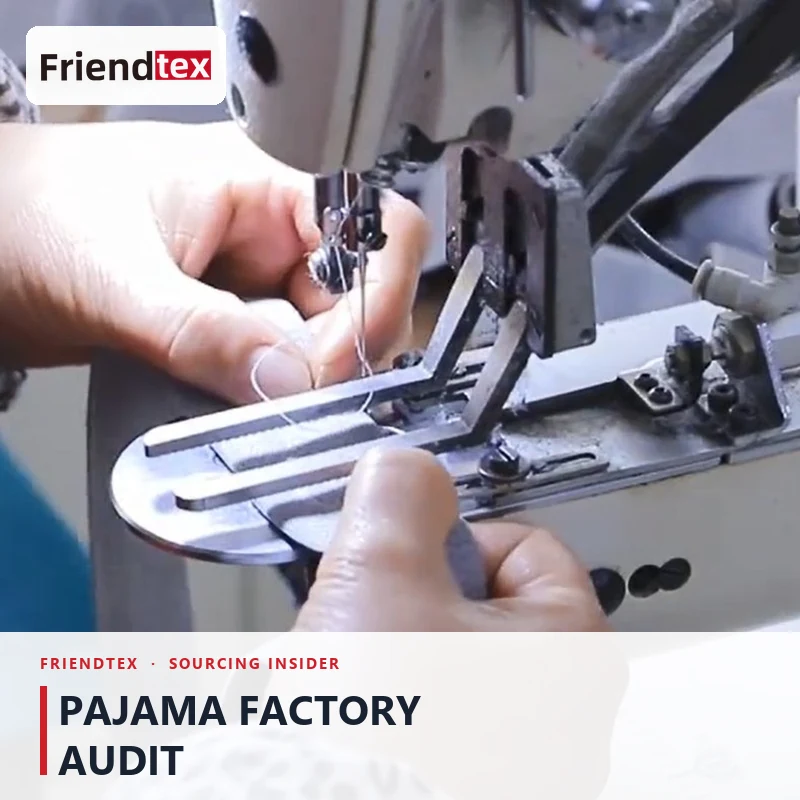
A pajama factory audit is the hour of work that decides whether the next six months go smoothly. Most buyers skip it. They compare quotes, look at a few photos, maybe order a sample, and commit a season of cash to a supplier they have never actually verified. The audit is not about distrust — it is about knowing which answers you are allowed to believe.
This article is the checklist we would hand a buyer who is comparing three or four factories for a sleepwear programme. It covers three layers of verification: the desktop audit you can run in an afternoon, the live video walkthrough that replaces a first site visit, and the sample-stage checks that catch what photos never will. It is written for sleepwear specifically, because our category has a few questions that a generic garment audit never asks — fibre documentation, flammability awareness, and the finish claims we examined in detail in our performance claims guide.
Nothing here requires a plane ticket. Everything here requires a pen, a video call and the discipline to write the answers down. The factories that resent being audited are telling you something; the ones that answer with documents are the ones worth shortlisting.
Key Takeaways
- Audit in three layers: desktop check, live video walkthrough, sample-stage verification — each layer catches what the previous one misses.
- Ask who holds the certificate, not whether a certificate exists. Scope and holder matter more than the logo.
- The 30-minute video walkthrough has a fixed route: cutting table, in-line QC, finishing, packing. Refusal is a signal.
- AQL is not a favour — written acceptance levels belong in the PO, not in a promise.
- Structure the first order as a pilot: small, documented, and designed to test the factory before the season tests you.

Three layers, because no single check is enough
A factory audit fails most often for a boring reason: the buyer relies on one source of truth. A polished website, a cheerful WhatsApp reply, a stack of certificate PDFs — any of these alone can describe a factory that does not exist.
The structure that works has three layers, and each one exists to catch what the previous layer cannot.
The desktop audit verifies that the company is real, licensed, and described honestly. It is paperwork, it costs nothing, and it eliminates maybe a third of the shortlist.
The live video walkthrough verifies that the physical operation matches the description. This is the layer most buyers skip, and it is the cheapest substitute for a site visit that exists. It is not a casual call — it is a scripted 30-minute route through the building with specific things to see.
The sample-stage verification verifies that the factory can do the work, not just talk about it. Reports, golden samples and construction records come out of this layer, and they are the documents that protect you for the whole life of the programme.
Certification audits — BSCI, WRAP, SEDEX and their peers — sit alongside all three rather than replacing them. Those schemes check social compliance, and we have covered what they actually examine in the factory audits 101 guide. A factory can pass every social audit and still ship you a season of pilled fabric, because nobody audited the thing you actually care about: whether the product will be right. That is the gap a pajama factory audit exists to close.
Layer one: the desktop audit
Set aside an afternoon. You are verifying five things, and every one of them has a documentary answer.
Legal identity. Company registration, business scope, and how long the entity has existed. A factory that incorporated last year but claims fifteen years of history deserves a direct question — sometimes the answer is legitimate (a renamed entity, a second plant), and how they answer matters more than the answer itself.
Export reality. A sleepwear factory selling internationally should be able to describe, without hesitation, how goods leave the country: which port, FOB or door-to-door, and how documentation works. The mechanics are covered in any sourcing guide; what you are testing here is fluency. Hesitation on export basics from a factory claiming a decade of export business is a finding.
The claims cross-check. Line count, machine count, staff numbers, monthly capacity. Ask for the numbers, then look for consistency across their website, their quotations and the video walkthrough later. Capacity arithmetic is covered in our guide to pajama production timelines — the short version is that capacity claims should be consistent with the lead times being quoted for your volume.
Product focus. A factory whose portfolio is 80% sleepwear answers category-specific questions differently from a generalist garment plant that takes pajama orders when capacity is free. Ask what percentage of their output is sleepwear and what their largest sleepwear programme last year was.
Communication structure. Who owns your order? A named merchandiser with direct email is a system. “Just message this number” is not. Response time during the audit period is itself data — it is the best it will ever be.
Layer two: the 24 questions that matter
Once the desktop audit is clean, send the questionnaire. Twenty-four questions, six areas, and every answer should end with a document or a demonstrable fact. A factory that cannot answer in a week is not necessarily hiding something — but it is telling you how it will communicate when your shipment is late.
Capacity and lines
- How many sewing lines, and how many operators per line?
- How many shifts run daily, and what is the current utilisation?
- What was your largest single sleepwear order in the past 12 months, and who shipped it to? (Brand names are not required — volume and destination market are.)
- What do you subcontract, and under what conditions? (Cut and sew only? Finishing? Nothing?)
Fabric and trims
- Which fabrics do you stock, and which do you source per order?
- Who supplies your knits — in-house, affiliated mill, or open market?
- How do you document fibre composition for each lot?
- Where do trims — labels, elastics, drawcords, packaging — come from, and who inspects them?
Patternmaking and sampling
- Is the patternmaker in-house or contracted?
- What is the sample turnaround, and what does a revision cycle cost in days?
- Do you grade from a base size, and can you show the grade rule?
- What happens to fit feedback — is there a systematic record, or does it live in an email thread?
Quality control
- What is your inline inspection model — who checks what, at which stage?
- What AQL do you work to, and will you write it into the PO? (Apparel commonly runs 2.5 major / 4.0 minor; what matters is that the number is written down.)
- Do you operate needle detection, and is it calibrated and logged?
- How are shrinkage and colour-fastness results recorded per lot? (The mechanics of this are in our pajama shrinkage testing guide.)
Compliance and documentation
- Which certifications do you hold in your own name, and which belong to suppliers?
- For any certificate offered: who is the holder, what is the scope, and does it cover the product you would be buying?
- How do you handle restricted substances declarations?
- If a finish or fibre claim is needed on the label, what evidence do you provide and when?
Programme management
- Who is the single point of contact for my order, and what is their English documentation like?
- What is your escalation path when production slips?
- How do you document a change request mid-production?
- What information do you send unprompted during production — photos, reports, or nothing until asked?
Question 18 deserves a note, because it is where most buyers get quietly exposed. Certificates in textiles frequently belong to the mill or the chemical supplier rather than the garment factory, and that can be perfectly legitimate — the OEKO-TEX chain is covered properly in our OEKO-TEX, GOTS and BSCI guide. The audit question is not “do you have a certificate” but “whose name is on it, and does my product fall inside its scope”. A factory that answers that precisely is safer than one that forwards a logo.
The 30-minute video walkthrough
A scripted video call is the highest-value hour in the whole audit. Schedule it in the factory’s working hours, ask for the walk to be live and handheld — a prerecorded tour is marketing, not evidence — and follow the same pajama factory audit route every time so factories are comparable.
Minutes 0–5: the cutting table. You want to see fabric being spread, markers in use, and the state of the floor. A quiet cutting room during claimed production hours is a finding.
Minutes 5–15: one full sewing line. Ask to see the line assigned to their current export order. Inline QC stations, work in progress, and the ticketing system that tracks output. Ask the operator what operation they are performing — fluency at line level is hard to fake.
Minutes 15–22: QC and testing corner. Needle detector, measurement table, light box for colour. Ask to see a recent inspection report with today’s date nearby.
Minutes 22–30: finishing and packing. Where garments are pressed, how they are polybagged, where cartons are sealed and labelled. This is where the last month of an order is decided, and it is the messiest room in weak factories.
Four red flags that the route is designed to surface:
- Refusal or repeated rescheduling of the walkthrough without a concrete reason.
- A guide who narrates but never picks anything up. Documentation should be on the table, not in a slide deck.
- Quiet floors during claimed production. Utilisation claims and visible reality should match.
- Everything subcontracted. Some subcontracting is normal; a factory where nothing you saw was made in the building you saw is a trading company with a sewing room.
For factories in China specifically — where most sleepwear sourcing runs — the walkthrough also quietly tests something the paperwork cannot: whether the person selling to you has ever stood on the floor they are selling. Our China factory sourcing guide covers the market structure; the walkthrough is how you verify it.
Layer three: verify the sample, not the promise
The sample stage is where audit findings get confirmed or overturned, and it works only if you treat the sample as a specification, not a preview.
The golden sample discipline. The approved sample is photographed, measured, weighed and recorded: fabric weight, composition, construction, trim list, label placement. Everything the bulk will be compared against lives in that record. When a dispute happens later, the golden sample record is the whole conversation.
Test what the claim needs. If the programme rests on shrinkage, wicking, fastness or any printed claim, the tests happen on the sample construction, at an accredited lab, before bulk is booked. The claim-versus-evidence discipline is the same one we described in the performance claims guide — the label can only say what a report supports.
Measure the process, not just the product. How many days did the sample take? How many revision cycles to reach approval? How precise were the answers to your fit comments? The sample stage is a rehearsal of bulk production, and factories rehearse the same way they perform.
The checks buyers forget
Three verifications fall outside the standard checklist and routinely catch problems the first three layers miss.
Reference calls. Ask for two customers with programmes similar to yours — similar product type, similar destination market. Brand names are not always shareable, and that is fine; what you want is a fifteen-minute call with someone who has received their containers. Ask one question: what went wrong, and how did the factory handle it? The answer to the second half is the real audit result.
Third-party inspection option. Even without a site visit, a third-party inspection company will run a defined checklist at the factory for a few hundred dollars. If the order value is significant and the video walkthrough left doubts, this is cheap insurance. The reports they produce also happen to be excellent at confirming the inline QC claims from question 13.
The unprompted-communication test. During sampling, note what the factory sends without being asked. A merchandiser who forwards photos of cutting tables and lot numbers unprompted is running a system. One who answers only when chased will be chased at 2 a.m. during bulk. Buyers consistently rate this signal above any certificate, and so do we.

Red flags, and what they usually mean
| Signal | What it often means | What to do |
|---|---|---|
| Quote far below every other shortlisted factory | A different factory than the one described — or fabric downgrades to hit the number | Ask which spec was cut to reach the price |
| Certificate PDF with no holder name or scope | Borrowed logo, unverifiable scope | Ask who holds it and whether your product is covered |
| Sample beautiful, bulk quote vague | The sample was bought, not made | Tie bulk to the golden sample record in the PO |
| Refuses video walkthrough or insists on prerecorded | Floors that do not match the story | Move the factory down the list |
| No AQL, no written inspection standard | Disputes will be settled by who is more tired | Put acceptance levels in the PO before signing |
| All communication through one chat number | No system, one person’s holiday stops your order | Ask for a named merchandiser and a backup contact |
| Cannot explain how a claim on their own samples was tested | Marketing copy inherited from suppliers | Reword claims before they reach your label |
One structural point: red flags are findings, not verdicts. A factory that explains a low quote by walking you through exactly which construction was simplified is being honest and may still be the right choice. The flag is not the discount — it is the inability to explain it.
The pilot order: how to structure the first PO
An audit, however thorough, is a prediction. The pilot order is the experiment.
Structure it deliberately: small enough that failure is survivable, real enough that the factory cannot special-case it. Place it through the same process the bulk will run — same PO format, same AQL in writing, same inspection standard, same shipping documents. A pilot that gets VIP treatment tells you nothing about how the factory handles your real season.
Two design choices make the pilot informative. First, put the acceptance criteria and the golden sample reference in the PO itself, so that the pilot tests the factory’s documentation discipline as much as its sewing. Second, keep the pilot small enough to run on stock fabric — for many sleepwear constructions, that can mean a first run from the 50-piece mark, which the low MOQ manufacturing guide explains in full. The point is not the small number; it is that the factory’s normal process, not a custom performance, produces your evidence.
If the pilot ships clean — reports attached, dates held, claims matching records — you have a supplier, not just a quote. That is what the whole audit was for.
FAQ
How long does a proper factory audit take?
A pajama factory audit splits into three layers with different clocks. The desktop audit is an afternoon. The questionnaire takes the factory a few days and the video walkthrough needs 30 scheduled minutes. Sample-stage verification runs on the sampling calendar. Total elapsed time is two to three weeks, most of it waiting on the factory — which is itself informative.
Can I audit without visiting China?
Yes, and most buyers do. The desktop audit, the scripted video walkthrough and third-party inspection together cover what a first visit would. Many brands make their first visit only after the first full season, if at all.
Is a BSCI or SEDEX certificate enough on its own?
No. Social compliance audits check labour and safety conditions, not product capability or documentation discipline. Treat them as one input in the compliance section of the questionnaire, not as a substitute for the audit.
What AQL should I demand for sleepwear?
Apparel commonly runs 2.5 for major defects and 4.0 for minor defects, tightened for children’s programmes. The specific numbers matter less than having them written into the PO, agreed before production, and inspected against by someone who did not make the goods.
What if the factory refuses the video walkthrough?
Ask once, with a concrete reason attached — some plants restrict filming by customer policy, and a third-party inspection is a workable alternative. A flat refusal with no substitute moves the factory out of the shortlist. You are about to send this factory your designs and a season of cash; the burden of proof is theirs.
How much should I rely on certificates in the questionnaire?
Rely on their scope and holder, not their existence. Ask who holds each certificate, what exactly it covers, and whether your product — this construction, this finish — falls inside that scope. A precise answer to that question is worth more than a wall of logos.
Is a small pilot order worth the extra setup?
It is the cheapest failure available. A pilot that runs through the normal process — written AQL, golden sample reference, standard documents — either produces a supplier with a working evidence chain or surfaces the problem while the cost is still small. Skipping it means the season performs the test instead.