A low MOQ pajama manufacturer solves a problem that has nothing to do with sewing. The reason most factories quote a high minimum is not that they are unwilling to cut a small order — it is that the fabric underneath it cannot be made in small quantities. Understand that constraint and the whole picture changes: what looks like a sales policy is actually a physics problem, and there is a specific way around it.
This article is for the brand that wants to place a first order without betting the season on it. A first collection, a capsule for one retail partner, a single print you want to test before you commit to a full size run. The question is not “how do I find a factory that will take 200 pieces” — plenty will say yes. The question is how do I start at a quantity that is genuinely low, and still be able to scale into thousands at the same supplier.
That second half is the part most buyers only think about a year later, usually after it has already cost them a season.
Key Takeaways
MOQ is a fabric rule, not a factory rule. Most knit fabrics carry a dye-lot minimum of roughly 50–100 kg, which lands at 200–500 finished pieces per colour. That is where the number comes from.
A stock-fabric colour card is how you step under it. Choosing an existing fabric skips the dye lot entirely, which is what makes an order as small as 50 pieces possible
Small and large are not two different suppliers. The same programme can start on stock fabric and move to made-to-order fabric later, without re-sampling the fit or re-approving the print from zero.
Ask for the minimum broken out three ways — per design, per colour, per size — because a headline number that is per colour can double or triple.
- Bring your in-warehouse date, not a design brief. It is the only piece of information that decides how much of your ambition is still achievable this cycle.
What “low MOQ” actually means
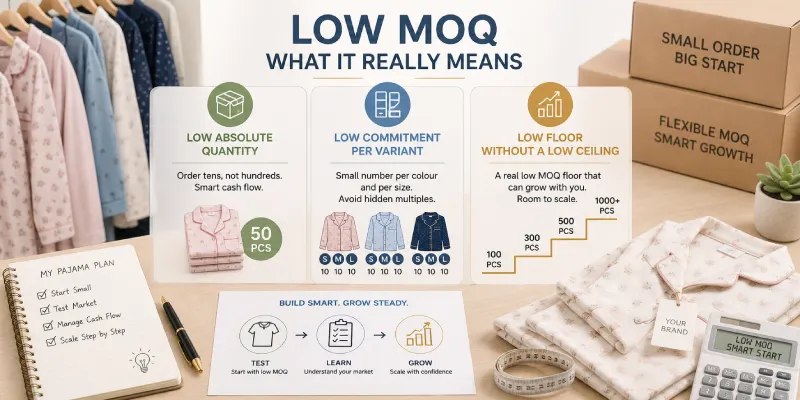
The phrase gets used loosely. “Low MOQ” is often a marketing line for 500 pieces — which is low compared with 5,000, and completely useless if your first order is a test.
It helps to be precise about the three things buyers mean when they say it:
Low absolute quantity. You want to order a genuinely small number of pieces — tens, not hundreds — because you are funding this from your own cash flow and every unit on a shelf is money that has stopped moving.
Low commitment per variant. You want to order a small number per colour and per size, not just a small total. An order of 300 pieces sounds manageable until you discover it is 300 per colour and you need three colourways, which is 900 pieces and the same inventory risk you were trying to avoid.
A low floor without a low ceiling. This is the one buyers underweight. A supplier who can make 100 pieces but freezes at 500 is not a low-MOQ supplier for your purposes — it is a startup-only supplier, and the clock on that relationship starts ticking the moment your product works. The most expensive order in this business is the second one you place somewhere else.
So when a low MOQ pajama manufacturer quotes you a number, the useful follow-ups are not “can you do less” — they are “less of what, per what, and for how long can I keep growing here.” For the full cost picture behind those options, our breakdown of pajama manufacturing cost sets out where each line item comes from.
Why MOQs exist: the dye lot, not the sewing machine
Ask ten buyers where MOQs come from and most will say “factory capacity” or “production efficiency.” Both are real, and both are secondary. The binding constraint sits one step upstream, at the fabric mill.
Knitted fabric is dyed in a dye lot — a single batch run through a dye vat. A dye vat has a practical minimum fill. Below it, the liquor ratio goes wrong, the shade becomes unrepeatable, and the mill burns more in setup and wastewater treatment than the fabric is worth. In practice, most knits carry a dye-lot minimum somewhere in the 50–100 kg range.
Convert that into garments and the picture sharpens. A typical pyjama set uses on the order of 0.8–1.2 kg of fabric depending on size and style, so 50–100 kg lands at roughly 200–500 finished pieces per colour. That is not a policy anyone chose. It is arithmetic.
Two practical consequences follow, and both catch buyers out:
It is per colour, not per order. A 300-piece minimum means 300 pieces in one colour. Three colourways is 900 pieces. This is why a quoted MOQ can look reasonable in an email and be unworkable in a purchase order.
It moves with the fabric, not the garment. Heavy fleece, wide-width jersey and specialised performance knits carry different minimums than a light single jersey. A supplier who quotes one number for everything is either simplifying for you or has not checked with the mill.
This is the whole reason a small order is difficult — and it is also the reason it becomes easy the moment you stop needing a custom dye lot.
The way around it: stock fabric
If the dye lot is the constraint, the bypass is obvious: use fabric that has already been dyed.
A stock-fabric colour card is exactly that — a range of fabrics the mill holds in inventory, already dyed, in a fixed set of colours, available by the metre without any minimum. Because there is no dye lot to run, the minimum disappears with it.
This is what makes an order of 50 pieces possible, and around 30 pieces on complex constructions where the extra make-up time is what sets the floor rather than the fabric. It is also the same logic that lets a custom sample move quickly — the fabric exists, so nothing waits on a dye vat.
The trade-off is honest and worth stating plainly. Your colour is limited to what is on the card. The fabric is not exclusive to you — another brand can buy the same quality in the same shade. And you may need to build the colourway around what is available rather than specifying a shade from a Pantone reference and waiting.
For a first order, those are usually the right trades. The alternative — accepting a 900-piece commitment to get an exact colour — is how a promising design becomes dead stock.
The three fabric routes, and who each one is for
| Stock fabric | Stock or made to order | Made to your colour | |
|---|---|---|---|
| Where the fabric comes from | An existing stock-fabric colour card | Depends on the quality and the colour — some are held in stock, some have to be dyed | Dyed to your specification, one dye lot |
| Typical quantity | 50 pieces upward (around 30 on complex constructions) | 300 – 1,000 pieces | 1,000 pieces and above |
| Colour freedom | Limited to the card | Limited or full, depending on the quality | Full |
| Fabric lead time | None — it is already dyed | Varies by quality | 30–35 days before production starts |
| Production window | 15–20 days | Depends on the route | 45–50 days |
| Best for | A first order, a test, a capsule for one retailer | A design that has proved itself and is being widened | A proven style at seasonal depth |
The middle column is the one buyers get wrong most often. It is not a fixed process — the honest answer to “how does the 300 to 1,000 range work?” is it depends on the fabric and the colour you want. Some qualities are held in stock and can move quickly. Some have to be dyed and behave like a larger order. A supplier who can walk both paths inside that range is worth more to you than one who only quotes a single number. If you are still shortlisting, our guide to how to find a clothing manufacturer covers the screening questions that separate the two. For a closer look at how a complete sleepwear programme is put together — from range planning through to production — see how to build a profitable sleepwear line.
4. The question that matters more than the MOQ
Here is the failure mode this article exists to prevent.
A brand launches with 150 sets. The design works. Reorders come in, and by month four the brand needs 700 sets, then 1,500. The original supplier — the one that was flexible at 150 — cannot do 700. Not because they are being difficult, but because their fabric supply cannot, and their line is set up for short runs.
So the brand goes looking for a bigger factory. And the cost of that move is not a price difference. It is:
New sampling. Two to three rounds is normal. Each round is fabric, labour and shipping, and each round is calendar time.
A second fit approval. The pattern has to be graded and re-fitted to the new factory’s block. Whatever your customers liked about the original fit is now a risk.
A new print or colour approval. Strike-offs, lab dips, and the approvals that go with them, run again.
A new compliance position. Test reports are tied to a factory and a construction. A new production site can mean new testing before the goods can ship.
Restarting the relationship. Payment terms, quality standards, escalation paths — all of it is built again from zero.
In a seasonal category, that sequence does not overlap neatly with your selling calendar. It delays the next order rather than displacing it, and the season does not wait. The same reset applies to labels and packaging — new artwork, new suppliers, new approvals — which our guide to custom pajama labels covers in more detail.
The question to ask a supplier is therefore not “what is your MOQ.” It is:
“What is the smallest order you can make, and the largest order you can make, without me changing factories in between?”
A supplier who can answer that across the full span — a small test order, a mid-range reorder, and a full seasonal buy, all in the same building — is a different kind of partner from one who is simply cheap at low volume. That is a harder thing to find than a low minimum, and it is worth more.
5. Five questions that get you a usable answer
Vague questions get vague quotes. These five produce numbers you can plan against.
1. “Is that minimum per order, per design, or per colour?”
The single most important clarification. A minimum that is per colour can multiply your commitment by the number of colourways. Ask for it written down that way.
2. “Is this quote based on a stock fabric or a fabric you would dye for me?”
The answer changes the unit price, the lead time, and your last date to order. A quote without this distinction is not comparable to any other quote you receive.
3. “At what volume can I move from one to the other?”
This is where you find out whether your supplier can actually carry you as you grow, or whether there is a wall you will hit at a predictable volume.
4. “What is the minimum per size, not just per design?”
Size grading is its own constraint. A per-design minimum of 300 can still mean an awkward per-size commitment in the tail sizes of a full run. If sizing is where your risk sits, our notes on family matching size blocks show how the blocks multiply an order.
5. “What does the lead time assume — a quiet month or peak season?”
A quoted lead time measured in a slow period is not the number you will experience in the run-up to a peak. Ask what changes, and by how much.
Also worth settling early: who holds the test reports, and will they transfer to you. In most markets the compliance documentation is tied to a specific construction and a specific production site — if you change factory later, a fresh report may be required. Ask where the reports sit before you need them, not afterwards. (For the labelling rules that go with them, see our guide to GCC and CPSC requirements for pajamas.)
6. When the small order is the right order
Low MOQ is not a virtue in itself. A supplier who takes 50 pieces and does it badly is worse than one who declines and refers you on.
It is the right order when:
The design is unproven. You are buying information, not inventory. Fifty units that tell you whether a shape and a print sell are worth more than five hundred units that guess.
Cash flow is the binding constraint. Inventory that has not sold is money that is not available for the next thing. A small first order is a financing decision as much as a sourcing one.
You are testing a new market or channel. A first run into a new country, a pop-up, a single retail partner — all of these justify a deliberately small commitment.
The season is short and undifferentiated. If the product has a narrow selling window, over-ordering to hit a minimum is a worse outcome than in almost any other category, because unsold units do not carry into a neutral season. They mark down or they sit.
It is the wrong order when the design is already proven in market and you are simply avoiding a commitment — at that point a small order is costing you margin you have already earned. A low MOQ pajama manufacturer removes the barrier to starting; it does not remove the case for ordering properly once you know the product sells.
7. Where to start
The practical sequence for a first collection looks like this:
- Fix your market and your compliance route. Destination decides labelling and, for children’s sleepwear, whether the garment itself has to change. Decide this before the design, not after.
- Pick the fabric route before the colour. If the quantity is small, the colour comes from the card. If the colour is fixed, expect the quantity to follow it. Whichever route you take, the fabric has to survive the wash a customer will give it — see our notes on pajama shrinkage testing.
- Ask for the minimum three ways — per design, per colour, per size — and in writing.
- Ask what the same supplier can do at ten and thirty times that quantity. This is the answer that tells you whether you are choosing a partner or a stopgap.
- Set the in-warehouse date and work backwards. Starting from the design and counting forward is how a plan looks reasonable in month one and lands late in month six. If the window is tight, our pajama production timeline breaks the sequence down stage by stage.
One factory, from a first small run to a full seasonal programme, is not a marketing line. It is the specific thing that saves you the sampling cycle, the re-approval and the lost season when your product works.
If you would rather see what a small-batch programme looks like in a finished garment before you commit, browse the Christmas pajamas range — seasonal programmes are where the low-MOQ question comes up most often, and where a stock fabric and a short window matter most.
FAQ
What is a realistic minimum order quantity for custom pajamas?
Working with a low MOQ pajama manufacturer, a programme on stock fabric can start as low as 50 pieces per design, with around 30 on complex constructions where the make-up time rather than the fabric sets the floor. On fabric dyed to your own colour, the practical floor is much higher — the dye lot is what sets it, and most knit dye lots land at 200–500 pieces per colour, which is why made-to-order fabric normally becomes economical from around 1,000 pieces.
Why is my MOQ quoted per colour instead of per order?
Because the constraint is the dye lot, and a dye lot is per colour. One run through the dye vat produces one shade. If you need three colourways in a custom-dyed fabric, you need three dye lots, and the minimum applies three times. When a low MOQ pajama manufacturer quotes you a single headline number, clarify whether it is per order, per design or per colour before you plan against it.
Can I order a small quantity and still get my own colour?
Sometimes, and it depends on the fabric. Some qualities are held in stock in a range of shades, which gives you a moderate choice without a dye lot. Others have to be dyed, and then the colour commitment and the quantity commitment are linked. The right question is not “can I have my colour in a small order” but “which of your qualities can give me a close colour without a dye lot” — the answer is material-specific.
Will a small factory be able to handle my order when it grows?
That is the thing to establish before you place the first order, not after. Ask what the supplier can make at ten times and thirty times your opening quantity, and whether the fabric can follow you up. A low MOQ pajama manufacturer who takes small orders but cannot scale is a stopgap; the cost of moving later is a repeat of sampling, fit approval, colour approval and compliance testing — which in a seasonal category can cost you a selling window.
Does a low MOQ mean lower quality?
Not in itself — the minimum is set by the fabric, not by the care taken in production. What a low minimum does change is cost per unit, because setup and inspection are spread over fewer garments. Judge quality on the sample, the construction details and the inspection standard, and judge the minimum as a separate commercial question.
How do I keep my first order small without running out?
Plan the reorder before you need it. Ask for the production window on stock fabric separately from the window on made-to-order fabric, and note both against your selling calendar. The point of a low first order is to leave room to react — which only works if the second order can be placed quickly, at the same supplier, without a fresh approval cycle.
What should I send to get an accurate quote?
Your market and destination, the design and any print, the size blocks and quantities per block, the colour direction (a shade from a card, or a colour you need matched), your packaging requirement, and your in-warehouse date. The destination matters as much as the design — it decides the compliance route and therefore the labelling, and in some cases the garment.