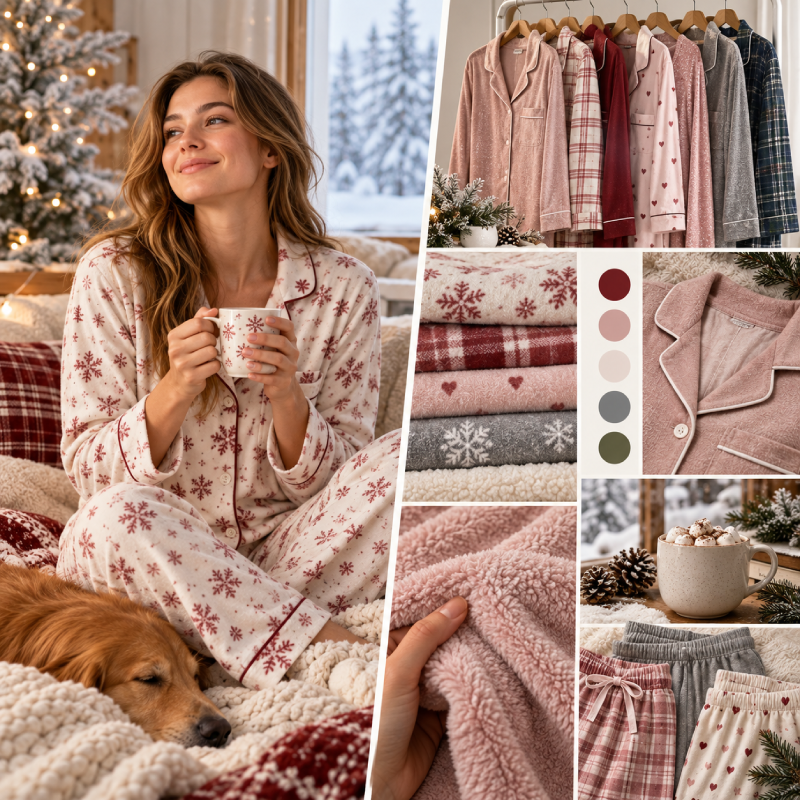
The winter sleepwear season is the sleepwear industry’s biggest revenue window — and right now, in late summer, is exactly when the winning brands are making their decisions. Fabric selections, color stories, and production slots for the 2026-27 cold season are being locked in this quarter. If you’re a sleepwear brand planning for winter, the trends shaping this season are clear: cozy textured fabrics that still breathe, oversized comfort silhouettes, a grounded earthy palette with expressive accents, and a sourcing timeline that rewards brands who act now rather than in October.
Key Takeaways
- The winter window is the category’s biggest sales season, and production decisions happen 3-4 months ahead — the September-October window is where 2026-27 winter inventory gets locked in.
- Fabric trends for 2026-27 center on texture and warmth: brushed cotton flannel, fleece, waffle knit, and brushed thermal knits lead the winter fabric mix, with breathability becoming a required feature even in warm fabrics.
- The silhouette story is oversized and draped: relaxed, intentionally oversized fits that bridge sleepwear and loungewear — pajama sets styled like real outfits, and robes making a comeback as statement pieces.
- The Pantone NYFW Autumn/Winter 2026/2027 palette blends grounded earth tones with vivid accents: terracotta clay, toffee and Arabian Spice browns, Red Mahogany depth, Burnt Olive and Green Envy greens, punctuated by Festival Fuchsia and Acacia yellow.
- Sustainability is now a winter requirement, not a bonus: eco-friendly fibers and certifications (OEKO-TEX®, GOTS) factor into fabric selection for the cold season, especially for US and EU markets.
- The global sleepwear and loungewear market is projected to grow from $63.5 billion (2023) to $103.7 billion (2032) — a 5.6% CAGR — and winter is the category’s peak seasonal window.
The Winter Market Context
Why Winter Matters
Winter is when sleepwear moves from “bedtime clothing” to “essential wardrobe.” Cold nights drive demand for warmer products, the holiday season drives gift purchases, and the loungewear crossover — wearing cozy sleepwear during long indoor evenings — peaks in the colder months. For most sleepwear brands, winter represents the largest seasonal revenue share of the year.
The market backdrop supports this: the global sleepwear and loungewear market was valued at $63.5 billion in 2023 and is projected to reach $103.7 billion by 2032, at a 5.6% CAGR (Dataintelo market research). The growth is powered by the same forces that shape the winter season: remote and hybrid work extending “comfort-first” dressing, and consumers investing in the coziness of cold-weather living.
The Production Calendar Reality
The most important fact about winter sleepwear: the selling season is November-February, but the production window is now.
| Timeline | What Happens |
|---|---|
| July-August | Fabric sourcing, color story development, sampling |
| September-October | Finalize styles, place production orders, lock capacity |
| November | Production and shipping (air/sea) for December retail |
| December-January | Holiday sales peak, reorders for January-February |
| February | Season wind-down, clearance, next-season planning |
Brands that haven’t locked their winter production by October will face either missed windows, air-freight costs, or sold-out stock at peak demand. The brands planning now — in August and September — are the ones with the full fabric range, the color story, and the production capacity they need.
Trend 1: Fabric — Texture and Warmth, With Breathability
The 2026-27 winter fabric story is about tactile comfort: fabrics that feel warm, soft, and substantial, but no longer sacrifice breathability. The winter fabric mix is consolidating around these leaders:
| Fabric | Winter Role | 2026-27 Notes |
|---|---|---|
| Brushed cotton flannel | The classic winter staple | Substantial warmth with cotton’s breathability; brushed finish for softness; the perennial favorite in fall-winter sleepwear guides |
| Fleece (micro/brushed) | The cozy heavyweight | Maximum warmth, fast-drying; polar and micro fleece for colder climates |
| Waffle knit | The textured middle ground | Thermal structure traps warmth while staying breathable; strong texture trend |
| Brushed thermal knits | The rising star | Brushed knit that traps warmth close to the body with a smooth, soft hand feel; increasingly popular in 2026 fall guides |
| Brushed modal / cotton-modal blends | The premium comfort option | Warmth with premium softness; the elevated alternative to flannel |
| Thermal jersey / long-sleeve knits | The layering base | Base-layer warmth; works under robes and heavier sets |
The 2026-27 differentiator: breathability inside warmth. Consumers burned by fleece that sweats now expect warm fabrics that also breathe — brushed cotton and waffle knit are winning precisely because they deliver both. Pure heavyweight fleece still has its place, but the trend is toward temperature-balancing warmth rather than heat trapping.
The sustainability layer: eco-fiber versions of these fabrics — organic cotton flannel, bamboo-fleece blends, recycled polyester fleece — are moving from niche to mainstream, especially for US and EU markets where OEKO-TEX® and GOTS certification is increasingly expected.
Trend 2: Silhouette — Oversized, Draped, and Worn Like Clothes
The 2026-27 silhouette story mirrors the broader Fall/Winter 2026 fashion direction: oversized shapes, soft textures, and intentional draping. In sleepwear specifically:
- Oversized and relaxed fits: Boxy, generously cut pajama sets that prioritize comfort without looking sloppy — the “cozy but put-together” standard
- Pajamas styled like outfits: Pajama tops worn open over tees, matching sets that pass as casual loungewear, pants that double as daywear — the pajama-as-wardrobe trend continues to grow
- The robe revival: Robes are no longer bath accessories — they’re statement layering pieces, with draped, kimono-style cuts and premium fabrics (see our family pajamas analysis for how loungewear silhouettes are converging)
- Matching sets over separates: Coordinated sets continue to outsell mix-and-match — the “looks intentional” factor consumers keep paying for
- Layer-friendly design: Sets designed to work under robes and over thermals, supporting the temperature-stacking approach to cold-weather sleep
The through-line: winter sleepwear in 2026-27 is designed to be seen and lived in, not hidden in the bedroom. The winning brands will treat winter sleepwear as a wardrobe category, not a nightwear afterthought.
Trend 3: Color — The Real Pantone AW 2026/2027 Palette
The Pantone Fashion Color Trend Report for Autumn/Winter 2026/2027 (New York Fashion Week) defines the season’s palette. Per the Pantone Color Institute, it’s a season of duality — “earthy tones and carefully considered neutrals sit alongside daring and outspoken vivid shades,” balancing minimalism with urban energy.
The 10 standout colors and the 5 seasonless neutrals, translated for sleepwear:
| Color Family | Pantone AW 2026/27 Shades | Sleepwear Application |
|---|---|---|
| Warm earth foundations | Muted Clay (terracotta), Arabian Spice (raw brown), Toffee | The foundation of the winter palette; flannel and brushed fabrics in warm, grounded tones |
| Deep, rich depth | Red Mahogany (red-toned brown) | The indulgent accent of the season; strong in flannel and velvet-look finishes |
| Layered greens | Burnt Olive, Green Envy, Neptune Green | The calm, grounded counterpoint; pairs beautifully with the brown family |
| Soft shades | Foxglove (muted mauve-pink), Egret (creamy white) | The softer expression — popular in brushed modal and silk-touch sets |
| Expressive accents | Festival Fuchsia, Acacia (green-infused yellow), All Aboard (maritime blue) | Statement prints and trims; smaller-scale usage in sleepwear |
The practical takeaway for brands: build the winter color story on warm earth tones (Muted Clay, Toffee, Arabian Spice) + Red Mahogany depth + Burnt Olive/Green Envy greens, with Foxglove for softness and the vivid shades (Fuchsia, Acacia, All Aboard) reserved for prints and trims. This palette spans both classic (flannel plaids in warm earth tones) and contemporary (brushed modal in Red Mahogany and Burnt Olive) directions.
Trend 4: Sustainability Meets Winter Comfort
The winter season used to be the exception to sustainability rules — fleece and synthetics dominated. That’s changing:
- Organic cotton flannel is now a mainstream winter option, not a niche product
- Recycled polyester fleece addresses the microplastic criticism of traditional fleece
- Bamboo and TENCEL™ winter weights deliver warmth with the eco-credentials that US/EU consumers check (see our sustainable sleepwear companies analysis for who’s doing this well)
- Certifications as purchase signals: OEKO-TEX® is table stakes; GOTS and recycled-content claims differentiate premium winter lines
For brands, the winter sustainability story is also a compliance story: kids’ winter sleepwear (flannel and fleece sets for children) carries CPSC flammability requirements in the US (16 CFR Parts 1615/1616), and GCC/CPC documentation is expected by retailers. The brands that combine winter warmth with verified sustainability and compliance documentation have a significant advantage in the 2026-27 season.
The Sourcing Checklist for Winter 2026-27
If you’re planning winter production now, here’s the practical checklist:
| Priority | Item | Why |
|---|---|---|
| 1 | Lock fabric and colors by September | Fabric mills book capacity early; late orders mean substitutions |
| 2 | Finalize 3-5 hero styles | Depth over breadth; winter has a shorter selling window than summer |
| 3 | Confirm compliance early | Kids’ winter sets need flammability testing and CPC docs — start now, not in November |
| 4 | Plan the layering story | Offer sets + robes + thermals as a coordinated system, not separate products |
| 5 | Book production capacity | September-October is when factories fill up; capacity is first-come, first-served |
| 6 | Choose fabrics with the breathability story | Warm but breathable (brushed cotton, waffle) outsells heat-trapping heavyweight |
| 7 | Design for the gift market | Winter sleepwear is a top gift category; gift-ready packaging and sets matter |
Planning Winter Production with Friendtex
At Friendtex, we support winter programs with a mix of in-house capability and fabric sourcing. Here’s what we can do for winter 2026-27 planning:
- Winter fabric sourcing: Our core fabric program covers Tencel™, bamboo, Lenzing Modal, and Pima cotton — including heavier winter weights — and our spot-fabric supplier network plus in-house knitting, weaving, and dyeing let us source waffle knit, brushed thermal, flannel, and fleece options to your spec. Tell us your target GSM and hand feel, and we’ll propose fabrics with samples.
- Kids’ winter compliance: CPSC flammability standards (16 CFR Parts 1615/1616) apply to children’s sleepwear — we support the testing route your market requires and provide the CPC/GCC documentation retailers ask for.
- Coordinated family and gift sets: Matching winter sets and robe-and-pajama systems that capture holiday gifting demand — read our family pajamas category analysis for the sizing and compliance details.
- Color and print development: Support for the AW 2026/2027 palette — from fabric dyeing through finished prints.
- Realistic timelines: Sampling in 6-17 days, bulk production in 30-60 days — which is exactly why September-October bookings are the ones that ship before the holiday window.
- Flexible MOQs: From 300 pieces per design, so you can test winter styles before scaling.
If you’re planning a winter 2026-27 collection, the window to lock fabrics, colors, and production is open now. Contact our team to discuss your winter program.
FAQ
When should brands start planning winter sleepwear production?
Now — August and September. The winter selling season runs November-February, and production takes time: sampling runs 6-17 days and bulk production 30-60 days. Fabrics, colors, and styles should be finalized by September, with production orders placed in September-October to ship before the holiday window. Brands that wait until October face capacity shortages and air-freight costs.
What fabrics are trending for winter sleepwear 2026-27?
Brushed cotton flannel leads as the classic staple, joined by fleece (micro and polar), waffle knit, brushed thermal knits, and brushed modal. The key trend: warm fabrics that remain breathable — consumers are moving away from heat-trapping heavyweight fleece toward temperature-balancing warmth.
What colors are trending for winter 2026-27?
The Pantone NYFW Autumn/Winter 2026/2027 palette pairs grounded earth tones with vivid accents: Muted Clay terracotta, Arabian Spice and Toffee browns as foundations, Red Mahogany for rich depth, Burnt Olive and Green Envy greens as the counterpoint, and Foxglove for softness. Vivid shades (Festival Fuchsia, Acacia, All Aboard) work best in prints and trims. Build winter lines on warm earth tones + Red Mahogany + olive greens.
Is the winter sleepwear market growing?
Yes. The global sleepwear and loungewear market was valued at $63.5 billion in 2023 and is projected to reach $103.7 billion by 2032 (5.6% CAGR, Dataintelo), with winter as the category’s peak seasonal window — driven by cold-weather demand, holiday gifting, and the loungewear crossover from remote/hybrid work.
Do kids’ winter pajamas need special compliance?
Yes. Children’s sleepwear sold in the US must comply with CPSC flammability standards (16 CFR Parts 1615/1616) — either tight-fitting construction or flame-resistant fabric. Winter flannel and fleece sets for kids require flammability testing and CPC documentation. Start this process early; testing lead times add weeks to the production calendar.
What’s the biggest mistake brands make planning winter sleepwear?
Waiting too long. Winter production has a hard deadline — inventory must ship before the holiday window — and fabrics, colors, and capacity all fill up by September-October. The second mistake is choosing warmth without breathability: consumers now reject fleece that sweats. Warm-but-breathable fabrics and early capacity booking are the two winning moves.
How can Friendtex help with winter sleepwear?
Friendtex offers winter-weight fabrics across our Tencel™, bamboo, Lenzing Modal, and Pima cotton program plus sourced waffle knit, brushed thermal, flannel, and fleece options; children’s sleepwear compliance support with CPC documentation; coordinated family and gift sets; sampling in 6-17 days and bulk production in 30-60 days; and MOQs from 300 pieces per design.
The Bottom Line
Winter 2026-27 is shaping up as a season defined by three shifts: warm-but-breathable fabrics replacing heat-trapping heavyweight fleece, oversized draped silhouettes that treat sleepwear as a wardrobe category, and a grounded earthy palette (Muted Clay, Toffee, Red Mahogany, Burnt Olive) with vivid accents for expression. Sustainability and compliance are no longer optional layers — they’re part of the winter product spec.
The operational reality hasn’t changed: winter production runs on an unforgiving calendar. The brands that lock fabrics, colors, and capacity in August-September are the ones with full inventory at peak demand; the brands that wait miss the window. The data says the market is growing, the trends say consumers want comfort that breathes, and the calendar says now is the time to decide.