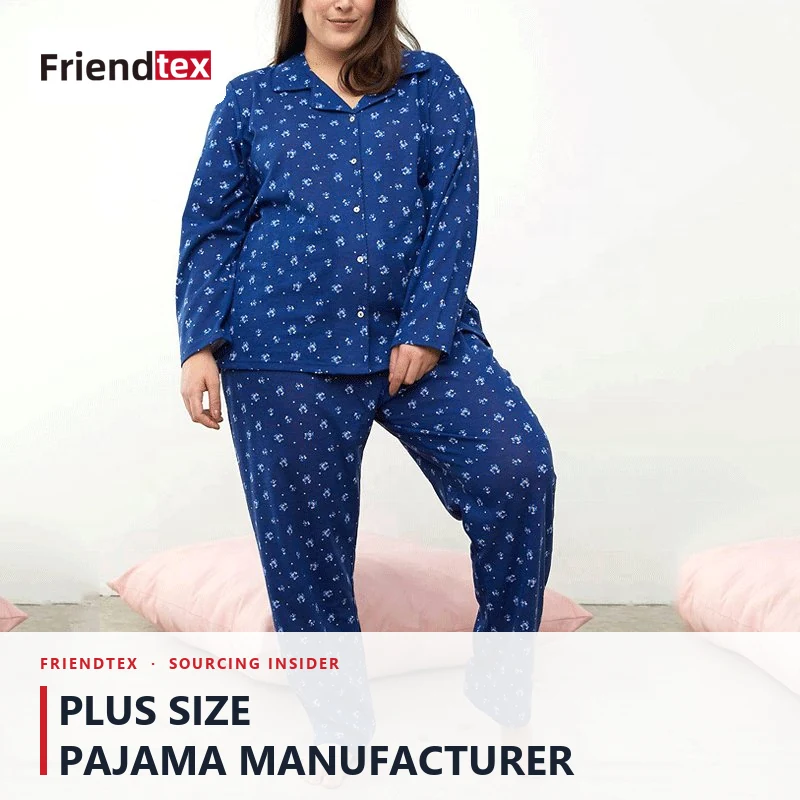
A plus size pajama manufacturer is judged on one thing: whether the graded sizes fit the bodies that buy them. Almost every factory will say it can make a 3XL, because grading software turns one pattern into a full size run in a few clicks. What the software cannot do is decide where the body stops behaving like a bigger version of the size M.
That is where extended size programmes fail, and they fail quietly. A waistband that rolls when the wearer sits down. A sleeve that takes the whole bodice with it when she reaches for a shelf. A back rise that splits at the cross seam after three washes. None of these are stitching faults — the construction is fine. They are pattern decisions, and they were made months before the fabric was cut.
This guide covers the six places where extended sizes are won or lost: the four points that have to be redrawn, the increment table behind them, the fabric property that matters more than stretch, the seams that carry the load, the fit protocol that catches what a spreadsheet cannot, and what all of it does to cost. It is written so you can take the questions straight into your next supplier conversation.
Key Takeaways
- Grading up is not the same as scaling up: four pattern points get redrawn rather than multiplied, and skipping any one of them turns a correct measurement table into a garment that fails on the body.
- Hip circumference grows faster than waist above 2XL, and back rise grows faster than front rise, so extended sizes need separate increments for each measure instead of one percentage applied across the board.
- Fabric growth matters more than fabric stretch: a knit that passes at 3% growth on a size M body will read as a bagging problem at 3XL, because the same fabric is working under higher tension.
- Fit the largest size first and fit it on a body that actually wears that size, since padding a size M model distributes volume in the wrong places and produces confident but wrong conclusions.
- A curved waistband and a reinforced back rise seam cost more in labour and far less in returns, which is why they are the two construction details worth arguing for in an extended size programme.
Why extended size programmes fail before the first cut
Most plus size ranges go wrong in one of three ways. The first is uniform grading, where the same increment is applied to every measurement point, size after size. The second is inheriting another customer’s pattern and relabelling it. The third is fitting only the base size and assuming the rest of the run will follow.
All three share a root cause, and it is worth naming plainly: a size label is being treated as if it were a measurement.
The label is not the measurement
In the US market, women’s plus sizes sit in a separate figure-type standard from misses sizes. ASTM D6960 covers the plus figure type across 14W to 32W, while ASTM D5585 covers misses 00 to 20. These are not the same ladder with a few extra rungs bolted on — the relationship between bust, waist and hip changes as you move up, which is precisely why the standards are separate documents.
The more useful detail sits inside the misses standard. ASTM D5585-11 lists two waists for every size: a straight waist and a curvy waist. At size 14 the straight waist measures 34 inches and the curvy waist 32.5 inches — 3.8 cm apart at the same nominal size. The hip-to-waist drop differs by 5.7 cm between the two. Same label, two different bodies, both correct.
That single fact should change how a tech pack is written. “Size 2XL” is not a specification. A specification is a measurement table with tolerances, plus a statement of which body shape the block was developed on. If your supplier cannot tell you which body the block came from, the size run is a guess that has been neatly formatted.
What the market is already selling
Before you commission a block, it is worth surveying what competitors actually stock in this segment. The plus size sleepwear assortment most brands compete against is easy to review, and the size range a competitor carries says more about real demand than any forecast does.
If they stop at 2XL, that tells you something. If they run to 4XL in three styles and nothing else, that tells you more.
The four points that get redrawn, not graded
For a plus size pajama manufacturer, the pattern block is the product. Grading moves points around; on four locations in a pyjama pattern, moving the point is not enough, because the geometry around it has to be rebuilt.
Skip any one of them and the garment will fit its measurements on a table and fail on a body.Here is what each point demands, and what the wearer notices when it is left as a grade:
| Point | What uniform grading does | What has to happen instead | What the wearer notices if it is skipped |
|---|---|---|---|
| Armscye and sleeve cap | Deepens in proportion to the chest | Widens more than it deepens; sleeve cap height comes down | Raising an arm lifts the whole garment and the hem climbs |
| Shoulder slope and neckline | Copied from the base size | Slope steepened 1–2°, front neck drop reduced slightly | Collar stands away from the neck; back neckline gapes when seated |
| Waist position, rise and waistband | Lengthened evenly front and back | Back rise grows faster than front; waistband cut on a curve and deepened | Waistband rolls down and the back waist pulls away when sitting |
| Thigh, leg opening and side seam | Same increment applied everywhere | Thigh follows the hip, not the waist; side seam shifts forward 1–2 cm | Leg binds at the thigh; side seam twists toward the front |
Armscye and sleeve cap
The armscye is the most common failure in extended sizes, and the reason is arithmetic. From a large to a 3XL, the chest might gain 25 to 30 cm of circumference across the full range. If the armscye depth grows at the same rate, the armhole ends up 4 cm deeper than the body needs, and the sleeve hangs from a point well below the shoulder joint.
The correction is counter-intuitive. Widen the armhole more than you deepen it, and lower the sleeve cap so the sleeve head sits closer to the shoulder. A flatter sleeve cap also gives more room to move without pulling, which matters more in sleepwear than in tailoring — nobody sleeps with their arms at their sides.
Shoulder slope and neckline
Plus size blocks typically need a slightly steeper shoulder slope than the base size, because the shoulder-to-shoulder distance and the bust volume do not grow at the same rate. Carrying the base slope up the run produces a neckline that sits too high at the front and stands away at the back.
One to two degrees of extra slope, plus a small reduction in front neck drop, fixes most of it. On a pyjama with a soft collar, this is the difference between a collar that lies flat and one that sits on the collarbone like a shelf.
Waist position, rise and waistband
This is where the body changes most and where linear grading is most visible. The distance from waist to crotch increases faster than the leg length does, and it increases faster at the back than at the front, because the seat has more volume to travel over.
The consequence of getting it wrong is the familiar waistband gap: the wearer sits down and the back waistband lifts away from the spine by two or three centimetres. A curved waistband is the structural answer, and it costs more to sew because the curve has to be eased in evenly. Some pattern rooms also swing the back rise angle inwards by three to five degrees above 2XL to keep the band in contact with the lower back.
Thigh, leg opening and side seam
Thigh circumference grows faster than the waist in the plus range. A leg opening graded off the waist will bind at the upper thigh long before the waist feels tight, and in a woven pyjama that binding shows up as a horizontal pull line across the front of the leg.
Grade the opening off the thigh instead. Shift the side seam forward by one to two centimetres in the larger sizes as well — a change that reads as visual rather than structural, but it is the difference between a garment that hangs straight and one that pulls toward the back.
The increment table: separate numbers, not a percentage
Once the four points are rebuilt, the increments still have to be set. The most damaging habit in size grading is expressing the grade as a percentage — “we grade up 8% per size” — because a percentage assumes every measurement grows at the same rate.
The body does not work that way, and the chart below shows where the assumption breaks.

Here are the starting values most pattern rooms work from:
| Measure | Typical increment per size | Note |
|---|---|---|
| Waist | 4–5 cm | The primary driver through the base range and up to about 2XL |
| Hip | 5–6 cm | Overtakes the waist above 2XL; the gap widens as sizes increase |
| Front rise | 0.5–1.0 cm | Grows, but slowly |
| Back rise | 1.0–1.5 cm | Grows faster than the front; the angle may need adjusting above 2XL |
| Thigh | Follows the hip | Not the waist — this is where most trouser-style pyjamas fail |
| Inseam | 1–2 cm | Vertical growth is slower than girth growth |
| Leg opening | Follows the thigh | A fixed opening becomes a tourniquet at 4XL |
These are starting values drawn from public industry ranges, not a standard. They should be replaced with your own body data as soon as you have a first run to learn from. What matters is the shape of the table: each measure moving independently, not one multiplier applied seven times.
Where to break the run
The same table makes a second decision visible — where to break the size run. Most programmes set a size break at 2XL or 3XL and develop a second block from that point up, rather than continuing the arithmetic from the base size.
The reason is accumulation. A small proportion error at each grade step compounds, and by 4XL the block can be two centimetres off in the rise while every individual increment looked reasonable.
For a walkthrough of how size charts and grade rules work in the base range, the size chart and grade rule guide covers the fundamentals. The equal-increment model described there is a good starting point for a misses run, and it is the right place to begin before the non-linear corrections above are applied.
Fabric: growth is the number that decides
Buyers ask about stretch. The property that actually decides whether an extended size survives a season is growth — the permanent elongation that remains after the fabric has been stretched and released.
ASTM D2594 measures both. Stretch is how far the fabric extends under a defined load; growth is how much of that extension never comes back. A cotton single jersey with 5% elastane might stretch 100% to 140% widthwise and recover 95% to 98%. A cheaper knit can post similar stretch numbers and recover only 88%, and that missing seven points is what a wearer sees as bagging at the knee and sagging at the seat.
Most programmes set an acceptance line at 3% growth for general apparel and 5% for heavy rib constructions. For extended sizes, the argument for holding to the tighter number is straightforward — the fabric is working harder. A 3XL puts more circumference under the same garment, so the knit sits at higher tension all day, and higher tension means more growth per wear cycle.
Three companion tests belong in the same specification, and each one bites harder in a plus range than in a base range:
- Dimensional stability after washing, commonly run to AATCC 135 — three per cent shrinkage is an inconvenience at size M and a garment that no longer fits at 3XL.
- Skew or torque, the diagonal twist that makes a side seam spiral toward the front after washing — it reads as cheap on any garment and worse on a garment where the seam is the main visual line.
- Pilling and surface abrasion — the thigh-to-thigh friction zone gets more use in a plus garment, and pilling shows there first.
The weight trap
When a plus range starts to feel too revealing in a light knit, the instinct is to go heavier. Weight and coverage are not the same thing, and a heavier knit that hangs stiffly makes a sleepwear garment hot and uncomfortable long before it makes it opaque.
The better answers are a denser stitch structure at a similar weight, a slightly higher elastane content with good recovery, or a second layer where the design allows it. The fabric types guide covers the trade-offs between the common sleepwear bases in more detail than is useful here.
Construction: where the load lands
A pattern can be perfect and the garment will still fail at the seams if the construction was specified for a size M. Four locations carry disproportionate load in an extended size.

If you are writing the specification rather than just approving it, these are the four lines that matter:
| Location | What to specify | What failure looks like |
|---|---|---|
| Back rise cross seam | Double row of stitching plus coverstitch or flatlock; seam strength verified per ASTM D1683 | Splits or grins open when the wearer sits or bends |
| Underarm and armscye | Bound or flatlocked; no raw edge under tension | Seam grin, then a hole within a few washes |
| Waistband join and channel | Band at least 5 cm deep, hidden elastic, bar-tack at the join | Band rolls, twists inside the channel, or the join bursts |
| Shoulder seam | Tape or coverstitch through the seam | Stretches out and slides off the shoulder |
The waistband is a component, not a strip
On an extended size, a straight elastic channel will roll whenever the wearer sits, because the band is fighting a curve it was not cut for. A curved band, a deeper channel, or a wide soft band with graduated tension all solve it, and all cost more labour.
Ask which one your supplier intends to use. Then ask to see it on a sample in the largest size, not the base size, because this is exactly the detail that gets quietly simplified when the sampling round is running late.
Fit testing: which body, which size
A grade is a hypothesis until a body confirms or disproves it. The protocol matters more than the number of samples, because a badly designed fit session produces confident conclusions that are wrong.

Three rules make the difference.
Fit the largest size first
Most sampling rounds fit the base size and assume the extremes will follow. The opposite is true: a block that works at 4XL almost always works at M, while a block that works at M frequently fails at 4XL. Start where the risk is.
Use a body that wears the size
Padding a size M fit model to simulate a 3XL distributes volume in the wrong places. It adds depth at the front and almost nothing at the hip, the seat or the upper arm, which are the three places the block was supposed to be re-engineered for.
The model’s measurements should sit within the size band being tested, and two or three models per size break with different proportions will catch more than five models of the same shape.
Test movement, not silhouette
A static fitting tells you whether the garment looks right standing still. Sleepwear is worn sitting, lying, rolling over and reaching, so the session has to look like that too.
Six actions are enough to expose most extended size failures before bulk:
| Action | What to watch | Failure |
|---|---|---|
| Sit for 30 minutes | Back waistband gap, rise depth | Band lifts more than 2 cm from the lower back |
| Stand up | Whether the rise returns | Garment stays displaced at the back |
| Raise both arms overhead | Hem lift, armscye pull | Hem climbs above the waistline |
| Cross both arms | Back width, sleeve tension | Pulls hard across the shoulder blades |
| Bend forward | Front rise, neckline | Neckline drops open, front rise cuts in |
| Lie down and roll over | Twist, leg ride-up | Leg climbs, side seam rotates to the front |
A factory that runs this protocol will ask you for a fit model or for measurements from your own customer base. That request is a good sign. It means the session is being designed around a body rather than around a sample that already exists.
What it does to cost and lead time
Extended sizes cost more, and it is worth understanding where the extra cost actually comes from, because only one of the four lines is large.
Fabric consumption is not linear
Published industry figures put fabric consumption 18% to 25% higher at EU 52 and above. The reason is marker efficiency rather than body area: a 3XL panel does not nest against other 3XL panels the way small panels nest against each other, so a higher proportion of the roll becomes waste. This is the largest single difference.
Development takes longer
Each additional block needs its own pattern work and its own fit sessions — typically two to three extra rounds for a new extended block. That adds two to four weeks before the first bulk order, and a development cost that published figures put in the high hundreds to low four figures per style.
Labour is the smaller variable
Sewing time does rise, but not in proportion to fabric area, because the same number of seams is being sewn over longer distances. That is why the unit price premium for an extended size is usually smaller than the fabric area premium, and why a supplier quoting a uniform 40% uplift across the whole plus range is guessing.
SKU depth is the hidden cost
Extending every style multiplies the number of variants you have to hold, and the inventory risk sits with you rather than the factory. The common approach is to extend the core, high-repeat styles first and leave statement pieces in the base range until the core proves the demand.
Production scheduling for a mixed size run is covered in the production timeline guide, which is worth reading before you commit to delivery dates.
What to put in the tech pack
Most extended size problems can be prevented at the tech pack stage, and the additions are small. A tech pack for a plus range should carry all of the following beyond the standard contents:
- A measurement table with tolerances, not a list of size labels — every point that will be measured in inspection, with an acceptable range.
- The four extended-size points named explicitly: back rise, thigh circumference, armhole circumference, and waistband measured both relaxed and stretched.
- A grading rule that states which points are non-linear, because a pattern room will follow a written rule and guess at an implied one.
- A declared size break, with a separate pattern required for sizes above it.
- Fabric performance numbers with pass thresholds: growth and recovery per ASTM D2594, dimensional stability per AATCC 135.
- The fit protocol, including the six actions above and the size of the model to be used.
- Print and embroidery placement graded by size, because a chest print positioned for a size M sits in the wrong place on a 3XL.
The general structure of a production-ready tech pack, and what a factory checks before accepting one, is set out in the tech pack guide for underwear and sleepwear. The full sampling-to-delivery sequence is covered in the pajama manufacturing process walkthrough.
How we run extended sizes
Everything above describes what a competent extended size programme looks like. It is also a description of how a plus size pajama manufacturer with its own pattern room works, and the practical difference is where the blocks come from.
We develop the block once and grade it in-house across the full run, including the second block above the size break. That matters more than it sounds. When different size bands are developed by different suppliers, the grade accumulates two sets of assumptions, and the seam where they meet is visible on the body — a 2XL that fits and a 3XL that suddenly does not, from the same style.
Sample sets can be produced in every size of the run. A first order can also be built on stock fabric from our colour card from 50 pieces for a simple style, which is enough to validate one size band before committing to the full curve. Because MOQ is set per style and per colour rather than per size, the size curve inside an order is your allocation decision — you can weight it toward the sizes your returns data says you actually sell. The low MOQ programme explains how that works in practice.
For brands extending an existing range, the fastest route is usually to send us the current block together with your return data by size. The pattern tells us what was built; the returns tell us where it failed. Between the two, the correction is usually visible before a single sample is cut.
If you would rather verify the pattern room before you send anything, the factory audit checklist covers what to ask for. A graded sample set from XS to 4XL in one style is the single most informative thing a plus size pajama manufacturer can show you, because it either exists or it does not.
Conclusion
If you take one thing from this guide, take the first point: extended sizes are a pattern problem before they are a production problem, and the pattern is decided long before anyone cuts fabric.
Here is the short version:
- Confirm which body the block was developed on, and ask for measurements rather than size labels.
- Redraw the four points — armscye, shoulder slope, rise and thigh — instead of grading them in proportion.
- Set separate increments for each measure, and declare where the size run breaks.
- Specify growth and recovery numbers on the fabric, with a test method attached to each.
- Fit the largest size first, on a body that wears it, through movement rather than a static pose.
Do that, and the extended range ships with a size curve that holds. Skip it, and the returns data will teach you the same lessons more expensively — one season later.
The styles we already run across the extended range are on the plus size pajamas page, and the wider capability picture sits on the sleepwear OEM page.
FAQ
What counts as plus size in sleepwear?
In the US market, plus sizes are usually labelled with a W suffix and run from 14W to 32W, following the ASTM D6960 figure type. In the EU the boundary is usually placed around 46, though the numbering varies by country and by retailer. For production purposes the label matters less than the measurement table — two brands can both call something a 2XL and be four centimetres apart at the waist.
Can you grade our existing size M pattern up to 4XL?
Usually yes, with corrections. The base pattern gives us the design intent and the proportions the block was built on, but it does not give us the non-linear behaviour above 2XL. The four points described earlier get redrawn rather than graded. If the original block was developed on a single body shape, we will also want to know which one, because that determines where the corrections go.
Why do plus size pyjamas cost more?
Mostly fabric. Published industry figures put consumption 18% to 25% higher at EU 52 and above, driven by marker efficiency rather than body area. Development adds a second cost, because a new extended block needs its own pattern work and fit rounds. Labour is the smallest part of the difference, which is why a uniform percentage uplift across the whole plus range is usually a sign that nobody costed it properly.
What is the minimum order for extended sizes?
MOQ is set per style and per colour, not per size, so extending the curve does not multiply the minimum. A simple style can start from 50 pieces on stock fabric from our colour card, which is enough to produce a graded sample set and validate one band. What does change with extended sizes is marker efficiency, so the practical advice is to concentrate the size curve in fewer colourways rather than spreading a thin curve across many.
Do we need a separate pattern for 3XL and above?
Above a certain point, yes, and the point is usually 2XL or 3XL. The reason is accumulation: small proportional errors compound with each grade step, so a run that continues the arithmetic from the base size drifts progressively further from the body. A second block, developed from body data for the upper range, resets the proportions instead of inheriting the drift.
How many fit sessions does an extended size range need?
At minimum, one session per size break, with the largest size fitted first and two or three models of different proportions in each band. In practice a new extended block takes two to three rounds before it is stable, because each correction has to be verified rather than assumed. Skipping rounds saves two to four weeks and costs far more in returns if the range ships with a rise that gaps.
Is stretch fabric necessary for plus size sleepwear?
Not necessary, but it changes the pattern work. A knit brings its own mechanical stretch, so the block can use less design ease; a woven needs either elastane, a bias cut, or enough ease to allow movement without strain. What matters in both cases is recovery rather than stretch — a fabric that extends well and returns badly will bag at the seat and knee regardless of how comfortable it feels on the roll.