Choosing a Christmas pajamas manufacturer in 2026 comes down to one thing: dates. Christmas falls on a Friday, the season compresses by about a week, and most buyers have not priced that in yet.
Most Christmas pajama guides are written for the shopper. This one is written for the buyer — the brand owner, retail buyer or sourcing manager who has to land stock in a warehouse before the gifting window closes.
That changes the questions. Not “which pajamas sell best,” but when does my PO have to be with the factory, and what does the factory need from me before it can start?
What follows is the production calendar, the lead times, the compliance decisions and the MOQ structure — in the order you actually have to make them.
Key Takeaways
- Christmas 2026 falls on a Friday — the season compresses by about a week. Peak selling is 1–15 December; the last normal delivery week is 7–11 December.
- Full custom programs on sourced fabric needed a mid-October order. Stock-fabric programs can start through mid-November; ready-stock private label as late as early December.
- Compliance is decided before sampling, not after — and your destination market decides it, not your design.
- MOQ follows the fabric route: stock-fabric programs from 50 pieces (30 on complex builds), custom-dyed fabric from about 1,000.
- A family matching design is a size-run program, not one SKU.
1. The date that decides everything: why 2026 is a week shorter
Christmas 2026 falls on a Friday. That single fact compresses the entire season, and almost no buyer has priced it in.
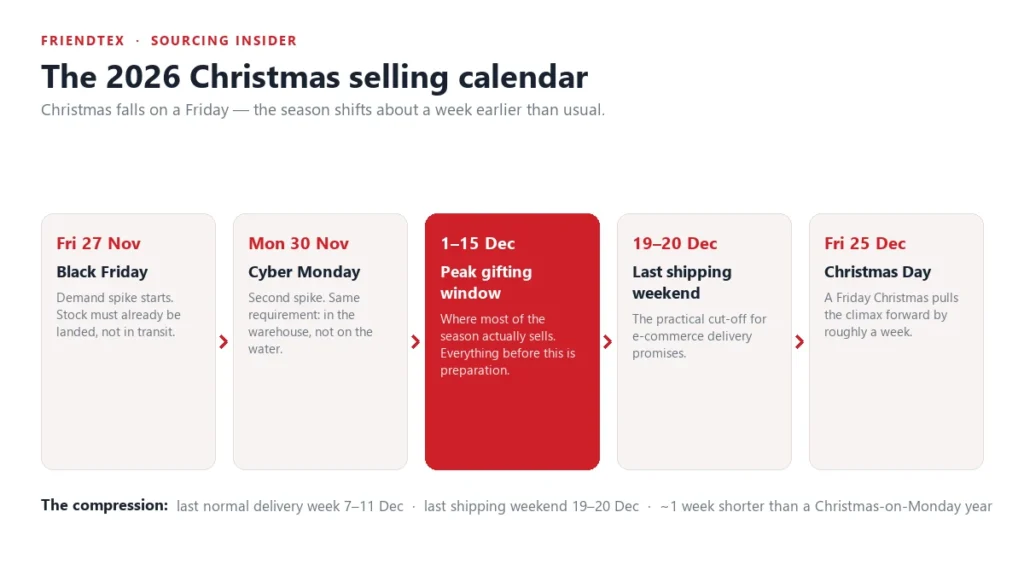
Here is the 2026 holiday calendar as it actually affects production and freight:
| Date | What it is | Why a buyer cares |
|---|---|---|
| Fri 27 Nov 2026 | Black Friday | Retail demand spike begins; stock must already be landed, not in transit |
| Mon 30 Nov 2026 | Cyber Monday | Second spike; same requirement |
| 1–15 Dec 2026 | Peak gifting window | Where most holiday volume is actually sold |
| Sat–Sun 19–20 Dec 2026 | Last big shipping weekend | The practical cut-off for e-commerce delivery promises |
| Fri 25 Dec 2026 | Christmas Day | — |
The compression: when Christmas lands on a Friday, the gifting climax pulls forward. Buyers sell the bulk of holiday sleepwear between 1 and 15 December, not spread evenly across the month. The last normal delivery week is 7–11 December; the last shipping weekend is 19–20 December.
Compare that to a year when Christmas falls on a Monday or Tuesday, where the selling window stretches later into the month. The same launch plan that worked in a previous year is structurally about one week shorter in 2026. If your assortment is not landed and sellable by the first week of December, you are not competing for the season — you are competing for what is left of it.
There is a second, quieter calendar effect. A Friday Christmas means the last full production week before the holiday sits right where freight carriers are already overloaded. Every day of buffer you build into the schedule costs less than one day of air freight at the tail.
2. The last-order calendar for Christmas 2026
This is the section to bookmark. The dates below are the last realistic window to place a purchase order and still land stock in time for a 1–15 December selling window — working backward from the calendar above, using standard factory lead times.
The table assumes three things. If any of them is not true for you, move your date earlier:
- Express or air freight after ex-factory (roughly 2–5 days transit)
- The PO is confirmed and print/label artwork is approved on the same day
- Pre-production sampling runs before the production clock starts
| Program type | Factory lead time | Last order window for 2026 | Notes |
|---|---|---|---|
| Full OEM, fabric sourced to order | 45–50 days production | Already at the edge — mid-October | Fabric lead time sits in front of production; the longest path |
| OEM on stock fabric | 15–20 days production | Mid-November | Realistically the last comfortable route for a 2026 launch |
| Private label on ready stock | As fast as 7 days | Early December | Relabel + repack only; no fabric or print development |
| Any program + ocean freight | +18–25 days transit | Move everything back 3–5 weeks | See the note below |
The ocean freight trap. The table above assumes air or express. Ocean freight adds roughly 18–25 days of transit — and every one of those days has to come off the front of the schedule. Working the math: a full OEM program with sourced fabric shipped by ocean needed to be ordered around September to land by early December. That window has closed for 2026.
Ocean freight still makes sense in three situations: a stock-fabric program landing by early December (place the order around the second or third week of October), a January restock to catch the post-Christmas and winter-print tail, and any program where the landed-cost saving is worth an earlier order date.
Do not plan against a mid-December launch. In a Friday-Christmas year that plan has no room for a single day of slippage — and sampling revisions and freight delays are the two most common slippages in holiday programs.
3. Why Christmas pajamas take longer than other sleepwear
The instinct is to treat a Christmas pajama program like any other sleepwear order. It is not, for four reasons that all stack on top of the base lead time.
Factories are capacity-constrained in exactly the months you need. Q3 and Q4 is when every sleepwear factory is running holiday orders. A lead time quoted in a quiet month is not the lead time you get in September. Every reference to production days in this article assumes a factory that has capacity for you — ask explicitly whether the quoted window accounts for the current queue.
Holiday motifs need their own print development. A plain cotton jersey needs a fabric decision. A Christmas print needs a pattern, and patterns go through rounds (see the next section).
Decorated styles add operations. Embroidery, appliqué, contrast rib, and custom woven labels each add a step and a quality control gate. A printed design and a garment with three decorative elements are not the same production time even when they are the same garment.
Gift packaging adds a second approval chain. Boxes, ribbons, printed polybags, and hangtags are usually produced by different suppliers than the garment, which means a separate set of lead times running in parallel — and a separate set of things that can go wrong (see section 7).
Taken together, a realistic holiday timeline from a standing start looks like this:
| Stage | Realistic duration in holiday season |
|---|---|
| Sampling and revisions | 10–20 days |
| Print / strike-off approval rounds | 1–3 weeks (highly variable) |
| Bulk production | 35–60 days |
| Peak-season capacity buffer | +10–20 days |
| Freight (ocean / air) | 18–25 days / 2–5 days |
Which is why buyers who want delivery in October or November are placing orders in June, July, and August — not September.
4. The holiday print pipeline: the step buyers always underestimate
If your program has a Christmas print, the longest and least predictable part of it is not production. It is the print getting approved.
A print goes through these gates before it can go into bulk:
- Pattern design — your artwork or the factory’s library
- Strike-off — a physical print sample on the actual fabric you will use
- Colour approval — and this is where seasons are lost, because the same Pantone reads differently on cotton jersey, flannel, and a Modal blend
- Shrinkage testing — a print that moves after wash takes the print registration with it (what we test for and why is covered in our pajama shrinkage testing guide)
- Scale and repeat check — a motif that looks right on a colour card may be too large or too small once it is on a size 2T vs. a men’s XL
- Licensing clearance — only if you are using character or licensed artwork, in which case add legal review
Each revision round adds days, and some revisions add weeks. Buyers who approve prints in April to June have a comfortable season. Buyers who approve them in September are negotiating with a factory that is already full.
Two practical consequences:
- Budget print approval in front of the production clock, not inside it. If your print is still in round two when your production window opens, your production window has moved.
- Specify the repeat across the whole size run at the strike-off stage. Family programs fail on this detail constantly — the same print has to work on an infant block and an adult block from one cylinder and one dye lot.
5. Compliance is a fork, not a checkbox: US, UK and EU
This is the section that most sourcing guides skip, and it is the one that can stop a container at the border. Children’s sleepwear is regulated differently from adult sleepwear, and differently again by market. The market you are selling into determines your labelling before you sample, not after.
United States — 16 CFR 1615 and 1616
Children’s sleepwear in the US falls under mandatory flammability standards: 16 CFR 1615 for sizes 0 through 6X and 16 CFR 1616 for sizes 7 through 14. The rules cover garments from size 9 months through size 14 that are intended to be worn primarily for sleeping. (For the full regulation text and how it applies to sleepwear orders, see our guide to GCC and CPSC for pajamas.)
There are two legitimate routes, and they are genuinely different products:
| Route | What it requires | Consequence |
|---|---|---|
| Flame-resistant | Fabric, seams, trim and garment must pass the standard and self-extinguish after a small open-flame ignition source; prescriptive sampling plans apply | Loose-fitting styles are possible |
| Tight-fitting (snug-fit) | Garment must not exceed prescribed maximum dimensions at chest, waist, seat, upper arm, thigh, wrist and ankle — per the size tables in 16 CFR 1615.1(o) and 1616.2(m) | Exempt from the sleepwear flammability test, but must still meet 16 CFR 1610 and must carry the specific labelling |
A snug-fitting garment must carry both a neck label stating the fit and flammability status and a yellow hangtag with prescribed dimensions, font, text, and background colour — unless it is sold in packaging, in which case the package carries the label. The text buyers will recognise: “For child’s safety, garment should fit snugly. This garment is not flame resistant. Loose-fitting garment is more likely to catch fire.”
Exempt categories include diapers and underwear, infant garments up to size 9 months (one-piece not exceeding 25.75 in / 64.8 cm in length, two-piece with no piece exceeding 15.75 in / 40 cm), and tight-fitting garments as defined. Exempt items still fall under 16 CFR 1610.
The design decision this creates: a loose, oversized family-matching Christmas pajama for a child is a different compliance path than a snug-fit one. You cannot design the garment first and choose the route afterwards.
United Kingdom — the 1985 Regulations, and the spelling
The UK runs its own regime: the Nightwear (Safety) Regulations 1985, applying to children’s nightwear for those over 3 months and under 13 years.
The structure is different from the US in a way that matters:
- Children’s nightdresses, dressing gowns and similar garments must comply with the flammability performance requirements of BS 5722 after washing.
- Pyjamas are exempt from mandatory compliance — but must carry a permanent label stating whether or not they meet the standard. If they do not meet it, the label reads “KEEP AWAY FROM FIRE” (red text, and for online or mail-order advertising, a red-sided equilateral triangle next to the advert). If they do meet it, a green triangle with “LOW FLAM”, or a black-text statement “LOW FLAMMABILITY TO BS 5722”.
- Nightwear treated with flame-retardant chemicals carries an additional washing-instruction label.
- BS EN 14878 is the newer standard covering all nightwear for children under 14, including pyjamas and babies’ garments — worth discussing with your supplier alongside the 1985 Regulations.
The commercial point: most US-first brands never optimise for the British spelling. Every UK-spelling variant — family christmas pyjamas, matching family christmas pyjamas — behaves as a distinct search term, and it costs nothing extra to write pyjamas into your titles, listings, and ad keywords for that market. But the compliance spec for a UK-bound kids’ program is not the same as the US spec. Decide the market before you sample.
Europe
For the EU, pair the compliance position with the terminology you print on the care label. Materials marketed as “bamboo” are regenerated cellulose — the fibre on a lawful label reads Modal, Viscose, or Lyocell, not “bamboo”. If your Christmas assortment leans on bamboo branding, the label and the listing copy have to agree.
Note for review: the compliance content above is sourced from CPSC’s published guidance on 16 CFR 1615/1616 and from the Nightwear Regulations 1985 as published on legislation.gov.uk. Before publishing, confirm current wording — labelling requirements in particular are the kind of detail that gets amended.
6. What “family matching” actually costs in SKUs
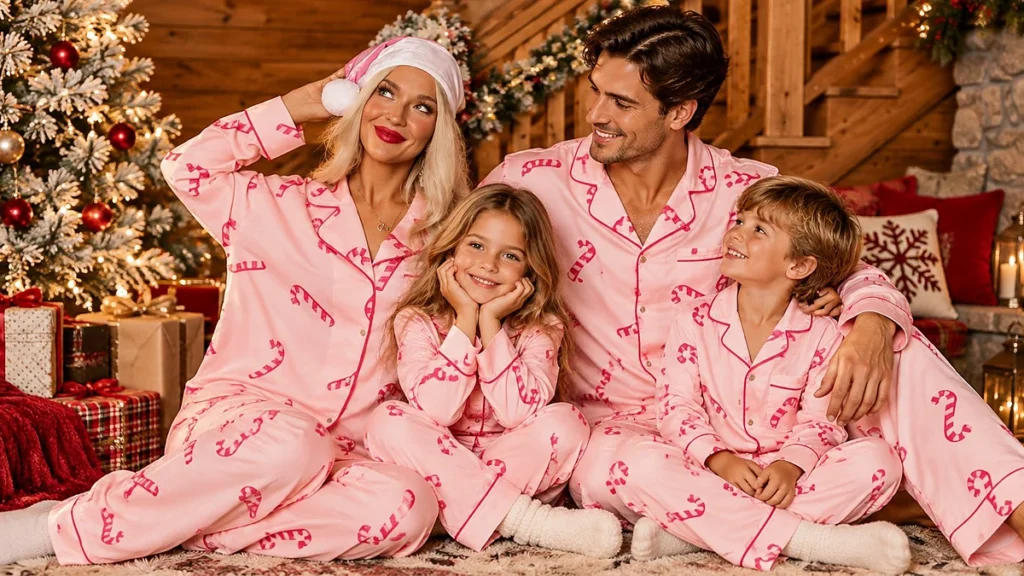
Family matching is the single strongest format in the holiday category — and the single most common way brands miscalculate their order. (See the styles themselves in our Christmas pajamas collection.)
A family program is not one product. It is a size run. A complete family set typically spans five blocks — we break down the full structure in our matching family pajamas category analysis:
| Block | Typical sizes |
|---|---|
| Infant | 0–24 months |
| Toddler / kids | 2T–6X and 7–14 |
| Youth | 8–16 (market-dependent) |
| Adult women | XS–3XL |
| Adult men | S–3XL |
At a modest 60 sets per block, a full five-block program is a 300-set opening order. That is a large commitment for an unproven print.
The lower-risk structure most brands use: start with the three most-photographed blocks — adult women, youth, and toddler — at 60 sets each, and hold adult men and infant for the reorder once the design proves itself. The 60-set-per-block floor exists so you can validate the print, the fit, and the bundle demand before committing to the full run.
The detail that separates a good family program from a bad one: the entire run has to come off one print cylinder and one dye lot. Adult and infant blocks cut from different dye lots produce a family photo where the reds do not match — and that photo is the product’s whole marketing premise.
Size inclusivity is a margin decision, not just an ethics one. If your adult blocks stop at XL and your kids’ blocks stop before the teen sizes, you are structurally excluding a meaningful share of households that want to buy the set. Extended sizing costs more in development and pays back in average order value.
7. Gift packaging: the part that delays shipments
Christmas pajamas are frequently bought as a gift, which turns packaging from a cost line into part of the product. It also turns packaging into a schedule risk, because most of it is not made by your garment factory.
A typical holiday package includes: gift box or sleeve, ribbon, printed polybag, holiday hangtag, and retail-ready barcode sticker. Each is a separate purchase with its own lead time, and none of them can be attached until the garment is finished.
Where this goes wrong: the packaging is treated as a last-minute detail, gets approved in November, and either delays the shipment or gets fast-tracked at premium cost — which also tends to compress quality control on the packaging itself. A gift box that arrives with the wrong red is still a wrong red.
The fix: approve packaging in the sample round, in parallel with the garment sample, not after bulk production starts. Put the box, the ribbon colour, the polybag print, and the hangtag on the same approval sheet as the garment. Then a single revision round covers the whole deliverable.
Plan the packaging with the disclosure question answered too. If the garment carries a compliance label — US snug-fit neck label and yellow hangtag, or UK “KEEP AWAY FROM FIRE” / “LOW FLAM” — decide now whether it prints on the garment, the hangtag, or the package. A gift box that hides a required warning label is a compliance problem, not a design choice. (Labelling options are covered in detail in our guide to custom pajama labels.)
8. MOQ reality for a first Christmas program
Every experienced Christmas pajamas manufacturer will tell you the same thing: over-ordering to hit a minimum order quantity is a worse outcome in this category than in almost any other, because unsold Christmas stock does not carry into a neutral season — it either sells at a markdown in the post-holiday window or it sits.
There is a second reason this matters more than usual in a holiday year: you have never sold this print before. Nobody knows whether the reindeer motif outsells the buffalo plaid, or whether families buy the bundle or just the kids’ blocks. Committing a full container to an unvalidated print is how brands end their season with a warehouse full of one design.
The production routes — and why the difference is fabric, not quantity
MOQ in sleepwear is not really a factory rule — it is a fabric rule. Most knit fabrics carry a dye-lot minimum, commonly quoted in the 50–100 kg range, which translates into roughly 200–500 pieces per colour for finished garments. That single constraint is what shapes everything else.
Which gives buyers three usable positions, not two:
| Stock-fabric route | Stock or sourced — it depends on the fabric | Sourced-fabric route | |
|---|---|---|---|
| Fabric | Chosen from an existing stock-fabric colour card | Whatever the material allows — some qualities are held in stock, some can be dyed to your colour | Dyed to your colour, minimum-dye-lot |
| Typical quantity | 50–300 pieces (30 on complex constructions) | 300 – 1,000 pieces | 1,000 pieces and above |
| Production lead time | 15–20 days — no fabric lead time to absorb | Depends on whether the fabric is held in stock or has to be made | 45–50 days — fabric sits in front of production |
| Best for | Validating a print, testing a fit, a first holiday season, a capsule for one retail partner | A print that has proved itself and is being scaled into a wider size run or a second colourway | A proven design, a full size run, your main seasonal depth |
| Trade-off | Colour is limited to what is on the card; the fabric is not yours exclusively | Availability varies by quality — the answer is material-specific, not a fixed rule | Full colour and fabric control, at a volume commitment |
The practical consequence for a Christmas program: the stock-fabric route is what makes a low-risk first holiday season possible. You pick from a colour card, you skip the dye-lot wait entirely, and you find out whether the design sells before you spend on a custom dye run. Then the sourced-fabric route is where the season’s real depth lives, once the print has earned it.
The common mistake is treating this as an either/or, or assuming the middle of the range is nobody’s territory. It is not — and this is the part most buyers get wrong when they shop around. The middle of the range is exactly where a brand gets abandoned. A print succeeds at 300 pieces, the buyer wants 600 or 800 for the second season, and the supplier that handled the sample order cannot make it — while the large factory that could make it is not interested in the volume. The buyer then re-samples, re-approves the print, re-negotiates terms and loses six weeks with a new supplier. Buyers do not change factories because they want to. They change because the factory they were using ran out of range.
So the question to put to any supplier is not “what is your MOQ” — it is “what is the smallest order you can make, and the largest order you can make, without me changing factories in between?” A Christmas pajamas manufacturer that answers that question across the whole 300 to 1,000 to 1,000+ span is one you can grow with. That is a harder thing to find than a low minimum.
The sequence still holds: validate on stock fabric, scale on sourced fabric. But the scaling step now has a middle, and that middle is where a long-term supplier relationship is won or lost.
Break down any MOQ quote into its three axes
Before comparing suppliers, get the minimum broken out — the three axes are what determine whether a multi-colourway holiday program is affordable:
| Axis | Ask this | Why |
|---|---|---|
| Per design | Is this the minimum per style, or can styles mix toward one minimum? | Mixed-style minimums let you test more prints for the same spend |
| Per colour | Is the minimum per colourway, or per base fabric? | Per-colour minimums are what make multi-colourway programs expensive |
| Per size | Can the size run break across a low minimum? | A family program’s per-block quantities may fall below a per-size minimum |
And ask the follow-up that actually decides your quote: “Is this price based on a stock fabric, or on a fabric you dye for me?” The answer changes the number, the lead time, and your last-order date. (How each choice moves the unit price is broken down in our pajama manufacturing cost guide.)
The strategy that fits a seasonal category
Place a smaller first order that validates the print and the fit, and plan the second order before the first one lands. Holiday restocking rides on air freight, which means the reorder window is real but short (see section 9). A buyer who plans two rounds from the start gets more total sell-through than a buyer who over-orders once — and a buyer who validates on stock fabric gets to the second round with data instead of hope.
9. The reorder window: planning round two before round one lands
Holiday sleepwear generates three demand waves, and the reorder plan has to serve all three:
| Wave | Window | What is selling |
|---|---|---|
| Early | 1–20 November | Early gift planners, family photo shoots, pre-holiday promotions |
| Peak | Black Friday → 15 December | The main event — and in 2026, compressed |
| Tail | 26 December – early January | Winter prints continue selling; Christmas-specific prints do not |
Two consequences:
Split the assortment by wave. Christmas-specific prints carry higher margin and a shorter selling window. Winter prints — snowflakes, winter animals, plaids, generic cold-weather motifs — carry a longer window and less risk. Running both types means part of your inventory keeps earning after 25 December instead of going to markdown on 26 December.
Plan the reorder route before the season, not during it. Ask your supplier, in advance, two questions: which styles can be filled from ready stock at short notice, and what the air-freight window looks like at peak. A peak reorder that cannot land by 15 December is not inventory — it is a stockout you have paid for.
Add buffer to the freight, not to the deadline. Port congestion, holiday closures, customs delays, and weather are normal in December, not exceptional. Buyers who plan well add roughly 7–10 days of buffer to the freight leg. In a Friday-Christmas year, that buffer is not paranoia.
10. The buyer’s checklist
Work through this in order. Each line is a decision that gets more expensive the later it is made.
Before you approach a supplier
- Name the market(s) — US, UK, EU. This sets the compliance path and the labelling.
- Decide the compliance route for any kids’ block (flame-resistant vs. tight-fitting/snug-fit in the US; labelled-to-BS 5722 position in the UK) before design.
- Decide the assortment split: Christmas-specific prints vs. winter prints.
- Decide the size blocks. If family matching, name the per-block quantities.
- Set the in-warehouse date, then work backward — do not start at the design and count forward. (The full backward-planning method is in our pajama production timeline guide.)
When you request a quote
- Ask whether the quoted lead time reflects current peak-season capacity, not a quiet-month figure.
- Get the MOQ broken out per design, per colour, and per size run.
- Ask which styles are fillable from ready stock at short notice, and the air window at peak.
- Ask which freight mode the quote assumes. Recalculate for ocean.
- Request the packaging lead time alongside the garment lead time.
Before bulk release
- Print approved at strike-off, on the actual fabric, at the correct repeat across the whole size run.
- Packaging approved in the same round as the garment sample.
- Compliance labelling locked, and its placement decided (garment / hangtag / package).
- Samples signed off against the final spec — not the initial brief. (Use our pajama quality control checklist as the reference sheet.)
11. FAQ
When is the last date to order Christmas pajamas for 2026?
For a December 2026 selling window with air or express freight: a full OEM program with sourced fabric needed a mid-October order; an OEM program on stock fabric can order through mid-November; a private-label program on ready stock can order as late as early December. With ocean freight, move every date back three to five weeks — which closed the sourced-fabric route in September.
Why is 2026 different from other years?
Christmas falls on a Friday. That pulls the gifting climax forward: the bulk of volume sells 1–15 December, the last normal delivery week is 7–11 December, and the last big shipping weekend is 19–20 December. Plans built on a later-selling Christmas are about a week too slow for 2026.
Do Christmas pajamas really take longer to produce than other sleepwear?
The garment itself does not. The program does — because holiday prints need their own pattern development and approval rounds, decorated styles add operations, gift packaging runs on a separate supplier chain, and factories are capacity-constrained in exactly the months you need. Sampling, print approval, production, and freight together realistically run 90–120 days.
What is MOQ for custom Christmas pajamas?
It depends on the fabric route, not just the quantity. Most knit fabrics carry a dye-lot minimum of 50–100 kg, which puts finished garments at roughly 200–500 pieces per colour — that is the sourced-fabric route, normally economical from about 1,000 pieces upward. If you choose a fabric from an existing stock-fabric colour card, you skip the dye-lot minimum entirely and the practical floor drops to about 50 pieces (around 30 on complex constructions), with a 15–20 day production window instead of 45–50. Between 300 and 1,000 pieces, whether the fabric comes from stock or has to be dyed depends on the material and the colour you want — some qualities are held in stock, others have to be made, so the honest answer is material-specific rather than a fixed rule. For a seasonal single-window product, the sequence that works is validate on a small stock-fabric run, then scale as the print proves itself. Always ask for the minimum broken out per design, per colour, and per size — and ask whether the quote assumes a stock fabric or a fabric dyed for you.
Can children’s Christmas pajamas be loose-fitting?
In the US, only if the fabric, seams, trim and garment pass the flammability requirements of 16 CFR 1615/1616 and carry the required labelling. Otherwise the garment must meet the tight-fitting dimensions in the standards and carry the snug-fit neck label and yellow hangtag. This is a design decision, not a labelling detail — it must be made before sampling.
How many SKUs is a family matching Christmas set?
Treat one family design as a size-run program, not a single SKU. Five blocks at 60 sets each is a 300-set opening order. Many brands start with the three most-photographed blocks and expand after the first reorder.
What should I send a supplier to get an accurate quote?
Your print direction, the size blocks and quantities per block, the destination market, your in-warehouse date, and your packaging requirement. The destination market matters as much as the design — it decides the compliance path, and therefore the labelling, the sampling, and in some cases the garment itself. A Christmas pajamas manufacturer who receives all five items can quote you accurately in one round instead of three.
12. Choosing your Christmas pajamas manufacturer: two ways in
Most of this guide is about planning far enough ahead. But in a Friday-Christmas year, the calendar is not the only thing buyers are fighting — some programs are already late by the time the buyer is ready, and the right answer at that point is not “wait until next year.”
So there are two ways in, and they serve different situations.
Small-batch custom, on our stock-fabric colour card.
If you are testing a print, launching a capsule for one retail partner, or entering the category for the first time, you do not need to commit to a full season to find out whether it works. We produce custom Christmas sleepwear on our own stock fabrics — selected from a colour card we hold — from as few as 50 pieces (around 30 on more complex constructions). No dye-lot minimum to absorb, no fabric lead time sitting in front of your production, and a production window of roughly 15–20 days once the sample is signed off.
That is the low-risk way to validate a design, because the expensive part of a holiday program is not the garment — it is committing a season’s budget to a print nobody has bought yet.
Ready stock, if the window has already closed.
If your selling dates no longer leave room for production, we may be able to fill from ready stock — styles already made, ready to ship, on a much shorter timeline than any made-to-order route. This is not a substitute for planning. It is a way to cover a gap: a reorder that has to land before 15 December, a retail partner who confirmed late, a bestseller that outran its forecast.
If you are in that position, tell us your in-warehouse date first. That is the only number that decides which routes are still open.
Tell us your in-warehouse date, your quantities per size block, and your destination market — and we will tell you which of the two routes is still open, and what it would take to hit your date. Whether you are placing a 50-piece validation run or a full seasonal program, you are working with the same factory from first sample to final shipment — no re-sourcing as you scale.